
# Roasted Garlic as a Spread and Its Uses in the Kitchen
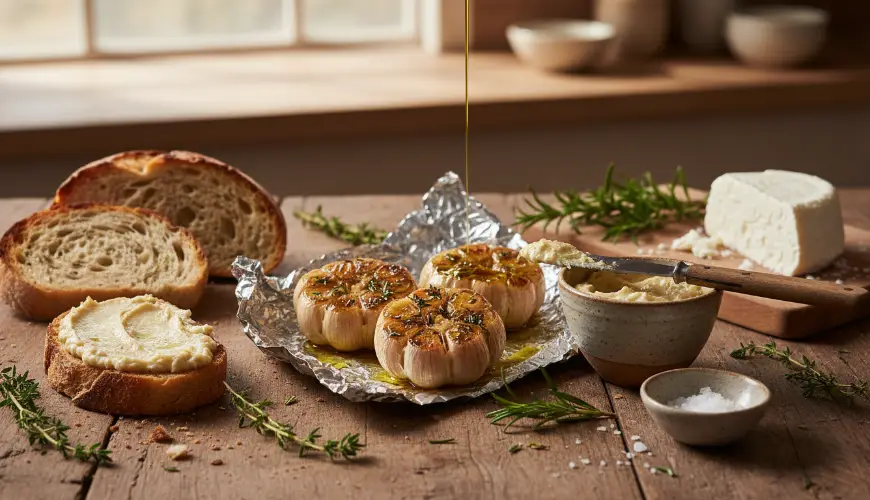
There are few things that can transform a simple dinner into something truly exceptional. Roasted garlic is one of those culinary delights that doesn't get talked about enough, despite deserving far more attention. Simply place it in the oven, wait about an hour, and the result is a golden, creamy, and surprisingly sweet paste that can be used in dozens of ways. And yet only a fraction of people who would otherwise adore it in restaurants or at farmers' markets actually prepare it at home.
Why is that? Probably because raw garlic has a reputation as a strong, pungent ingredient that leaves a pronounced aftertaste and isn't suitable for every occasion. However, roasting fundamentally transforms its entire character. The sharp intensity fades, and in its place emerges a deep, caramelised sweetness with a gentle earthiness. It is precisely this transformation that makes it one of the most versatile foundations in home cooking.
Try our natural products


What happens to garlic during roasting and why it matters
To understand why roasted garlic works so well as a spread, it helps to know what is actually happening inside the cloves. Raw garlic contains a compound called allicin, which is responsible for its characteristic sharp smell and flavour. When heated, this compound breaks down, and together with the natural sugars found in the garlic bulb, what is known as the Maillard reaction and caramelisation begin to occur. The result is a significant deepening of flavour, a change in texture to a silky-soft consistency, and the formation of new aromatic compounds that raw garlic simply does not have.
From a nutritional standpoint, roasted garlic still contains a range of beneficial substances. Garlic is generally well known for its antioxidant properties and its content of sulphur compounds, which may contribute to supporting the immune system. According to information from the National Institutes of Health database, there is scientific evidence that regular consumption of garlic may have a positive effect on cardiovascular health. While roasting does cause some biologically active compounds to be lost, garlic retains many of its beneficial properties and, moreover, becomes more digestible for those with a sensitive digestive system.
The preparation itself is surprisingly straightforward. Simply take a whole head of garlic, cut off the top so that the cloves are slightly exposed, drizzle with olive oil, add a pinch of salt, wrap in foil, and roast in an oven preheated to approximately 180 to 200 degrees Celsius for 45 minutes to an hour. The result is soft, golden cloves that can easily be squeezed out of their individual skins with a gentle press. The paste obtained this way is immediately ready to use, or it can be stored in the refrigerator for up to a week if covered with olive oil.
How to turn roasted garlic into the perfect spread
The most natural and simplest way to use roasted garlic is as a spread. The squeezed paste can be spread directly onto toasted bread or a crusty baguette, or it can be combined with other ingredients to create a more sophisticated variation. Roasted garlic as a spread is not just one recipe – it is an entire family of possibilities that vary depending on what happens to be in the fridge and what you want to serve.
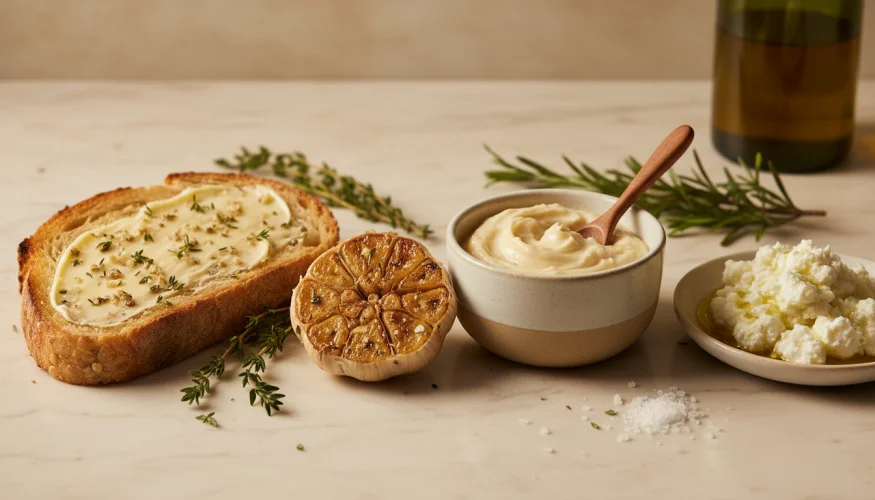
The basic version combines roasted garlic with quality butter or cream cheese. Simply mix the squeezed cloves with softened butter, add a pinch of sea salt, and optionally some fresh herbs such as thyme or rosemary. This mixture can then be spread on fresh bread, but it also works well with meat or as a base for preparing garlic bread baked in the oven. The resulting flavour is rich but not at all aggressive – the garlic is present, but it does not overpower the other ingredients.
A second popular variation works with ricotta or mascarpone. The creamy consistency of these cheeses pairs beautifully with the caramelised sweetness of the garlic, and the resulting spread has a luxurious character suited to more celebratory occasions. It works wonderfully on bruschetta drizzled with a drop of quality olive oil and sprinkled with fresh basil or parsley. Such a simple combination can impress guests who are accustomed to elaborately prepared starters.
For those who prefer lighter options, an ideal base is white yoghurt or hummus. Roasted garlic stirred into thick Greek yoghurt with a little lemon juice and ginger creates a refreshing spread that works not only on bread but also as a dip for vegetables or as a sauce for roasted meat. This approach is particularly appreciated by people who are mindful of their diet and are looking for alternatives to richer spreads.
Experienced chef and food blogger Samin Nosrat, author of the book Salt, Fat, Acid, Heat, says of garlic: "Garlic is one of those ingredients that has the ability to completely transform the character of a dish – it all depends on how you handle it." And roasting is precisely the way to get the very best out of what garlic has to offer.
Using roasted garlic far beyond the spread
It would be a shame to limit roasted garlic to the role of a spread, because its uses in the kitchen extend far beyond that. Once you realise how versatile this ingredient is, you will start adding it to almost everything.
One of the most common uses is adding roasted garlic to soups and sauces. Stirred into a tomato sauce or a creamy pumpkin soup, it adds depth and body of flavour without needing to add significant amounts of salt or fat. Roasted garlic in sauces acts as a natural flavour enhancer, which is why it is a favourite technique among professional chefs as well. Simply mash it with a fork and stir it into the finished sauce just before serving, or add it during cooking and allow the flavour profiles to meld together.
It also works excellently in pasta dishes. The classic pasta aglio e olio uses raw garlic, but the version with roasted garlic is gentler and suitable even for those with more sensitive stomachs. Mashed roasted garlic mixed with olive oil, chilli flakes, and Parmesan creates a simple yet very flavourful dressing for any type of pasta. It is a recipe that any beginner can manage, yet the result looks as though it was prepared by an experienced chef.
Imagine a situation that many people will recognise: guests arrive unexpectedly on a Friday evening and there is nothing special in the fridge. But there is a head of garlic, some butter, Parmesan, and a packet of pasta. During the hour that the garlic spends roasting in the oven, a salad can be prepared, wine can be opened, and time can be spent enjoying good company. And then a pasta dish with roasted garlic arrives at the table, looking like a carefully planned dinner, even though it was made from whatever happened to be on hand. It is precisely this flexibility that makes roasted garlic a reliable ally in any household.
Another excellent use is preparing homemade dips and salad dressings. Roasted garlic blended with tahini, lemon juice, and olive oil produces an exceptional dip that surpasses most shop-bought versions. It works equally well as a base for vinaigrette – simply mix it with mustard, vinegar, and oil to create a dressing with a rich, complex flavour that will elevate even a simple leafy green salad.
Roasted garlic finds its place even in dishes where you might not expect it. For example, stirred into mashed potatoes in place of regular garlic or onion, it adds a gentle sweetness that turns the mash into an entirely different experience. It works just as well as a filling in quiche, as part of marinades for meat, or as an ingredient in homemade legume-based spreads.
For those who embrace healthy eating and eco-conscious cooking, it is worth mentioning that roasted garlic is an ideal way to make use of garlic that is beginning to sprout or dry out. Rather than ending up in the bin, it gains a new lease of life through the transformation in the oven and becomes the basis of a delicious dish. This approach aligns with the zero-waste cooking philosophy that is increasingly becoming part of a modern, mindful lifestyle.
When it comes to choosing the garlic itself, it is worth reaching for quality domestic or organic varieties. Garlic grown without pesticides generally has a more intense flavour, and roasting brings that flavour out even more. At farmers' markets or in health food shops, you can find various garlic varieties that differ in intensity, sweetness, and aromatic profile – and experimenting with different varieties can be an enjoyable part of home cooking.
It is also good to know that roasted garlic can easily be prepared in larger quantities at once. Several heads roasted together will keep in the refrigerator covered with oil for approximately a week, or they can be frozen in smaller portions. This means that one hour spent at the oven over the weekend can supply an entire week's worth of this fragrant ingredient, always on hand whenever a dish needs depth and character.
Roasted garlic is proof that the best culinary discoveries are often the simplest ones. It requires no complex equipment, expensive ingredients, or hours spent in the kitchen. It only needs time, heat, and a willingness to try something that may not yet have been part of everyday cooking. And once you have experienced that golden, creamy sweetness spread on warm bread, it is hard to imagine how you ever managed without it for so long.