
Balcony garden even for complete beginners
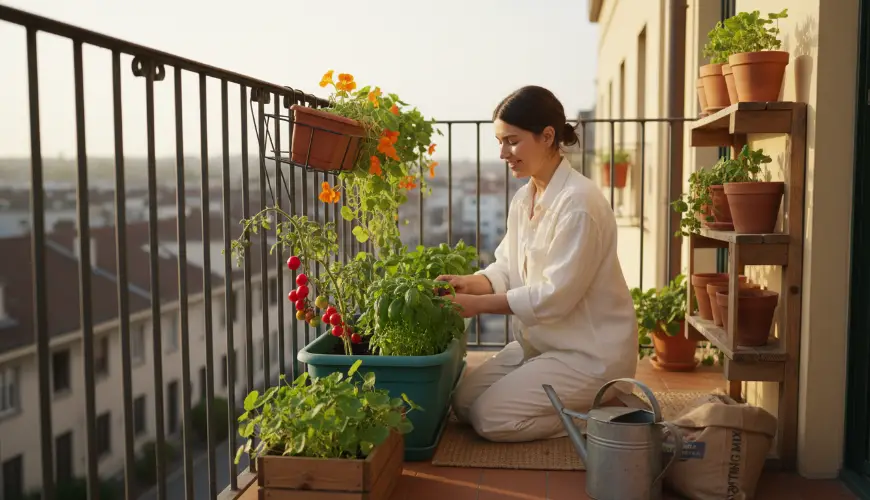
Having your own garden is a dream for many people, but the reality of urban life doesn't always make it possible. An apartment block, a rented flat, a small space – these are the arguments people repeat to themselves, convincing themselves that growing plants simply isn't for them. Yet a balcony, a terrace, or even a deep windowsill can be a surprisingly generous space for vegetables, herbs, and ornamental plants. A balcony garden is not the privilege of experienced gardeners – anyone who feels like experimenting a little and doesn't mind getting their hands dirty can manage it.
The trend of balcony growing has grown significantly in recent years. The pandemic played a part, bringing people back to nature and home activities, but so has the growing interest in sustainable living and awareness of where our food comes from. According to data from the Czech Statistical Office, approximately 40% of the Czech population lives in flats, and the vast majority of these flats have at least a small balcony. That is an enormous untapped potential – green oases waiting to be noticed.
Try our natural products





Where to start when you know absolutely nothing
The first step for any beginner is observation. Before you buy your first seedling or seed, spend a few days watching your balcony. How many hours of sunlight does it get each day? Does the wind come from the north, or is the balcony sheltered? Is it facing south, west, or perhaps north? These seemingly simple questions determine what will grow on your balcony and what will simply wither away pointlessly.
A south-facing balcony is a gardening jackpot – it gets the most sun and is ideal for tomatoes, peppers, basil, or lavender. A north-facing balcony, on the other hand, suits shade-loving plants such as ferns, begonias, or spinach leaves. East and west orientations are a compromise that can accommodate a surprisingly varied range of plants. Garden adviser and author of a popular urban gardening blog, Lucie Dvořáčková, sums it up simply: "The worst mistake beginners make is buying their favourite plants without considering the balcony's conditions. Nature doesn't work according to our wishes."
Another factor is the load-bearing capacity of the balcony, which beginners often overlook. Large planters filled with moist soil are surprisingly heavy – a single standard 80 cm planter can weigh as much as 30 kilograms. If you are planning a larger number of containers, it is sensible to consult the building manager or a structural engineer, especially in older panel-block buildings.
Choosing containers is the next milestone. The market offers an enormous selection, from classic terracotta pots and plastic window boxes to designer concrete or jute versions. For beginners, self-watering planters are practical – they have a water reservoir in the lower section and the plants draw moisture as needed. They significantly reduce the risk of overwatering and drying out, which are the two most common causes of failure for beginner balcony gardeners. Environmentally conscious growers will reach for containers made from recycled materials or natural fibres, which are not only kinder to the planet but also aesthetically interesting.
The substrate – that is, the soil – is the foundation on which the entire garden stands or falls. Ordinary garden soil from a garden is not suitable for a balcony – it is too heavy, drains poorly, and over time compacts into a dense mass that suffocates plant roots. A much better choice is a quality universal substrate or specialist balcony compost, ideally enriched with perlite or vermiculite to improve aeration. Adding coconut fibre helps retain moisture without the soil becoming waterlogged.
What to grow so that it actually works
This is where the most enjoyable part comes in – choosing your plants. And this is precisely where beginners make their most common mistake: they want to grow everything at once. The result is an overcrowded balcony where plants compete with each other for light, air, and nutrients, and in the end nothing grows properly. A wiser strategy is to start with five to ten species and gradually expand the range as you gain experience.
For complete beginners, herbs are ideal – they are undemanding, grow quickly, and their harvest brings an immediate reward in the kitchen. Chives, parsley, mint, basil, or coriander can all be grown in small containers on a windowsill. Mint is so vigorous that gardeners recommend growing it separately, as it will otherwise take over an entire planter at the expense of other herbs. Basil, on the other hand, loves warmth and dislikes draughts – this is important to know before placing it on a windy balcony.
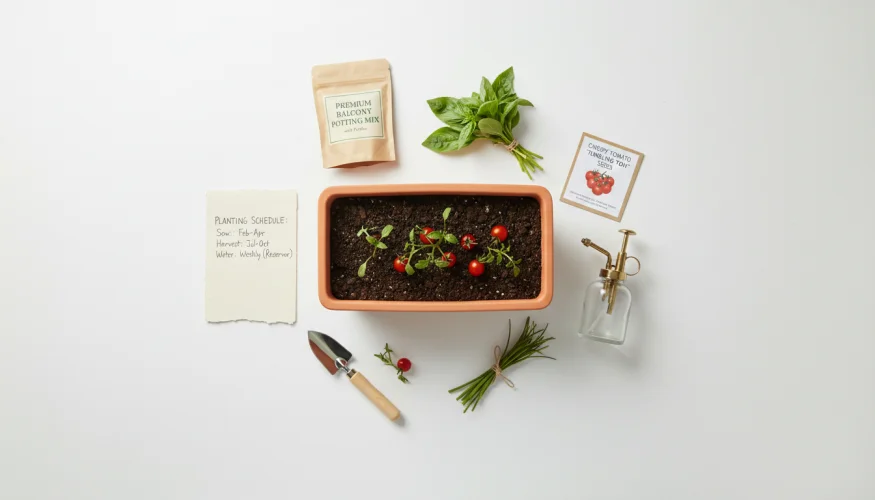
Among vegetables, tomatoes are particularly well suited to balconies, especially cherry varieties or specialist balcony types such as 'Tumbling Tom' or 'Balconi Red'. These varieties have been bred specifically for container growing, have a more compact habit, and yet still produce a generous crop. Balcony cucumbers and peppers are similar – given a sufficiently large container (at least 10–15 litres), they will grow reliably.
Leafy vegetables such as spinach, rocket, or various types of lettuce are a genuine treasure for balcony gardeners. They germinate quickly, are harvested quickly, and unlike tomatoes do not require direct sunlight all day. They can also be grown using the "cut and come again" method – harvesting the outer leaves gradually while the plant continues to grow. Such a lettuce plant can supply an entire household throughout the summer.
An interesting option that beginners often overlook is edible flowers. Nasturtiums, begonias, or violas are not merely ornamental – their flowers are edible and add not only colour but also interesting flavour to salads or desserts. They also attract pollinators, which benefits the health of the entire garden.
Consider a situation that is typical for beginners: Jana, a thirty-year-old accountant from Brno, decided last spring to try balcony growing for the first time. She bought a large planter, filled it with soil from her parents' garden, and planted tomatoes, peppers, basil, and a melon – all together. The result was predictable: the tomatoes proliferated and smothered the other plants, the melon never reached harvest size, and the basil dried out over the first hot weekend when Jana went away on holiday. The following year she approached things differently – she chose just three species, bought a self-watering planter, and used quality substrate. Her cherry tomatoes kept her supplied all summer long.
Care that won't take up your entire weekend
One of the biggest barriers that stops people from taking up balcony gardening is the belief that it will be time-consuming. In reality, a well-managed balcony garden takes no more than 15–20 minutes a day – and not even every day at that.
Watering is the most important and at the same time the most frequently neglected – or conversely, overdone – aspect of care. Containers on a balcony dry out far more quickly than beds in a garden, because they are exposed to air and sun on all sides. During summer months, watering twice a day – morning and evening – may be necessary. The best test is simply to push a finger into the soil: if it is dry to a depth of two centimetres, it is time to water. Always water thoroughly, until water flows out through the drainage holes – surface watering does nothing for the roots.
Feeding is the second pillar of success. Plants in containers consume nutrients from a limited volume of substrate far more quickly than those in open ground. Regular feeding every 7–14 days with liquid fertiliser during the growing season is therefore essential. Environmentally minded gardeners will reach for organic fertilisers such as nettle liquid feed, compost tea, or granulated fish compost – these options are gentler on soil microorganisms and do not create chemical residues on the fruit.
An important but underestimated part of care is regular inspection of your plants. Checking the leaves once a week will help you spot pests or diseases early. Aphids, spider mites, or mildew are far more manageable in their early stages than once they have spread across the entire balcony. Natural protection methods – such as a garlic water spray, a soap solution, or the introduction of beneficial insects – are ideal for balcony gardening, as they require no chemicals in the immediate vicinity of a living space.
At the end of summer and into autumn comes the time for reflection and preparation for the next season. Annual plants are composted, perennials and overwintering herbs are brought indoors or covered with fleece fabric. The soil in containers is topped up with fresh substrate and enriched – for example with vermicompost from a home wormery, which is perfectly suited even to a small flat. Research by the Crop Research Institute has repeatedly shown that regular enrichment of substrate with organic matter significantly improves yields and plant health in the following season.
Balcony gardening has another dimension that is not talked about as often – its psychological benefits. Caring for plants reduces stress, improves mood, and brings a sense of meaningful daily routine. A study published in the academic journal Journal of Health Psychology found that gardening as an activity significantly reduces levels of cortisol – the stress hormone – and improves overall wellbeing. At a time when more and more people are struggling with anxiety and overload, a small balcony garden can be a surprisingly effective form of therapy.
Getting started has never been easier. All it takes is one planter, one bag of substrate, a few herb seedlings, and a little patience. A balcony can become a place where every morning begins with the scent of fresh mint, where July breakfasts are flavoured with home-grown tomatoes, and where even in the middle of a grey city the buzzing of bees can be heard. This is not a utopia – it is a reality waiting behind every balcony door.