
# Make Your Own Non-Alcoholic Ginger Beer at Home Domácí zázvorové pivo je osvěžující nápoj s příje
There is something magical about making a drink at home that tastes better than anything from a shop. Homemade non-alcoholic ginger beer belongs precisely in this category – it is a drink with a long history, a surprisingly simple preparation process, and a flavour profile capable of surprising even the most discerning palates. This is by no means a passing trend of recent years. Ginger beer has its roots deep in the 18th century and for centuries enjoyed enormous popularity in Britain, the Caribbean, and North America. Today's non-alcoholic version of this drink brings the best of the traditional brewing world without a single drop of alcohol.
Interest in fermented and probiotic drinks has grown significantly in recent times. People are looking for alternatives to overly sweet fizzy drinks and industrially produced juices – they want something that refreshes them while also benefiting their bodies. Non-alcoholic ginger beer fills this gap perfectly – it combines the natural spiciness of ginger, a gentle sweetness, a light fizziness, and in the case of the fermented version, live probiotic cultures that support gut health.
Try our natural products
Why ginger, and why make it at home?
Ginger (Zingiber officinale) is not just a spice for Christmas gingerbread. It is one of the most thoroughly researched medicinal plants in the world. Studies published in the specialist journal Foods have repeatedly confirmed that ginger contains bioactive compounds – primarily gingerol and shogaol – which have demonstrable anti-inflammatory and antioxidant effects. It helps with nausea, supports digestion, alleviates muscle soreness after exercise, and some studies suggest that it may contribute to lowering blood sugar levels. It is no wonder that it has become a firmly established part of many traditional healing systems, from Ayurveda to traditional Chinese medicine.
But why make ginger beer at home when you can buy it in a shop? The answer is simple yet fundamental. Commercially sold ginger drinks – however healthy they may appear – very often contain minimal amounts of real ginger, but enormous quantities of sugar, artificial flavourings, and preservatives. When you prepare the drink yourself, you know exactly what goes into it. You can control the sweetness, the intensity of the ginger flavour, and the method of preparation. And what's more – the whole process is surprisingly enjoyable and satisfying.
Consider Markéta, a thirty-four-year-old teacher from Brno, who decided to stop buying fizzy drinks and start experimenting with homemade beverages. She began with non-alcoholic ginger beer. After her first successful attempt, she was so enthusiastic that she started preparing larger batches and sharing them with her neighbours. Today she makes it every week, adding lemongrass or fresh raspberries, and says it is one of the best things she has done for her health – and one of the most affordable.
Homemade production is also economically sound. The basic ingredients – fresh ginger, sugar or honey, lemon juice, and water – are readily available and reasonably priced. If you opt for the fermented version, you will also need a so-called ginger starter, or ginger bug, which is a fermented ginger culture that you grow yourself over five to seven days. But more on that in a moment.
Two methods of preparation: quick and fermented
There are essentially two approaches to preparing homemade non-alcoholic ginger beer, and each has its own charm.
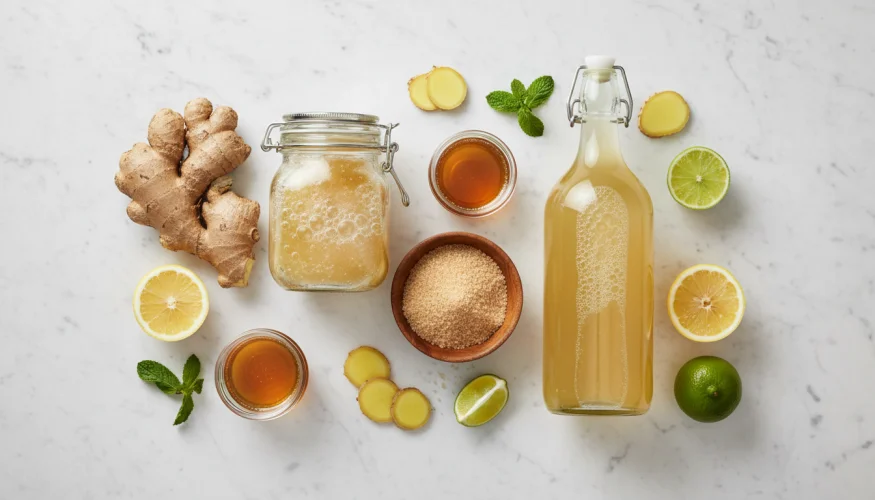
The first option is quick and straightforward – suitable for those who want results as soon as possible. The basis is a ginger syrup, prepared by simmering freshly grated ginger with water and sugar or honey. Once cooled, it is strained, fresh lemon or lime juice is added, and the drink is topped up with sparkling water. The result is a refreshing, mildly spicy lemonade with a strong ginger flavour, ready for immediate consumption. This version contains neither alcohol nor probiotics, but is an excellent choice for children, pregnant women, or anyone looking for a simple and quick refreshment.
The second approach is somewhat more adventurous – the fermented version with live cultures. This is what was historically referred to as ginger beer, and it traditionally contained a very low amount of alcohol produced during fermentation (usually below 0.5%, placing it in the non-alcoholic beverage category). The key to success is the ginger starter – a live culture of wild yeasts and lactic acid bacteria, which is easily prepared at home. Simply add a teaspoon of freshly grated ginger and a teaspoon of sugar to a jar of water each day for five to seven days. The culture will begin to bubble and work actively – this is a sign that it is ready to use. As British journalist and fermentation writer Sandor Katz noted: "Fermentation is the oldest form of biotechnology, and at the same time the most accessible – it requires nothing more than patience and basic ingredients."
Once the starter is active, it is combined with ginger tea (ginger simmered with sugar and water), lemon juice is added, and the mixture is left to ferment at room temperature for one to three days in sealed bottles. During this time, the yeasts process some of the sugar and produce carbon dioxide – the drink's natural fizziness. The result is a living, naturally sparkling drink full of beneficial microorganisms, whose complexity bears no resemblance to anything available in a supermarket.
Safety is important to bear in mind during fermentation. The bottles need to be regularly "burped" – briefly opened to allow excess pressure to escape and prevent them from bursting. Plastic bottles are more practical in this regard, as you can check by feel how much pressure has built up inside. Once a bottle is as firm as a rock, it is time to move the drink to the refrigerator, where fermentation will slow considerably.
Choosing the right ingredients plays a key role in home production. Fresh ginger is always preferable to dried – it contains more active enzymes and a stronger aroma. Organic ginger is the ideal choice, because when making the starter, it is used with the skin on, where natural yeasts reside. For sweetening, you can use cane sugar, coconut sugar, or honey – each lends the drink a slightly different flavour character. Honey, for example, adds a delicate floral note and also enriches the drink with its own antimicrobial compounds.
Variations, tips, and how to incorporate the drink into everyday life
One of the greatest joys of home production is the opportunity to experiment. The basic recipe for non-alcoholic ginger beer can easily be varied and adapted to personal taste. Fresh turmeric works wonderfully as an addition, giving the drink a golden colour and further enhancing its anti-inflammatory properties. Lemongrass lends an exotic, lightly citrusy note. Chilli or black pepper for the more adventurous spice lovers – and the result is a drink that warms you from the very first sip. In summer, a combination with fresh raspberries or elderflower cordial works beautifully; in winter, cinnamon and cloves come into their own.
For those interested in a healthy lifestyle and an eco-conscious household, home production of drinks has one more significant dimension – it considerably reduces the amount of packaging waste. Plastic bottles from fizzy drinks, aluminium cans, and glass bottles from the shop are all eliminated. The drink is prepared and stored in reusable glass bottles that can be used indefinitely. If this topic interests you, Zero Waste Europe offers a wealth of inspiring materials on reducing household waste, including in the area of food and drinks.
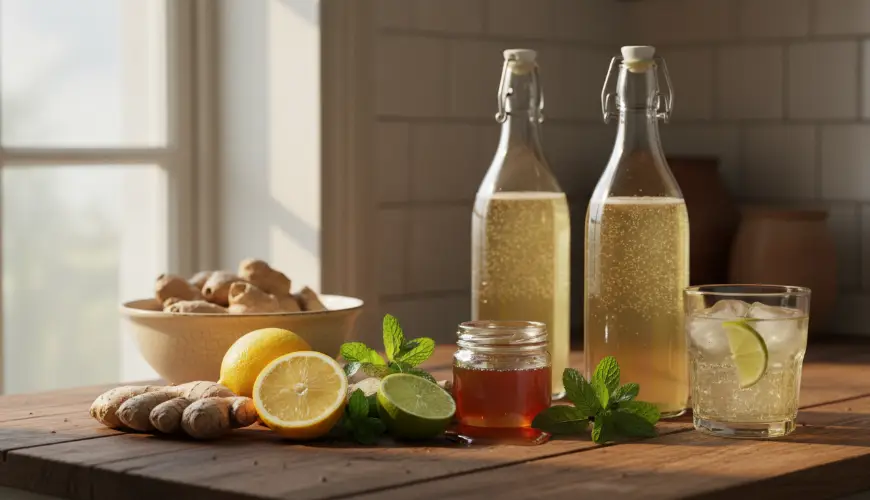
Non-alcoholic ginger beer is an excellent substitute for alcoholic drinks at social occasions. Thanks to its fizziness and complex flavour, it feels celebratory and certainly does not come across as "boring for non-drinkers." An increasing number of people are also embracing the so-called sober curious approach – consciously reducing alcohol consumption without the need for complete abstinence – and homemade fermented drinks are a natural part of this lifestyle for them. Ginger beer can be served in elegant glasses with ice, a slice of lime, and fresh mint, resulting in a drink that will impress every guest.
In terms of everyday integration, a glass of homemade ginger beer before a meal can support the production of gastric juices and prepare the digestive system for food intake. After a meal, it helps to ease feelings of fullness and bloating. The fermented version also contributes to the diversity of the gut microbiome, an area to which modern science is devoting ever-increasing attention – as demonstrated, for example, by research published in the journal Cell, which has repeatedly confirmed the fundamental role of the gut microbiome in overall human health.
It is of course important to maintain a healthy perspective and not regard any drink as a miracle cure. Ginger beer is first and foremost a pleasure – a tasty, refreshing, and slightly adventurous one. But if this pleasure also brings something extra for your health, gut microbiome, and the environment, why not make the most of it? Homemade non-alcoholic ginger beer is one of those activities that combines the joy of creating, care for one's own body, and respect for the planet – all with minimal cost and maximum satisfaction.