
# Which houseplants to choose for darker apartments Not everyone has a bright, sun-drenched apartme
Every person who has ever lived in a ground-floor apartment with north-facing windows, or simply in an older building where a neighbouring house blocks most of the daylight, knows that feeling. Plants turn yellow, wilt, die – and you start wondering whether it's even worth trying. Yet the desire for greenery inside an apartment is entirely natural. Houseplants are not merely an aesthetic accessory – they have a demonstrable impact on psychological wellbeing, air quality, and the overall atmosphere of a home.
The good news is that nature has dealt with many challenges over millions of years of evolution, including the deep shade of a tropical rainforest. A wide range of plants has adapted to life in conditions where direct sunlight never reaches – growing beneath dense forest canopies, on rocky walls, or in caves. And it is precisely these species that are ideal candidates for dark apartments, windowless hallways, or offices lit exclusively by artificial light.
Try our natural products



What does a "dark apartment" actually mean?
Before we get into specific tips, it is worth clarifying what the term dark apartment actually means. Experts in growing houseplants distinguish light conditions by the intensity of illumination measured in lux. Full sunlight at a window reaches values of around 10,000 to 20,000 lux, while more distant corners of a room or north-facing rooms range between 50 and 500 lux. That is an enormous difference that most plants cannot tolerate.
In practical terms: if you can comfortably read a book in a room during the day without turning on the lights, that is medium lighting. If you have to squint or do need to switch the light on, those are truly dark conditions. And it is precisely for such spaces that choosing the right plants is crucial – not every "shade-loving" plant can tolerate real dimness.
An interesting real-life example: Jana, an interior stylist from Brno, struggled for many years with the fact that her beloved windowless hallway stood empty. Plants died there one after another, until she switched to zamioculcas and snake plant. "I stopped fighting nature and started respecting it," she says. Today her hallway is full of greenery, even though almost no natural light reaches it.
It is also important to mention that no plant can survive in absolute darkness – photosynthesis simply requires at least a minimal supply of light energy. However, if you have at least faint natural light available, or are willing to invest in a quality LED grow light, a surprisingly wide range of options opens up to you.
The best houseplants for dark and shady spaces
The world of shade-tolerant houseplants is more varied than it might seem. From elegant tropical species to hardy succulents to ferns that seem to call out for a humid and dark environment – there is something for everyone.
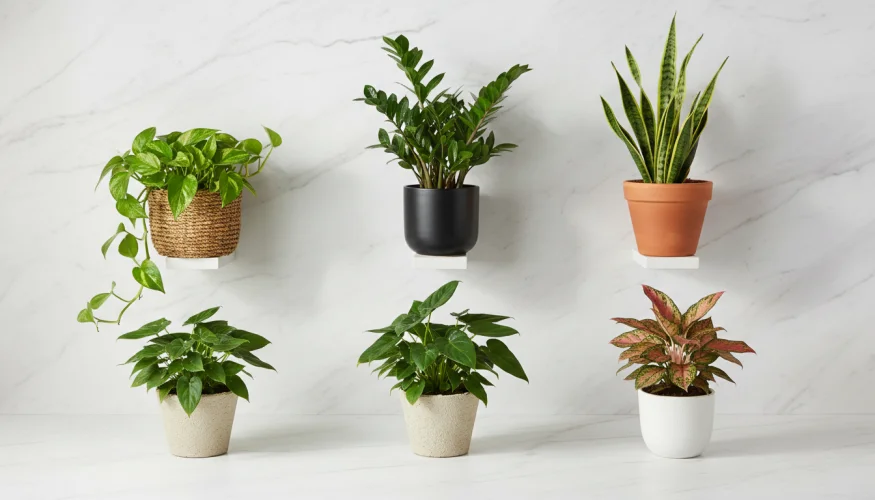
One of the most resilient and at the same time most elegant choices is zamioculcas zamiifolia, also known as the ZZ plant or eternity plant. It originates from East Africa, where it survives long periods of drought and lack of light. Its glossy, dark green leaves look almost like plastic – which is precisely why many people mistakenly take it for an artificial plant. Zamioculcas stores water in its rhizomatous roots, so forgotten waterings do not bother it much. It is absolutely ideal for dark corners of an apartment.
Equally undemanding is sansevieria, known in English as snake plant or mother-in-law's tongue. This plant is among the absolute record-holders for resilience – it tolerates low light, irregular watering, and draughts. NASA research from the late 1980s even showed that sansevieria can filter certain amounts of toxic substances such as formaldehyde or benzene from the air. Although these results are today considered somewhat overestimated in the context of a real apartment, it remains an excellent choice for anyone who wants to bring a little nature into their home without unnecessary effort.
Another excellent candidate is pothos, or epipremnum aureum, nicknamed "devil's ivy". This climbing plant with heart-shaped leaves in golden, white, or marbled varieties is practically indestructible. It grows quickly even in low light, tolerates irregular watering well, and readily trails along shelves, wraps around poles, or hangs from hanging baskets. For beginner growers, pothos is literally the ideal starting point.
Ferns also have an irreplaceable place in dark apartments. In particular, nephrolepis exaltata, the sword fern, loves humidity and shade – exactly the conditions found in bathrooms or shady kitchens. Ferns do require regular watering and misting, but their reward is airy, delicate fronds that bring a truly natural atmosphere to an interior.
We must not forget philodendron, which is among the most popular houseplants of all. It comes in dozens of varieties – from the heartleaf philodendron with trailing stems to large-leaved species such as philodendron gloriosum to the impressive philodendron bipinnatifidum. They all share one characteristic: tolerance for lower light levels and relative ease of care. Philodendron is one of those plants that forgives the mistakes of beginners and busy people alike.
Aglaonema, commonly known as Chinese evergreen, is another plant made for dark interiors. Its leaves in combinations of green, silver, red, or pink are a true decorative gem. Yet it is one of the most resilient houseplants of all – tolerating low light, dry conditions, and irregular care. Aglaonemas have become very popular in recent years thanks to their appearance, which resembles exotic tropical plants without requiring corresponding care.
For those who prefer a minimalist aesthetic, aspidistra elatior, popularly known as the cast iron plant, is the ideal choice. Its nickname is no coincidence – this plant survives practically anything. Low light, draughts, forgotten waterings, dust on its leaves. Aspidistra was popular in Victorian England, where it adorned hallways and drawing rooms without access to natural light, and to this day retains its reputation as an unbeatable houseplant.
How to properly care for shade-tolerant plants?
Knowing the right species is only the first step. Equally important is understanding how to care for them in a dark environment, because plants in low light have different needs than those on a sunny windowsill.
The most fundamental rule is watering. Plants in dark conditions consume water much more slowly because their metabolism is slowed down. Overwatering is far more dangerous in such conditions than a lack of water – root rot is the most common cause of houseplant death in general. As a basic rule: before watering again, allow the substrate to dry out thoroughly, at least in the top third of the pot. With zamioculcas and sansevierias, wait until it dries out completely.
Fertilising is another area where less means more. In dark environments, plants grow slowly and therefore need significantly fewer nutrients than their sun-basking counterparts. Over-fertilising causes root burn and a build-up of salts in the substrate. Fertilising once every six to eight weeks during spring and summer is sufficient; in winter, it is better to avoid it altogether.
A very practical solution for truly dark spaces is specialist LED grow lights, which emit light in the spectrum required for photosynthesis. Modern models are aesthetically pleasing, energy-efficient, and readily available. If you care about your plants not merely surviving but actually thriving, investing in a quality lamp is worthwhile. The Royal Horticultural Society website offers detailed information on the light requirements of various plant species and can be an excellent guide for any grower.
It is also worth mentioning regularly rotating pots. Even in a dark apartment, light generally comes from one direction – from a window or from above. The plant naturally turns towards the light, causing uneven growth. Rotating it by 90 degrees every few weeks will ensure a symmetrical shape and even development of the leaves.
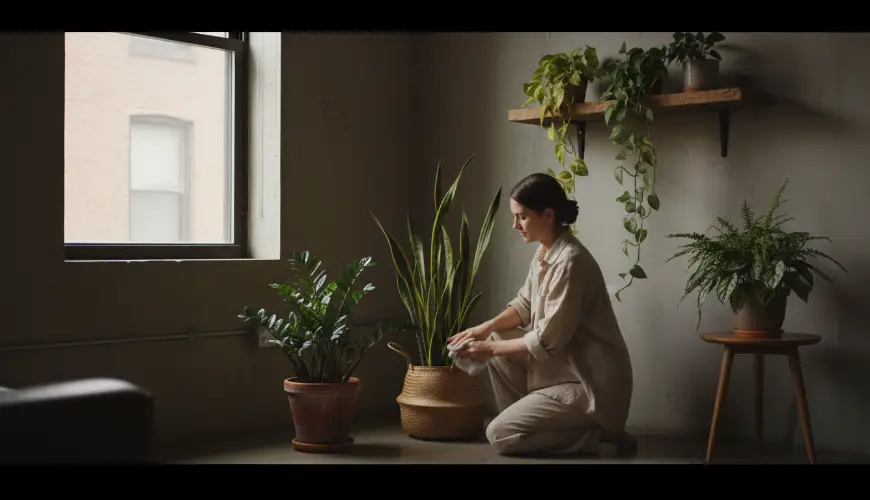
Clean leaves play a greater role in dark conditions than many people realise. Dust on leaves reduces their ability to capture light – and when light is scarce, every photon counts. Simply wipe the leaves gently with a damp cloth once a month, or rinse the plant with lukewarm water in the shower. Simple, but effective.
As garden writer Christopher Lloyd once wrote: "Gardening is the science of knowing where to give up and where to persevere." And this applies doubly to houseplants in dark apartments – the key to success is not fighting the conditions, but adapting to them intelligently.
If you are looking for inspiration for a more ecological approach to growing houseplants, it is also worth considering your choice of substrate and pots. Peat-based substrates are still widespread, but their extraction damages valuable ecosystems. Alternatives based on coconut fibre, compost, or bark are more environmentally friendly and perfectly adequate for most shade-tolerant species. Similarly, it is worth reaching for pots made from recycled materials or natural raw materials such as bamboo or terracotta.
Green plants in the home are not merely a fashionable trend or Instagram aesthetic. They are living organisms that share our space with us and in return give us calm, cleaner air, and a visual connection with nature that we as a species deeply crave. And the fact that your apartment is not bathed in sunlight? That is simply a challenge for which nature has long had an answer ready.