

## What kitchen cookware do you really need
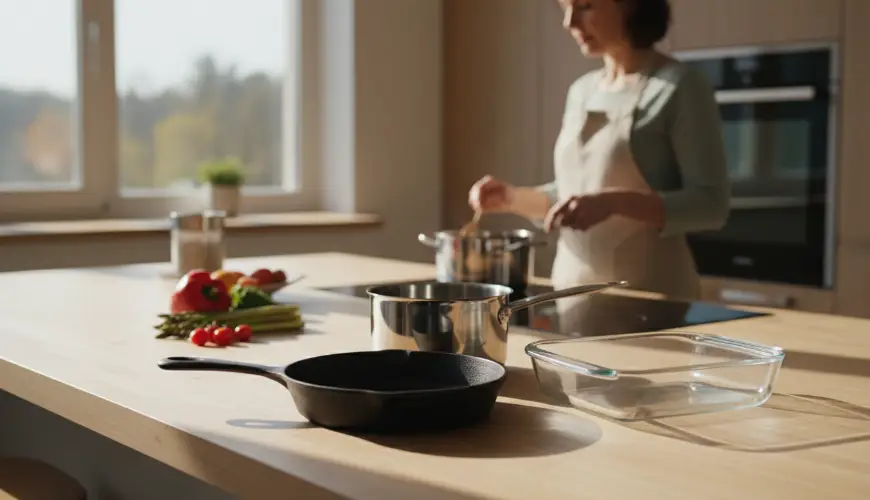
Everyone who has ever moved or furnished a new apartment knows the feeling. You stand in the kitchen surrounded by pots, pans, muffin tins, and a special Parmesan grater you've used exactly once in your life. Half the drawers won't close properly, the cupboards are bursting at the seams, and yet – when you want to make a simple risotto – you discover you don't have the right pan. The question of what kitchen cookware we actually need and what merely takes up space is surprisingly complex. And yet it touches on far more than just practicality – it's about the way we think about consumption, sustainability, and everyday life.
The average Czech household has over twenty pieces of various cookware, of which it regularly uses fewer than half. The rest waits for an occasion that either never comes, or comes so rarely that it would make more sense to borrow the item from a neighbour. Yet a quality, thoughtfully chosen set of cookware can significantly transform everyday cooking – while also considerably lightening both the kitchen cupboard and the conscience burdened by excessive consumption.
Try our natural products
-1-m.jpg)
-1-m.jpg)
-1-m.jpg)
-1-m.jpg)
-1-m.jpg)
What actually ends up in our hands when we cook
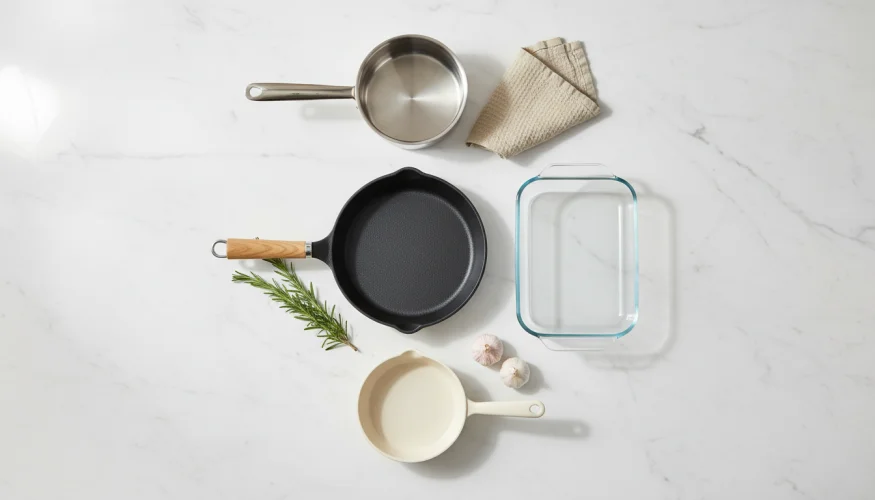
If we take a sober look at kitchen equipment, most cooks – whether professional or home – work with the same basic set. One large pot for boiling pasta, making soups, or blanching vegetables. A smaller saucepan for sauces and reheating leftovers. One quality non-stick pan and one cast iron or stainless steel pan for frying and braising. Add a baking tray and a roasting dish. That is the foundation from which the vast majority of recipes are built. Everything else is an add-on – sometimes useful, but never essential.
Yet most people buy cookware impulsively, driven by advertising or the excitement of a new recipe they want to try. The result is a pile of specialised equipment that gets shoved to the back of the cupboard after its first use. A wok purchased after watching an Asian cooking show, a Bundt cake tin used once a year at Christmas, or an electric egg cooker – these are classic examples that almost every household will recognise. The point isn't that these things are universally useless. The point is whether they are useless for you specifically.
The key to making thoughtful choices is an honest answer to a simple question: how do I cook? Someone who mainly cooks Asian cuisine may find a wok absolutely essential. Someone who bakes bread every weekend will appreciate a quality cast iron pot with a lid, in which the bread rises beautifully and bakes as if from a professional bakery. It's about understanding your own cooking habits first, and only then making purchases – not the other way around.
An interesting perspective on this topic is offered by the New York Times Cooking minimalist kitchen project, where cooks repeatedly emphasise that most of the world's cuisines were created with very limited equipment. French beurre blanc, Italian ragù, or Indian curry – none of these dishes require a special gadget. They require time, attention, and the right pot.
Material matters more than we think
Once we know what we actually need, the next decision arrives: what should the cookware be made of? And this is where things get complicated, because the market offers dozens of options and the marketing promises are tempting. Yet the choice of material affects not only cooking results, but also health, the environment, and long-term costs.
Teflon-coated pans are popular for their practicality and low price. The problem arises when they are scratched or overheated – at that point, substances may be released that are at the very least questionable from a health perspective. The US Environmental Protection Agency (EPA) has long been researching perfluorinated compounds found in some non-stick surfaces, and their findings suggest that caution is warranted. An alternative is ceramic surfaces, which are safer when handled correctly, though less durable.
Cast iron cookware has seen a marked renaissance in recent years – and rightly so. Cast iron heats slowly but evenly, withstands high temperatures, and with proper care can last literally for generations. It's not uncommon for a cast iron pan to be inherited from a grandmother and to perform better than many things bought in a modern shop. Moreover, cast iron cookware is naturally non-stick when properly seasoned – without any chemical coatings. For a sustainable household, it's a choice that makes sense both ecologically and economically.
Stainless steel is another reliable material appreciated by professional cooks and home enthusiasts alike. It is durable, hygienic, does not react with acids and fats, and importantly – contains no potentially problematic surface treatments. Cooking in a stainless steel pan requires a little more experience (food tends to stick more easily), but the results are excellent and the cookware lasts for decades.
An interesting chapter in its own right is glass and ceramic baking dishes, which are ideal for baking and reheating in the oven. Glass is an inert material – it does not react with food, does not transfer any substances, and is easy to clean. For a healthy kitchen, it is one of the safest choices available.
Fewer things, better cooking
There is a compelling argument for owning fewer pieces of cookware, but of higher quality. When you have one truly excellent cast iron pan instead of three cheap ones that get scratched within a year and end up in the bin, you not only save money in the long run – you also learn to work with that tool. You know its characteristics, how it responds to heat, how to clean it properly. A kind of relationship develops between the cook and the cookware, which has a positive effect on cooking results.
French chef Jacques Pépin, one of the legends of world gastronomy, says: "A good cook doesn't need a hundred tools. They need ten that they have mastered completely." This approach, common among many professional cooks, has in recent years been spreading into homes – not merely as a fashionable minimalist trend, but as a practical response to overcrowded kitchens and unnecessary expenditure.
Imagine, for example, a family that decided to radically reduce their kitchen equipment. They discarded everything they hadn't used in more than six months and were left with twenty pieces of cookware instead of the original forty-five. The result? Cooking paradoxically became simpler. They knew exactly where everything was, cleaning took less time, and grocery shopping became more considered, because fewer pieces of cookware meant fewer opportunities for impulsive cooking of complicated recipes that would end up in the bin. This approach is described, for instance, by research in the field of behavioural economics, which shows that an uncluttered environment positively influences decision-making and reduces stress.
Sustainability, moreover, is not only about what we buy, but also about how long we use it. Cookware that lasts twenty years is always more ecologically sound than cookware that is discarded and replaced every two years. That is why it is worth investing in quality when making a purchase – and this is especially true for the basic pieces that are used in the kitchen every day.
Another aspect worth mentioning is repairability and recyclability. Cast iron cookware can be re-seasoned if scratched or rusted and restored to its original condition. Stainless steel pots can be recycled. By contrast, cookware with chemical non-stick surfaces is practically destined for the bin once scratched, and recycling is complicated. From the perspective of the circular economy – an approach that seeks to minimise waste by keeping products in use for as long as possible – the choice of material is a crucial decision.
The transition to a more considered approach to choosing cookware need not happen overnight. It is enough to start by asking yourself a simple question the next time you are about to buy a new pot or pan: how many times a week will I actually use this? If the answer is "once a month or less", it may be better to borrow the item, or to do without it entirely. If you will use it every other day, then investing in a quality piece makes complete sense.
The kitchen is the heart of the home – a place where time is spent, where family traditions are born, and where decisions are made every day about what we eat and how we live. The cookware we keep there should reflect this role: it should serve, endure, and help – not merely take up space. Choosing the right kitchen cookware means thinking about your real needs, about materials that are safe and lasting, and about the value of quality over quantity. A kitchen that has fewer things, but where each one has a purpose, is a kitchen in which cooking is better, easier, and more joyful.