

# Everything About Babywearing in a Wrap for Beginners
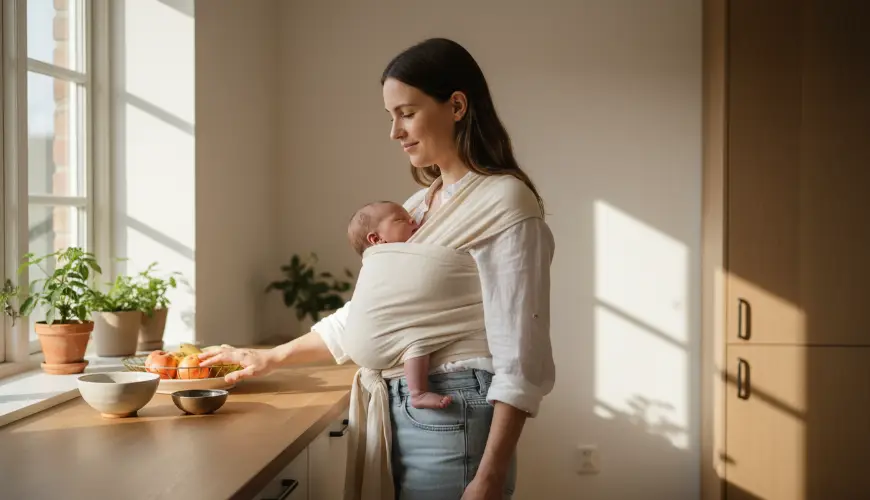
Imagine a morning when a little baby is crying and refuses to be anywhere but in your arms. Your hands are full, you need to prepare breakfast, and yet you feel how this tiny being holds you firmly by both the heart and the arms. It is precisely in moments like these that thousands of parents around the world have turned to an old and proven solution – carrying a baby in a wrap. This practice, which reaches thousands of years into the past and still survives today in cultures from Africa through Asia to Latin America, has been experiencing a significant renaissance in Europe over recent decades. For many mothers, the first encounter with a wrap is somewhat mysterious – a lot of fabric, a lot of knots, and the question of whether they can manage it at all. The answer is almost always yes, you just need to know where to start.
Carrying children in a wrap is not merely a practical tool for busy parents. It is a profound way of building a relationship with a newborn or infant, of giving them closeness, warmth, and a sense of security they knew from the womb. Research shows that children who are regularly carried cry less, sleep better, and display lower levels of the stress hormone cortisol. A study published in the journal Pediatrics, for example, found that carrying a baby for at least three hours a day reduces their overall crying by up to 43 percent. These are numbers that speak for themselves.
Try our natural products





How to choose the right wrap and take your first steps with it
Before a mother begins her first tying attempt, she faces an important choice – what kind of wrap to actually choose. Several basic types exist on the market, and for complete beginners the range can initially be confusing. The simplest option for newborns and infants is the woven stretchy wrap, made from elastic fabric, usually a blend of cotton and elastane or bamboo. Its great advantage is that it is easier to work with, more forgiving when tying, and exceptionally comfortable for small children. The disadvantage is that as the baby grows it loses stability, and from around the sixth month of the child's life it ceases to be the ideal choice.
For those seeking a wrap for the longer term, a suitable alternative is the woven non-stretch wrap, which has no elasticity but offers excellent support and can be used practically from birth until the child is three or four years old. These wraps are somewhat more demanding to learn, but thanks to their stability and versatility they have become popular with experienced babywearers around the world. Other options also exist, such as the mei tai or ring sling, but for absolute beginners it is advisable to start with a stretchy wrap and only gradually move on to other types.
The length of the wrap depends on the size of the person wearing it and on the chosen tying method. The most common lengths range from four to five and a half metres, and for the basic tie known as the "front wrap cross carry" or "tummy-to-tummy carry" a length of around four metres is usually sufficient. If you are unsure, it is a good idea to seek out a babywearing consultant, who can help with both the selection and the first tying session. Such specialists are active in almost every larger city today, and many offer online consultations as well.
The material of the wrap plays a crucial role not only in terms of comfort, but also from the perspective of sustainability. Wraps made from organic cotton, bamboo, or hemp are gentler on the environment and at the same time more pleasant against the skin of both the child and the parent. This is a conscious choice that aligns with the values of sustainable parenting – a topic that is more relevant than ever today.
Safe babywearing – rules that save lives
No guide to carrying a baby in a wrap would be complete without mentioning safety. Although babywearing is perfectly safe when done correctly, there are fundamental rules that must be known and followed. The international community of babywearing specialists collectively refers to these rules by the acronym TICKS, which stands for: Tight, In view at all times, Close enough to kiss, Keep chin off chest, Supported back.
In practical terms, this means the wrap must always be firmly tightened, with no loose fabric into which the baby could slump. The baby's head must always be visible and accessible for checking. The child should be positioned high enough – roughly at the level where the mother can kiss them on the forehead. The nose and mouth must never be covered or pressed against the body of the person carrying them. And finally, the baby's back must be supported in its natural physiological curve, not arched backwards.
Special attention must be paid to newborns and premature babies, whose airways are highly vulnerable. For these smallest children it is absolutely essential to seek individual guidance and not to begin babywearing without expert supervision. The World Health Organization and paediatric associations agree that carrying a child is, when safety rules are followed, beneficial for both its physical and psychological development – more information can be found, for example, on the website of the ISRG – International Babywearing School.
A real-life example can help to clarify things. Jana, a mother from Brno, began carrying her son Matěj in a stretchy wrap when he was one month old. "At first I was afraid I wouldn't manage. The first five minutes were chaotic, but then I saw how Matěj fell asleep immediately and how his whole little body relaxed. That was the turning point for me," she recalls. Today, a year and a half later, she has moved on to a woven wrap, and babywearing has become a natural part of their everyday life.
One of the most common concerns among new babywearers is the question of whether carrying might damage the child's spine or hips. The experts' answer is unequivocal: when carried correctly in a physiological position, with the child's knees higher than their bottom and their legs spread in an M-shape, babywearing is not only safe but is actively recommended as a preventive measure against hip dysplasia. This fact is also confirmed by the International Hip Dysplasia Institute, which designates ergonomic babywearing as a so-called "hip-healthy" activity.
It is equally important to think about the wearer's back as well. A correctly tied wrap distributes the child's weight evenly across the parent's entire body, so even carrying a heavier toddler should not cause back pain – provided the technique is correct. It is therefore worth investing time in mastering the correct technique from the outset, rather than becoming accustomed to incorrect habits that are then difficult to unlearn.
Carrying a baby in a wrap also has a significant dimension for breastfeeding. The closeness of the child against the mother's body naturally stimulates milk production through the release of oxytocin, the hormone of love and bonding. Many lactation consultants therefore actively recommend babywearing as a supportive tool for breastfeeding mothers who are struggling with insufficient milk supply. As lactation consultant and author Ina May Gaskin says: "Closeness is the best medicine."
It is also interesting to note how babywearing influences the neurological development of the child. The movement of the person carrying the baby during walking mimics the rhythmic rocking the child knew in the womb, thereby stimulating the vestibular system – the sensory system responsible for balance and spatial orientation. Children who are carried therefore have a better opportunity to develop motor skills and coordination. This is not simply about comfort – it is about actively supporting development.
For mothers who are hesitant about investing in a wrap, it is worth knowing that a quality wrap can today be purchased for a price comparable to a conventional pram, while its lifespan with proper care is considerably longer. A wrap can be machine-washed, taken easily on trips, into nature and into the city, and unlike a pram it can be folded into a bag. It is an investment that pays off – not only financially, but above all in the form of a calmer child and free hands for everyday life.
The babywearing community in the Czech Republic is today very lively and welcoming. There are dozens of groups on social networks, wrap libraries where a wrap can be borrowed before purchase, and regular meetups where mothers help one another with tying. A beginner therefore certainly does not have to face babywearing alone – all it takes is reaching out, and help will come of its own accord. And perhaps that is precisely where one of the greatest charms of the entire babywearing world lies: it creates not only a bond between parent and child, but also between people who share the same values – closeness, naturalness, and conscious parenting.