
Yoga Positions for Leg Relief After a Day in Heels
Every woman who regularly wears heels knows that feeling when she gets home in the evening. Legs like lead, tight calf muscles, aching feet and fatigue spreading from the heels all the way up to the back. Heels may be elegant and capable of adding confidence along with a few extra centimetres of height, but wearing them every day has significant consequences for the body. The good news is that there is a simple yet highly effective way to help the body recover – through yoga. The right yoga poses for relief after a day in heels can transform tired, painful feet into rested and regenerated ones in just twenty minutes.
Before we get into the poses themselves, however, it is worth understanding what actually happens to the body when wearing heels. High heels shift the body's centre of gravity forward, forcing the foot into an unnatural position. The heel is raised, the toes are compressed into the toe box of the shoe, and the entire weight of the body rests on the ball of the foot. The calf muscles are shortened and tense throughout the day, the Achilles tendon is under constant pressure, and the muscles of the foot work overtime to maintain balance. According to research published in the Journal of Experimental Biology, regular heel wearers experience permanent shortening of muscle fibres in the calves, which manifests over time as pain even when walking in flat shoes. This is a signal that the body needs regular care – and yoga is one of the most natural ways to provide it.
Try our natural products



What happens to the body after a full day in heels
Fatigue from heels is not just a matter of the feet. Shortened calf muscles affect the entire kinematic chain of the body – that is, the way in which individual parts of the body work together during movement. A tense calf pulls on the knee, which affects the hip, and the hip in turn affects the back. It is therefore no coincidence that many women who regularly wear high heels also suffer from lower back pain or tension in the hip area. Yoga for leg relief therefore works not only with the feet and calves, but with the entire body as a whole.
Transitioning from heels to comfortable house shoes or walking barefoot is itself the first step towards relief. But simply taking off your shoes is not enough. Muscles that have been under tension all day will not relax on their own – they need conscious work and stretching. This is precisely where yoga comes in, combining deep stretching, conscious breathing and calming of the nervous system. The result is not only physical relief, but also an overall sense of relaxation and calm after a demanding day.
Take Kateřina, for example, a manager from Prague who spends eight to ten hours a day at work and for whom heels are practically a mandatory part of her wardrobe. In the evenings she would come home feeling as though her feet were "glued" and every step hurt. It was only when she began regularly dedicating twenty minutes to evening yoga focused on releasing the calves and feet that she started to notice a significant difference – not only in her physical condition, but also in how she got up in the morning, both literally and figuratively.
Yoga poses that truly help
One of the most effective poses for releasing the calf muscles is Downward-Facing Dog (Adho Mukha Svanasana). This classic yoga pose creates an intense stretch along the entire back of the leg – from the heels through the Achilles tendon to the calves and thighs. The key is to actively press the heels towards the mat, even if they do not touch it at first. Each inhale lengthens the spine, and each exhale allows the heels to drop a little lower. Alternately bending one knee and then the other in this pose creates a dynamic stretch that thoroughly awakens and releases the calf muscles.
Another pose deserving special attention is Warrior I (Virabhadrasana I), and in particular its closing variation with a forward fold over the front leg. When performed correctly, the back leg is significantly stretched in the calf and Achilles tendon area, while the front leg strengthens the muscles around the ankle. This pose is also excellent because it works with balance and stability – qualities that wearing heels gradually undermines.
For direct work with the feet, Hero Pose (Virasana) or its variation with the toes tucked under the foot is indispensable. You sit on your heels with the toes tucked and bent towards the shin. This simple exercise creates an intense stretch of the plantar fascia – the fibrous band on the underside of the foot that suffers particularly from wearing heels. Many women describe this sensation as painful yet enormously relieving at the same time. "It hurts in a good way" – this is how regular practitioners describe the experience, and it is precisely the signal that something beneficial is happening.
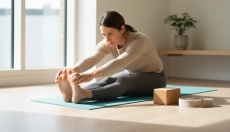
One should also not forget Child's Pose (Balasana) with knees spread wide, which releases the hips and back while allowing the feet to rest in a natural position. And for those who suffer from tension in the ankle area, Butterfly Pose (Baddha Konasana) combined with rotating the feet and gently massaging the feet with one's own hands is ideal.
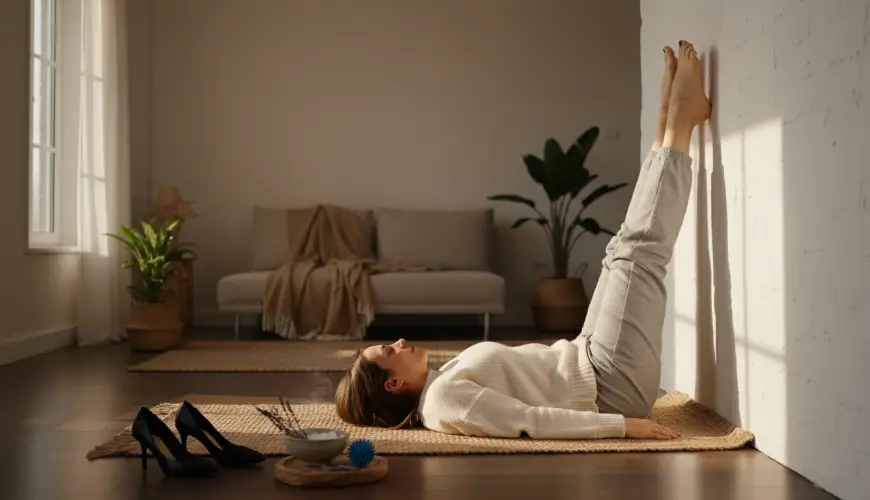
An important part of any evening yoga practice after a day in heels should also be Legs Up the Wall (Viparita Karani). This is one of the simplest yet most effective restorative poses – simply lie on your back, move close to a wall and rest your legs against it in a vertical position. This position promotes the drainage of blood and lymph from the lower limbs, reduces swelling and induces deep relaxation. It is recommended to remain in this pose for five to ten minutes, ideally with eyes closed and slow, conscious breathing.
The order of poses matters. It is advisable to begin with more dynamic poses, such as Downward-Facing Dog or Warrior, and gradually transition to calmer and more restorative positions, such as Child's Pose or Legs Up the Wall. This way, the body is first activated and warmed up, which facilitates deeper stretching, and then calmed and prepared for rest.
Yoga also uses the breath as a tool for release. Conscious, slow breathing activates the parasympathetic nervous system – the part of the autonomic nervous system responsible for rest and recovery. While wearing heels all day can keep the body in a state of mild stress, yoga rewrites this state. According to recommendations from the American Association for Pain Research, regular yoga practice can significantly reduce chronic musculoskeletal pain, even in individuals who have caused it through inappropriate footwear or prolonged static loading.
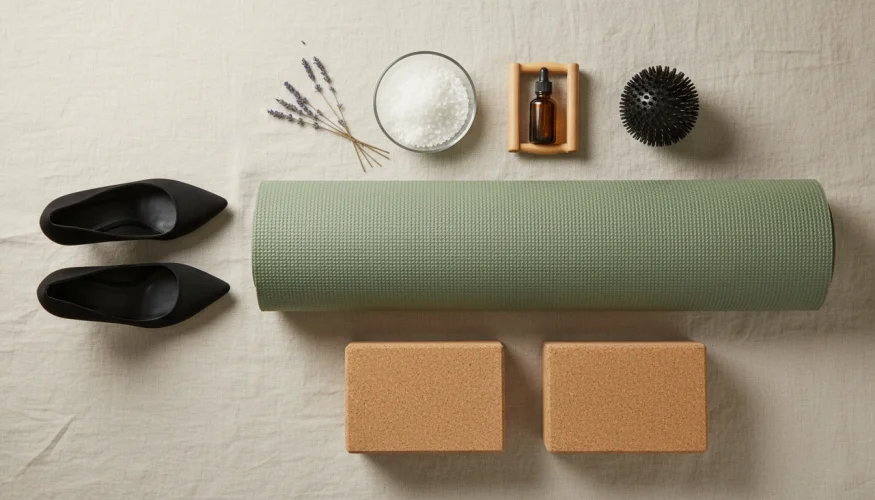
For an evening yoga practice to be truly effective, it is also worth paying attention to the mat and the environment. A quality yoga mat with sufficient thickness and grip ensures that the feet have stable support and do not slip during stretching. Ferwer offers a selection of ecologically certified mats made from natural materials that are gentle on both the body and the planet – a detail that matters especially to those who want to live their healthy lifestyle consistently.
In addition to yoga itself, there are complementary ways to support foot recovery. Massage balls or rollers for the feet can release tension in the plantar fascia in a way that yoga alone cannot replicate. Simply stand on the ball and slowly roll your foot over it – a movement that takes just a few minutes but brings significant relief. Similarly, a warm foot bath with the addition of sea salt or essential oils, such as lavender or peppermint, enhances the effects of yoga stretching and accelerates the recovery of tired muscles.
A question many women ask is: do I need to practise every day? The answer is that even three to four sessions per week can make a noticeable difference. Consistency is more important than duration – twenty minutes every evening after returning from work has a greater effect than an hour-long session once a week. The body gets used to a regular rhythm and begins to ask for the care it needs on its own.
Wearing heels does not have to be harmful if it is complemented by conscious care for the body. Elegance and health are not mutually exclusive – they simply need the right balance. In this respect, yoga is not just exercise, but a way of listening to one's own body and giving it what it truly needs. And feet that have carried the weight of the world on their toes all day more than deserve a twenty-minute evening ritual of release.