

# Why Yoga Is Not Just for Flexible People
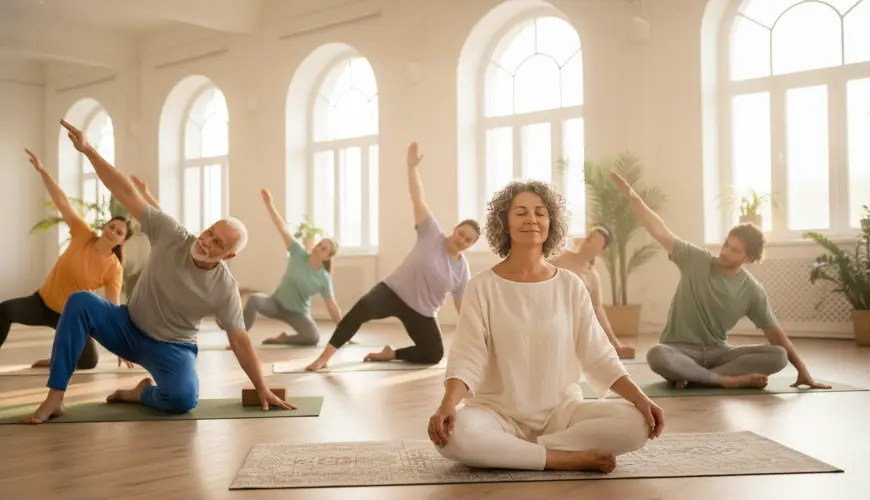
The idea that yoga is exclusively for people who can twist their bodies into the shape of a pretzel is one of the most widespread and simultaneously most harmful myths of the modern age. Just look at Instagram or fitness magazines – nothing but slim figures in perfect poses, all smiles and flawless balance. It's no wonder that many people tell themselves: "That's not for me." But what if this very notion were completely wrong?
Yoga in its original sense was never a sport for the chosen few. It originated thousands of years ago in India as a philosophical and spiritual system whose goal was the connection of mind, body and breath – not the performance of acrobatic feats. It was only the modern world that turned it into a visual affair where performance and flexibility play the leading role. The truth, however, is that yoga is accessible to absolutely everyone, regardless of age, weight, fitness level or joint mobility.
Try our natural products




What yoga truly is and what to expect from it
Before embarking on your first class, it's worth letting go of a few preconceptions. Yoga is not a competition. Nor is it a discipline where a beginner should immediately master advanced poses. It is a practice – and the word practice is key here, because it suggests something that develops gradually, with each subsequent session. As the famous yogi B.K.S. Iyengar said: "Yoga is a light, which once lit will never dim. The better your practice, the brighter your flame."
Scientific research clearly shows that the benefits of yoga are unrelated to how deeply a person can bend. Studies published in the Journal of Clinical Psychology repeatedly confirm that regular yoga practice reduces levels of cortisol – the stress hormone – and improves overall psychological wellbeing. Similar results come from research by Harvard Medical School, which recommends yoga as a complementary therapy for anxiety, depression and chronic back pain. These benefits do not depend on whether the practitioner can manage a headstand or only simple seated stretches.
Beginners very often arrive at their first class with tense muscles, stiff hips and the feeling that they are the least capable person in the room. Yet it is precisely these people who often benefit most from yoga. Bodily stiffness is not an obstacle to yoga – it is one of the reasons to start yoga. A body that has been largely sedentary or suffers from a desk-bound lifestyle responds to gentle stretching and mindful movement surprisingly quickly. After just a few weeks of regular practice, most beginners notice that they bend more easily, their backs hurt less and they sleep better.
Take Martina, a forty-year-old accountant from Brno, who spent her whole life convincing herself that yoga wasn't for her because she had "never been flexible." On the recommendation of her doctor, who had diagnosed her with chronic tension in her neck and upper back, she eventually signed up for a beginner's yoga course. "I expected to be the worst in the whole class and to find it harder than everyone else. Instead, I discovered there were twenty other people with the same concerns," she says. After three months of practice, her tension headaches disappeared and her sleep improved significantly – without her ever managing to touch the floor with her palms.
Martina's experience is not exceptional. On the contrary, it is typical of a large proportion of adults who take up yoga in their thirties or forties. This age group, in fact, benefits most from yoga, because the body at this stage begins to lose the natural mobility and muscular balance that yoga helps to maintain.
How to start without embarrassment and where to find support
The biggest barrier for beginners is not physical unpreparedness – it is shame. The fear of looking ridiculous, of not understanding the instructor's cues, or of their body simply not being "good enough." This feeling is entirely understandable, yet it is also unnecessary. Every experienced yogi was once a beginner, and every teacher worth their salt knows this well.
A practical first step is choosing the right type of class. For complete beginners, classes labelled "yoga for beginners," "gentle yoga" or "hatha yoga" are ideal. These forms emphasise slow and mindful movement, correct breathing and an understanding of basic principles – not performance. Conversely, it is worth avoiding classes such as "power yoga" or advanced vinyasa, which assume a certain baseline level of fitness and knowledge of poses.
If direct contact with others feels too stressful, online classes can be an excellent starting point. Platforms such as Yoga with Adriene on YouTube offer hundreds of free videos specifically aimed at beginners, people with stiff bodies or those who are overweight. Adriene Mishler, one of the most-watched yoga teachers in the world, is known precisely for her "yoga for everyone" approach, and her favourite motto is "Find What Feels Good." This approach perfectly captures the philosophy that should accompany every beginning.
An important part of preparation is also equipment. There is no need to immediately invest in expensive leggings or specialist accessories. The foundation is a quality yoga mat that provides sufficient grip and cushioning. For beginners, yoga blocks and a strap are particularly useful, helping to achieve correct body alignment even with limited flexibility. These props are not a sign of weakness – on the contrary, professional instructors recommend them even to advanced practitioners as tools for deeper and safer work with the body.
Clothing should be comfortable, breathable and allow free movement. Materials made from organic cotton or bamboo are a popular choice not only for their pleasant feel against the skin, but also because they are kinder to the environment – which aligns with the philosophy of mindful and sustainable living that yoga naturally supports.
One of the things that surprises beginners most is how little it matters what they "manage" in a class. Yoga is not about achieving goals in the traditional sense. It is about presence – about what is happening in the body and mind right now, in this particular pose, with this particular breath. This is precisely why yoga can be so liberating for people who are accustomed to constant performance-driven competition in other areas of life. A yoga class is a space where nothing needs to be proved.
Regularity plays a greater role than intensity. Twenty minutes of yoga three times a week will produce significantly better results over a month than one hour-long class per week. The body adapts to movement gradually and needs repetition in order to internalise new movement patterns. Beginners are therefore advised to start slowly but consistently – and not to expect immediate results.
Yoga also has a strong social dimension that is lost when practising at home. A group class creates a community – people with the same goals and similar doubts. Many beginners admit that it is precisely this community that is one of the main reasons they stayed with yoga. The awareness that they are not alone, that others also struggle with stiff hips or a wandering mind, is enormously encouraging.
Yoga for older adults and seniors deserves special mention. The World Health Organization WHO recommends that older adults engage in regular physical activity focused on balance and flexibility – and yoga fulfils these requirements perfectly. Specialist "chair yoga" classes allow people with limited mobility, or those who cannot stand on a mat, to practise as well. This form of yoga is popular in care homes and rehabilitation centres around the world, and its benefits are well documented by science.
Yoga, then, is truly not the preserve of those born with natural flexibility or those who have been active all their lives. It is a practice that adapts to the individual – not the other way around. Every body is different and every yoga journey looks different. What one person manages with ease may take another months – and that is perfectly fine. What matters is to begin, to persevere and to allow oneself to be in the class exactly as one is, without comparison and without judgement.
Perhaps the greatest paradox of yoga lies in the fact that people who feel "not ready for yoga" are, in reality, precisely those who need it most. Stiff muscles, a tired mind, overstretched nerves – these are the very reasons to step onto the mat. Not obstacles that must first be overcome. Yoga does not begin at the moment when the body is perfect. It begins at the moment a person decides to take the first step – even if uncertain, even if a little embarrassed, even if not knowing what lies ahead.