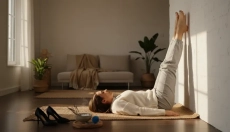

Try balance exercises with a pillow under your feet
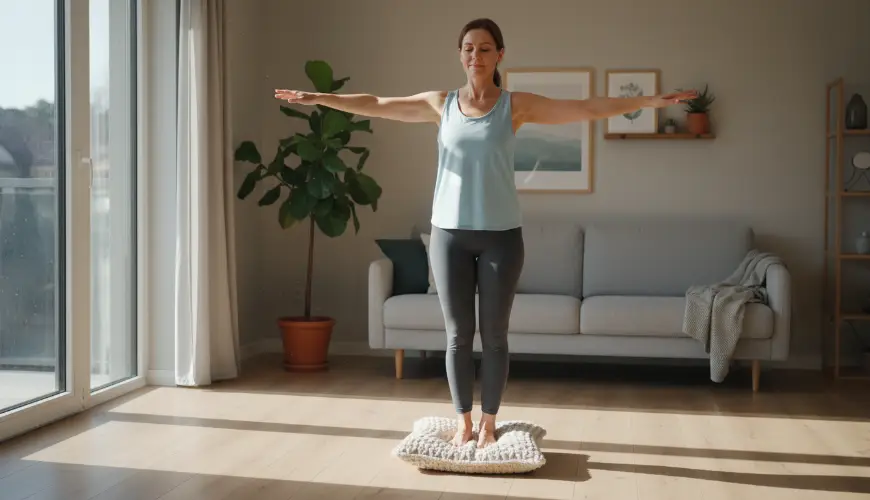
Imagine standing on one leg, with a soft pillow under your foot, your body gently swaying from side to side as your brain and muscles work to maintain balance. It sounds simple, perhaps even trivial. In reality, it is one of the most effective ways to strengthen deep stabilising muscles, improve coordination and prevent injuries – and you don't need a gym or expensive equipment. Balance exercises with a pillow under your feet have been making a major comeback in recent years, not only in physiotherapy clinics but also in home workouts around the world.
The reason is straightforward: an unstable surface, which a pillow undoubtedly is, forces the body to activate muscles that would remain completely passive on a firm floor. It's not just about the legs. The core, deep back muscles, foot muscles and small stabilisers around the ankles and knees all become engaged. The result is a comprehensive workout that benefits the body in ways that conventional strength training simply cannot replicate.
Try our natural products





Why an unstable surface works wonders
The human body is evolutionarily designed to handle uneven terrain. Our ancestors didn't walk on paved pavements or parquet floors – they moved across stones, roots and soft soil. The modern lifestyle has completely removed this natural stimulus, and the muscles responsible for balance gradually weaken as a result. Exercise on an unstable surface elegantly corrects this deficit.
Scientific research supports this idea. Studies published in the Journal of Strength and Conditioning Research have repeatedly demonstrated that training on an unstable surface significantly increases the activation of deep stabilising muscles compared to training on a firm surface. In other words, even a seemingly simple squat on a pillow is more demanding and complex for the body than the same movement performed on the ground.
Physiotherapists have been applying this principle for decades. Balance exercises with a pillow or on specialist equipment form the foundation of rehabilitation following ankle, knee and lower back injuries. It is therefore no coincidence that this method has gradually moved from clinics into living rooms and home gyms. If it works for athletes recovering from surgery, it will work for anyone who wants to strengthen their body and protect it from future injuries.
Interestingly, the effect of an unstable surface also manifests at a neurological level. When balancing, the brain intensively processes signals from receptors in the feet, ankles and joints – so-called proprioception, the ability to sense the position of one's own body in space, demonstrably improves with training. This has a direct impact on fall prevention, improved athletic performance and overall confidence of movement in everyday life.
How to get started: from simple standing to advanced exercises
Before attempting complex movements, it is worth understanding that a pillow under your feet is not merely an accessory – it is a tool that changes the entire dynamics of movement. Beginners should choose a firmer and lower pillow, ideally one that doesn't sink too much. A pillow that is too soft and too high can be counterproductive at the start, because the instability is too great and the body is unable to control the movement properly.
A practical example might be Jana, a forty-four-year-old accountant from Brno, who after years of sitting at a computer began suffering from knee pain and instability when walking up stairs. Her physiotherapist recommended starting with balance exercises at home, and since she had no specialist equipment, she used a firmer decorative pillow from her sofa. After three weeks of regular exercise – just ten minutes a day – Jana noticed a significant improvement in stability and a reduction in pain. It is a simple story, but a telling one: results come faster than most people expect.
The fundamental exercise is a simple single-leg stand with a pillow under the foot. All you need to do is stand, maintain balance for thirty seconds, then switch legs. Does it sound easy? Try it. Most people find that their body immediately starts working at full capacity. Once this position ceases to be a challenge, you can add arm movements, close your eyes or shift weight from heel to toe.
The next step is squats with a pillow under your feet. Place the pillow on the floor, stand on it and perform a standard squat. The knees naturally become more activated, the core has to work more intensively and the entire movement becomes significantly more complex. It is important to ensure the knees are properly aligned – they must not cave inward – and to perform the movement slowly and with control.
For those who want to engage the upper body as well, lunges with a pillow are an excellent choice. One foot stands on the pillow while the other steps forward or backward into a lunge. This variation places exceptional demands on the gluteal muscles, the front of the thigh and the trunk stabilisers. The result is an exercise that combines strength, balance and coordination in a single movement.
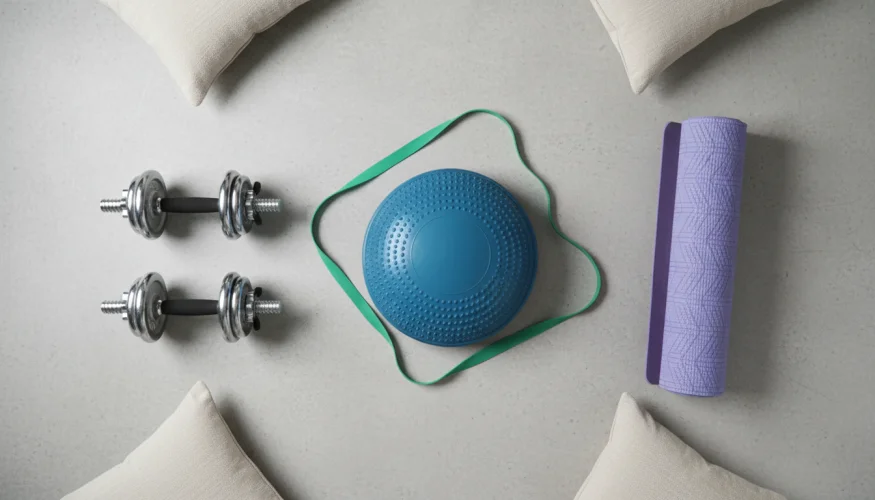
More advanced exercisers can try simple exercises with a dumbbell or resistance band while standing on a pillow. Adding external resistance increases the demands on stabilisation and significantly accelerates progress. World-renowned physiotherapist and author Gary Gray, who has devoted his career to functional movement, puts it precisely: "The body is not a collection of isolated muscles – it is an integrated system that functions best when trained as a whole."
Who benefits most from balancing on a pillow
Balance exercises with a pillow under your feet are not solely the domain of athletes or those in rehabilitation. The range of people who can benefit from them is surprisingly broad.
Older adults are among those who benefit most from balance training. Falls are one of the leading causes of serious injury in elderly people, and the World Health Organization reports that approximately one third of people over the age of sixty-five fall each year. Regular balance training demonstrably reduces this risk. A pillow represents a safe and accessible alternative to expensive balance boards or BOSU balls.
Athletes at all levels can significantly improve their performance through balance training. Footballers, skiers, tennis players, runners – all need stable ankles, strong knees and well-functioning proprioception. Incorporating balance exercises into regular training reduces the risk of injury while also improving movement precision and confidence.
People with sedentary jobs form another large group. Long hours spent at a desk weaken the deep back muscles and disrupt the natural stability of the spine. Balance exercises specifically strengthen these muscles and serve as a natural counterbalance to sitting all day. Just ten minutes a day is enough for results to become apparent within a few weeks.
And then there are pregnant women, whose centre of gravity shifts constantly as their bump grows. Gentle balance exercises – carried out after consulting a doctor, of course – can help maintain stability, strengthen the pelvic floor and prepare the body for the physical demands of labour and the postnatal period.
For all these groups, one universal principle applies: start slowly, listen to your body and gradually increase the level of difficulty. Overloading an unstable surface without sufficient baseline strength can lead to incorrect compensatory movement patterns that are more harmful than beneficial in the long run. Patience truly pays off here.
When it comes to choosing a suitable pillow, it largely depends on what is available. Decorative sofa cushions, folded blankets, camping mats folded into a square or specialist balance pillows – all of these options work. Specialist balance pillows, which can be purchased for example as part of a home workout set, have the advantage that their shape and firmness are designed specifically for this purpose. They offer an optimal degree of instability without unnecessary risk of falling.
It is also important to consider safety. Exercise should always take place near a wall or stable piece of furniture so that you can quickly steady yourself if you lose balance. Bare feet or thin socks are a better choice than thick trainers, because the foot needs to feel the surface beneath it as much as possible – this contact is the key source of proprioceptive feedback.
An interesting aspect of balance training that is often overlooked is its positive effect on mental wellbeing. The concentration required to maintain balance works similarly to meditation – the mind focuses on the present moment and everyday worries temporarily fade into the background. Many people report feeling not only physically but also mentally refreshed after balance training. This combination of physical and mental benefit makes balance exercise one of the most valuable forms of movement there is.
Balance exercises with a pillow under your feet are therefore far more than just a fashionable fitness trend. They represent a return to the natural way of moving that the human body is missing, a smart solution for anyone who wants to be stronger, more stable and more resilient – and at the same time proof that effective training requires nothing more than a piece of soft padding and the determination to step onto it regularly.