

Get children involved in household chores playfully
Every parent knows it. You ask a child to tidy their room, and suddenly they either become invisible or burst into tears as if it were the greatest injustice in the world. Household chores and children – seemingly irreconcilable enemies. Yet all it takes is a change of perspective and approach, and what was once a daily battle can become something children seek out on their own. The key is play and meaningfulness – two things children naturally love.
Psychologists and educators agree that involving children in household management has a fundamental impact on their development. It's not just about giving parents less work to do – though that's not unwelcome either – but about building essential life skills, responsibility, and self-confidence. According to research from Harvard University, regular participation in household chores during childhood is among the strongest predictors of success in adulthood. Children who help at home adapt better in social settings, are more empathetic, and manage stress more effectively.
The problem arises when parents treat household chores as obligations that children must fulfil. This approach almost always meets with resistance. Children don't naturally recognise the value of a clean floor or folded laundry – they only see an interruption to play, fun, or rest. And this is precisely where there is room for parental creativity.
Try our natural products


Turn Boring Tasks into Adventures
The secret to success lies in reframing the entire situation so that the child doesn't perceive household work as work. It sounds simple, but in practice it requires a little imagination. Consider seven-year-old Tomáš, who hates tidying his room. His mother tried a different tactic – instead of "Tidy your room," she said: "Come on, let's see if you can put all the cars in their place before I count to thirty." The result? Tomáš not only tidied up, but also asked to try again to beat the record.
Timed challenges work wonderfully well with pre-school and younger school-age children. So do point-scoring systems, where children collect "stars" or stamps for completed tasks and, upon reaching a certain number, earn a reward – a trip to the zoo, a movie night, or a favourite dinner. It's important that the reward isn't always material. Children often appreciate shared time or an experience far more than a new toy.
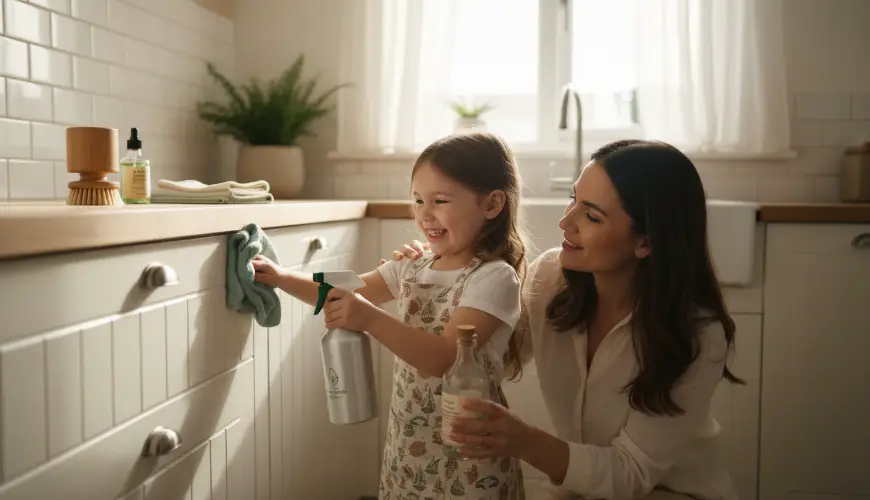
Another excellent tool is role-playing. Young children love being able to "play at being grown-ups." If a four-year-old girl gets her own small cloth and can "help mummy" dust, she experiences it as a privilege, not a chore. The same applies to cooking – involving a child in meal preparation is one of the most effective ways to teach them patience, precision, and cooperation. And food that a child has prepared themselves always tastes better.
Music is another powerful ally. Putting on a favourite playlist while tidying transforms the entire atmosphere. Dancing together between dusting and vacuuming becomes a memory that children recall with a smile. The goal isn't a perfect result – it's making the process enjoyable.
Age Matters: What Younger and Older Children Can Handle
One of the most common mistakes parents make is either overloading children with tasks beyond their abilities, or underestimating what they are capable of. Age-appropriateness is essential – and it's also worth knowing that children can manage far more than most parents think.
Children aged two to three are naturally curious and imitate adults. This is the ideal time to start – and the expectations are, of course, minimal. A child can help carry light objects, throw rubbish in the bin, or place napkins on the table. The goal isn't the result, but building habits and a sense of belonging.
Children aged four to six can water plants, fold laundry (even if not always perfectly), feed pets, or wipe accessible surfaces. Children aged seven to ten are capable of vacuuming, washing dishes, preparing simple breakfasts, or tidying an entire room. Older children and teenagers can take responsibility for specific areas of the home – such as regularly cleaning the bathroom or shopping from a list.
As American psychologist and parenting author Wendy Mogel puts it: "Children need to feel that they are useful to the family – not as ornaments, but as genuine contributors." This sense of belonging and importance is absolutely essential for a child's healthy psychological development.
A family council or regular meeting, where everyone plans together who will have which task for the coming week, gives children a sense of control and shared decision-making. When a child chooses for themselves whether they'll be in charge of dusting or taking out the rubbish, they take on the task with far greater willingness than if it were assigned without their input.
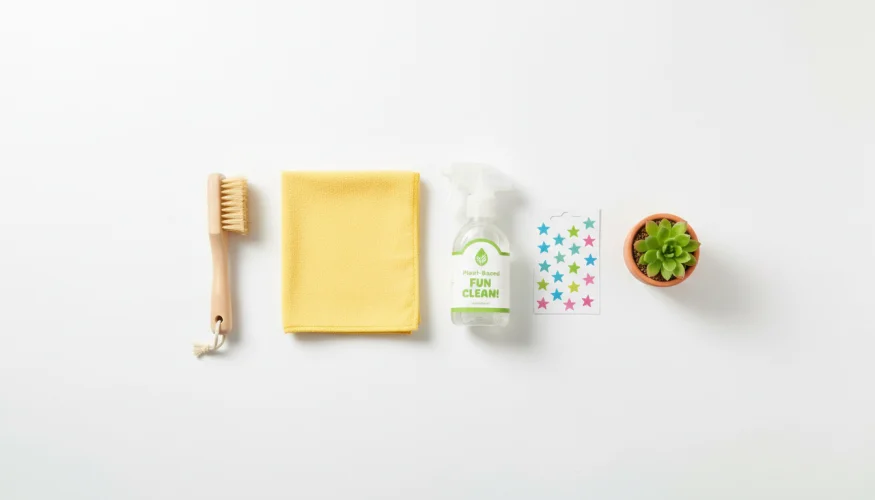
Environmental education, which naturally connects with household chores, is equally important. Sorting waste, saving water while washing up, or using eco-friendly cleaning products – all of these are topics that can be incorporated into household chores naturally and gently. On Ferwer.cz, parents can find a wide range of eco-friendly household products that are safe even for the smallest helpers – from natural cleaning products to sustainable household tools that children can use without concern.
Involving children in eco-friendly cleaning has a dual effect. On one hand, they learn practical skills; on the other, they develop a relationship with the environment and a sense of responsibility towards the planet from an early age. A child who understands why plastic and paper should be sorted separately grows into a conscientious adult – and that is an investment that pays back many times over.
A practical example might look something like this: every Saturday morning, the family sets aside an hour for a "big clean." Every member of the household – including the youngest – has a task suited to their age. They put on favourite music, prepare eco-friendly cleaning products, and get to work. Once finished, everyone sits down for a shared snack, which the children help to prepare. This ritual becomes something the family looks forward to – not something they dread.
The key to success isn't perfection, but consistency and a positive atmosphere. If a child doesn't do something perfectly – and this will always happen – there is no room for criticism, only encouragement. "Well done, next time we'll try to do even better" works incomparably better than correcting or redoing the work in front of the child, which demotivates them and convinces them that they simply can't do it.
It's also important not to forget appreciation and gratitude. Thanking a child for their help, telling them how much the family valued their contribution, is a powerful tool. Children are sensitive to recognition, and if they feel that their effort has meaning and is noticed, motivation naturally increases. This doesn't mean excessive praise for every little thing – that can have the opposite effect – but sincere and specific appreciation: "Thank you for watering the plants. They'll do well now."
Modern research in child psychology, such as the work of Richard Ryan and Edward Deci in the field of self-determination theory, shows that intrinsic motivation – the desire to do something because it is meaningful, not because a reward will follow – is far more effective in the long term than extrinsic motivation. Parents who can connect household chores with a sense of purpose and belonging raise children who help spontaneously, without the need for reminders or punishments.
Of course, not every day will be ideal. There will be moments when a child refuses, is tired, or simply isn't in the mood. And that's perfectly fine. Flexibility and understanding are part of a healthy approach. Parenting isn't about perfect results, but about building a relationship and values – step by step, day by day.
Involving children in household chores in a playful way isn't just about a clean home or a tidy table. It's about time spent together, about passing on values, about building self-confidence, and about preparing for life. And if along the way you laugh and put on a favourite song, then you've done brilliantly.