

# Exercises for Flat Feet That Actually Work
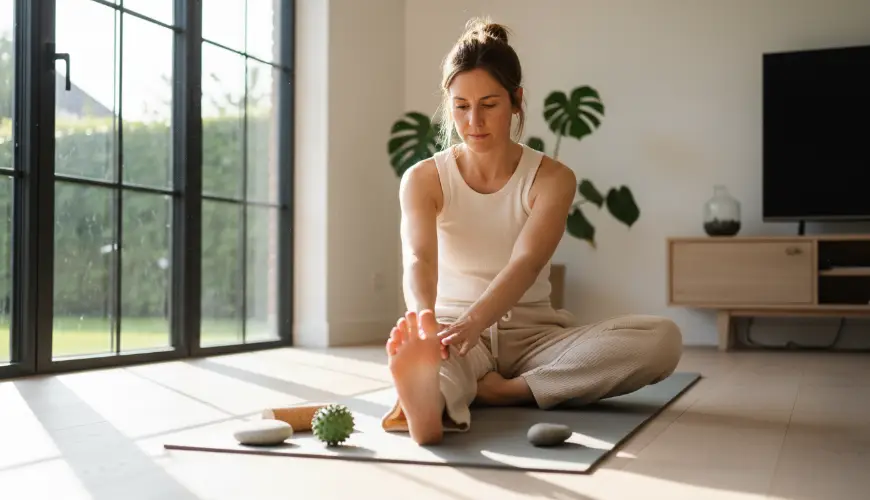
Flat feet are not just an aesthetic issue. Anyone who lives with them knows well that it is a condition that can manifest as foot pain, fatigue after prolonged walking, and even problems in the knees, hips, or even the back. It is surprising how few people realise that this problem can be effectively addressed — without surgical intervention or expensive orthopaedic aids. Properly chosen exercises for flat feet can significantly improve the condition of the arch and the overall quality of movement.
It is estimated that approximately 20–30% of the adult population suffers from flat feet, with the majority experiencing what is known as acquired flat foot — a condition that developed over the course of life due to inappropriate footwear, sedentary work, excess weight, or lack of physical activity. This is also good news, because what has been acquired can largely be corrected or at least significantly improved.
Try our natural products
Why the foot arch is so important
The human foot is a fascinating structure. It is made up of 26 bones, 33 joints, and more than a hundred muscles, tendons, and ligaments — and it is precisely their interplay that creates the arch, which functions as a natural shock absorber. When this arch is absent or weakened, the entire body loses its primary shock absorption system. The result is overloading of structures that are not designed for it, and progressive pain that spreads upward through the entire musculoskeletal system.
The modern lifestyle does not support the foot arch particularly well. Hard concrete surfaces, shoes with full soles that prevent the foot muscles from working, and hours spent sitting — all of this contributes to the weakening of the small muscles of the foot. These muscles then become unable to maintain the arch in its natural position, and flat feet gradually worsen. The good news, however, is that muscles can be strengthened. And that is precisely the goal of the exercises discussed below.
As physiotherapist Katy Bowman, author of the book Move Your DNA, says: "The foot is the foundation of the entire body — if it is weak or stiff, the problems will not be limited to the foot alone."
Before diving into specific exercises, however, it is important to mention one thing: exercises for flat feet are not a quick fix. Results come gradually, over weeks and months of regular practice. Those who approach it with patience and consistency can achieve surprisingly good results — even in adulthood.
Exercises that truly help
One of the best-known and most effective exercises is the so-called picking up objects with the toes. The principle is simple: small objects — such as marbles, pebbles, or small pieces of fabric — are spread on the floor, and the task is to pick them up using only the toes and transfer them into a bowl or box. This seemingly childlike exercise activates the muscles on the underside of the foot, which are chronically weakened and insufficiently engaged in most people. It is recommended to perform it every day for five to ten minutes, ideally in the morning before putting on shoes.
Another very effective exercise is arch lifting without moving the toes, known in English as the "short foot exercise". In this exercise, one stands with a bare foot on the floor and attempts to shorten the distance between the heel and the front part of the foot — as if the foot were trying to "shrink" — without bending or lifting the toes off the floor. The result is activation of the deep muscles that directly support the longitudinal arch. Research published in the academic journal Journal of Physical Therapy Science confirms that regular performance of this exercise demonstrably increases arch height in people with flat feet.
A very popular and easily accessible tool is a massage ball or tennis ball. Simply place it under the foot and slowly roll the entire sole over it — from the heel through the middle to the toes — with gentle pressure. This exercise not only acts as a pleasant massage but also stretches the plantar fascia, the connective tissue on the underside of the foot, which tends to be shortened and tense in people with flat feet. Regular release of this fascia is a prerequisite for other strengthening exercises to work to their full potential.
One should not overlook walking on tiptoes and on heels, which is simple but surprisingly effective. Alternating tiptoe walking strengthens the calf muscles and the Achilles tendon, while heel walking engages the front of the lower leg. Both of these muscle groups have a direct influence on how the foot functions with each step. It is sufficient to walk the length of a room several times — for example, during the morning routine or while waiting for coffee to brew.
A specific and highly targeted exercise is spreading the toes apart. One sits on a chair with the soles of the feet flat on the floor and tries to spread the toes as wide as possible — as if making the largest possible "fan". This ability is significantly suppressed in most people due to wearing narrow shoes, yet the toes play a crucial role in the dynamic stabilisation of the arch during walking. Once this ability is redeveloped, the foot begins to function more efficiently.
A somewhat more demanding but very effective exercise is lunges with knee position control. During a forward lunge, it is essential to ensure that the knee does not collapse inward — this pattern, referred to as valgus knee, is a direct consequence of flat feet and simultaneously worsens them. By consciously maintaining the correct position of the knee over the second to third toe, not only the ankle joint is strengthened, but the neuromuscular coordination of the entire lower limb is also trained.
An interesting real-life example is the story of Martina, a thirty-four-year-old accountant from Brno, who spends her entire working day sitting at a computer. After giving birth, she began to complain of heel pain and foot fatigue after longer walks. An orthopaedist diagnosed her with flat feet and recommended orthopaedic insoles. These provided relief but did not address the underlying problem. It was only after six months of regular exercise — particularly the short foot exercise and picking up objects with the toes — that she noticed significant improvement, both in her subjective experience and at a follow-up examination. "My shoes still fit differently than before, but the pain is gone," she described her progress.
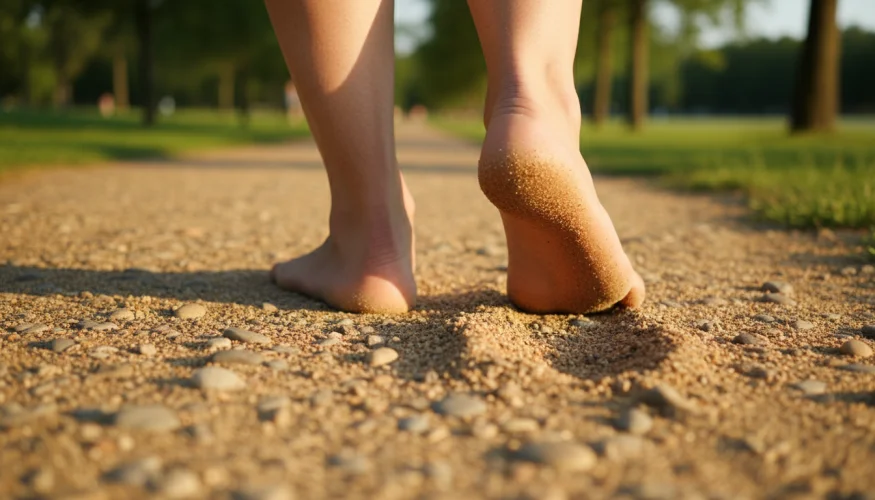
In addition to these specific exercises, barefoot walking also plays an important role. Walking on uneven terrain — grass, sand, a pebble path — naturally activates a whole range of small foot muscles that remain passive when walking in shoes. Biomechanics experts, such as the team at Harvard University, have long pointed out that the excessive cushioning in modern footwear paradoxically contributes to the weakening of the foot. Short walks barefoot in the garden or in a park can therefore be a very valuable supplement to any exercise programme.
How to incorporate exercise into everyday life
The biggest obstacle with flat foot exercises is usually not their difficulty, but consistency. Exercise is most effective when it becomes part of the daily routine — not a special activity that requires setting aside time. This is precisely why it is advantageous that most of the exercises described can be performed anytime and anywhere: picking up objects with the toes while watching television, the short foot exercise while standing in a queue, spreading the toes while working at a desk.
The recommended frequency varies between individual exercises, but it is generally true that ten minutes of daily exercise will yield better results than an hour of exercise once a week. The muscles of the foot are accustomed to constant work — after all, with every step they bear the full weight of the body — and they respond well to frequent but gentle stimulation.
It is also important to pay attention to footwear selection. Shoes with a thin, flexible sole and a sufficiently wide toe box allow the foot to function more naturally than rigid sports shoes with massive cushioning. There is a wide range of so-called "minimalist" or "barefoot" shoes on the market that respect this principle. However, the transition to them should be gradual — a sudden change after years of wearing conventional footwear can overload muscles that are not yet prepared for greater demands.
Exercise can also be combined with other approaches, such as yoga or Pilates, which generally strengthen the conscious engagement of small muscles throughout the body, including the feet. Some yoga poses — for example, Tadasana, or the mountain pose — directly work with the conscious distribution of weight across the foot and activation of the arch.
Flat feet are not a fate that cannot be changed. They are a challenge to which the human body — with the right approach — is capable of responding. All it takes is to start slowly, persevere, and give your feet the attention they have deserved throughout their entire life.