

We will advise you on how to choose energy-efficient appliances correctly
Energy prices have risen significantly in recent years, and many households are looking for ways to reduce their monthly expenses. One of the most effective long-term investments is purchasing energy-efficient appliances that consume less electricity while doing the same — or even better — job than their older counterparts. However, the market today is flooded with offers, manufacturers entice customers with various certificates and energy labels, and navigating it all can be quite a challenge. So how do you choose energy-efficient appliances wisely, without feeling like you're lost in a labyrinth of technical specifications?
The answer is not as complicated as it might seem. You just need to know what to focus on, what to verify, and what not to take at face value.
Try our natural products




The energy label is not just decoration
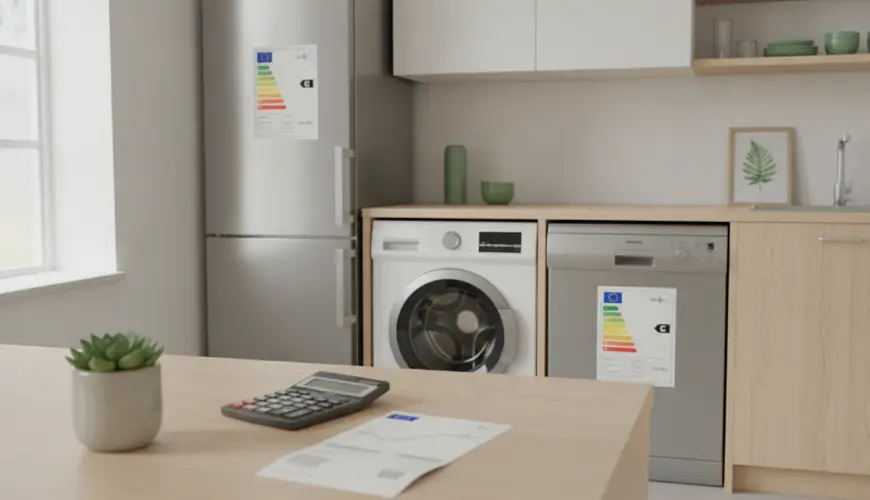
The first and most important tool when choosing an energy-efficient appliance is the energy label. This colourful label, which is mandatory for most household appliances sold in the European Union, provides a quick overview of how much energy a given device consumes. Since 2021, the energy label has undergone a significant reform — the original scale, which ranged from A+++ to G, was replaced by a clearer scale from A to G, with class A currently intentionally left empty or only minimally occupied, to leave room for future technological progress.
In practice, this means that an appliance with class B or C today may actually be very energy-efficient, while an older appliance labelled A++ may be average or even below average according to the new standards. This shift confuses many customers who think they are buying the best product because they see a letter near the beginning of the alphabet. The European Commission introduced this system precisely to motivate manufacturers to continue innovating — details about the label reform are available on the European Commission's pages dedicated to energy labels.
When looking at the label, it is important to pay attention not only to the class itself, but also to the specific consumption in kilowatt-hours per year. This figure is far more telling than a letter. If two washing machines both offer class B, but one consumes 150 kWh per year and the other 210 kWh, the difference will make itself very noticeably felt on your bills after a few years at today's electricity prices.
How to think about the true cost of an appliance
One of the most common mistakes when buying household appliances is focusing exclusively on the purchase price. A cheaper appliance may seem attractive at first glance, but if its operation costs thousands of crowns more per year than a more expensive alternative, the seemingly good deal quickly turns into a costly lesson. Experts therefore recommend thinking in terms of the so-called total cost of ownership — that is, the sum of the purchase price and the expected operating costs over the appliance's lifetime.
Let's take a specific example: the Novák family was choosing between two dishwashers. The first cost 8,000 crowns and consumed 1.1 kWh per cycle, while the second cost 12,000 crowns but consumed only 0.7 kWh per cycle. With an average dishwasher usage of five times per week and an electricity price of 7 crowns per kWh, the annual saving works out to approximately 730 crowns. Over five years of operation, the more expensive dishwasher saves over 3,600 crowns on electricity alone — and that's without counting water consumption, where more efficient models also lead by a significant margin. The difference in purchase price is therefore recovered in approximately five and a half years, while a dishwasher typically has a lifespan of ten to fifteen years.
This way of thinking applies to virtually every appliance — from the fridge, which runs continuously 24 hours a day, to the washing machine and dryer, all the way to air conditioning or heat pumps. The more frequently and the longer you use an appliance, the more worthwhile it is to invest in a more efficient model.
As the German consumer portal Stiftung Warentest once noted: "The cheapest appliance in the shop is rarely the cheapest appliance in the home." This thought captures the essence of the entire approach to selecting energy-efficient appliances better than any tables or graphs.
What to focus on for specific types of appliances
Different categories of appliances have their own specific characteristics worth paying attention to. Fridges and freezers are among the biggest energy consumers in the home, as they run continuously. Here, the energy efficiency class is absolutely crucial — the difference between an average and an efficient model can amount to several hundred kilowatt-hours per year. The right size also matters: an oversized fridge that is half empty wastes energy unnecessarily.
With washing machines and dryers, not only electricity consumption but also water consumption plays a major role. Modern heat pump washing machines can significantly reduce energy consumption during drying — heat pump dryers consume approximately 50% less electricity than condenser models without a heat pump. If a household uses a dryer regularly, the investment in a heat pump model pays off very quickly.
Dishwashers are an interesting category, as modern energy-efficient models can wash dishes on a short programme at a low temperature with a surprisingly small consumption of both water and energy. The key is to choose models with an automatic detergent dosing function and sensors that adjust the washing intensity to the actual level of soiling.
When selecting televisions, computers and other electronics, it is worth monitoring the consumption in standby mode. Many older devices consume unnecessarily large amounts of energy in standby mode — so-called "vampire power" or energy vampirism can account for up to 10% of total annual electricity consumption in an average household, as reported by the International Energy Agency (IEA).
Certifications and eco-labels you can trust
In addition to the mandatory EU energy label, there are other certifications that can help when choosing genuinely energy-efficient and environmentally friendly appliances. The Energy Star certification originates from the United States but is also recognised in Europe, and focuses on office equipment, household appliances and lighting. Products with this certification must meet strict energy consumption criteria that go beyond the minimum legal requirements.
The EU Ecolabel (the European flower) is another reliable indicator. This label does not evaluate energy consumption alone, but the entire lifecycle of the product — from manufacturing through operation to disposal. Products with the EU Ecolabel are therefore kind not only to your wallet, but also to the environment, which is particularly appreciated by customers who want to consciously reduce their ecological footprint.
It is also worth knowing that manufacturers sometimes state energy consumption under ideal laboratory conditions, which may differ from real-world operation. It is therefore worthwhile to read reviews from independent testing organisations, such as the Czech dTest, which regularly tests household appliances under real-world conditions and whose results often differ significantly from manufacturers' marketing materials.
Practical tips for smart purchasing
When actually selecting and purchasing an energy-efficient appliance, it helps to follow a few principles that have proven effective in practice:
- Compare annual consumption in kWh, not just the energy class — two appliances in the same class can conceal significantly different actual consumption levels.
- Consider size and capacity — bigger is not always better, and an oversized appliance operated half-empty is a waste of energy.
- Read independent tests — reviews from dTest, the German Stiftung Warentest or the British Which? are a more reliable source than advertising materials.
- Ask about warranty conditions and availability of spare parts — an energy-efficient appliance that breaks down after three years and cannot be repaired is not a sustainable choice, either financially or ecologically.
- Keep an eye on subsidy programmes — in the Czech Republic, various support programmes exist, for example within the framework of Nová zelená úsporám, which can provide financial support for the purchase of energy-efficient appliances and technologies.
When does it make sense to replace an old appliance
Many people hesitate over whether to replace a functioning but old appliance with a new, more efficient model. As a general rule, appliances older than ten to fifteen years are significantly less energy-efficient than today's models, as technology has made enormous progress in that time. Old fridges from the turn of the millennium can consume two to three times more energy than today's comparable models.
At the same time, it is important to realise that manufacturing a new appliance has its own ecological footprint — it consumes raw materials and energy, and produces emissions. It is therefore not always ecologically responsible to replace an appliance as soon as a more efficient model appears on the market. The right approach is to calculate how long it will actually take for the replacement to pay off — both financially and ecologically — and make the decision based on this calculation.
If an appliance is functional but relatively new, it may be better to wait for a natural replacement. However, if an appliance regularly requires repairs, is more than ten years old and has high running costs, replacing it with a modern energy-efficient model makes sense both for your wallet and for the environment.
Choosing energy-efficient appliances is not rocket science, but it does require a little patience, a willingness to compare, and the ability to think over a longer time horizon. Households that adopt this approach typically find that their investment pays off sooner than they expected — and that lower energy bills are just one of the benefits. The second is the peace of mind that comes from knowing their household is operating more efficiently and with a smaller impact on the planet.