
Reverse Lunges as a More Gentle Option for Knees and Stability
Painful knees are an everyday reality for many people – whether due to a previous injury, excess weight, or simply joint wear from years of active movement. Yet the desire for firm thighs, a well-developed glutes, and overall fitness doesn't abandon even those who need to be careful with their knees. This is precisely where reverse lunges come into play – an exercise that may seem like an ordinary variation of the classic lunge at first glance, but actually represents a fundamentally different way of loading the body. More gentle, more controlled, and for many exercisers, literally a lifesaver.
The classic forward lunge is one of the foundational exercises in every fitness program. However, if you suffer from knee pain or are recovering from such an injury, you may have noticed that the forward lunge can be quite uncomfortable. The knee of the front leg shifts significantly forward past the toes, increasing pressure on the patellar tendon and kneecap cartilage. For a healthy knee, this may not be a problem, but for a weakened or sensitive knee, it's unnecessary additional strain.
Try our natural products


Why Reverse Lunges Are Different – and Better for Knees
The reverse lunge works on the opposite principle. Instead of stepping forward and shifting your center of gravity over the front foot, you step back with the rear foot. The result is that the front knee remains more stable and moves forward less, while the glutes, hamstrings, and gluteal muscles do the main work. Biomechanically, this is a significantly more joint-friendly movement for a knee that needs protection.
Research in sports biomechanics has consistently shown that the force on the anterior cruciate ligament and patellar tendon is lower during a reverse lunge than during a forward lunge. For example, a study published in the Journal of Strength and Conditioning Research confirmed that the reverse lunge generates less pressure on the knee than its classic forward variant. These findings come as no surprise to physiotherapists, who routinely incorporate reverse lunges into rehabilitation programs following knee injuries.
Consider Martina, a forty-three-year-old physical education teacher who injured her anterior cruciate ligament two years ago. After surgery and rehabilitation, she wanted to return to strength training, but classic forward lunges were an insurmountable obstacle for her – her knee hurt and she feared further injury. Her physiotherapist recommended she start with reverse lunges. "At first I didn't believe it would be any different," says Martina, "but after the first training session, I found that my knee didn't protest at all, while my muscles were working at full capacity." Today, reverse lunges are a permanent part of her training plan.
Similar stories exist by the hundreds. And it's not just about people recovering from injuries – reverse lunges are also suitable for those with structurally sensitive knees, those suffering from chondromalacia patellae, or simply those who want to train more intelligently and preventively. Last but not least, they are an excellent choice for older exercisers whose joints simply need a bit more respect.
How to Perform a Reverse Lunge Correctly
Technique is crucial in reverse lunges – as with any strength exercise. A poorly performed reverse lunge will be less harmful than a poorly performed forward lunge, but correct execution is what makes it a truly effective and safe exercise.
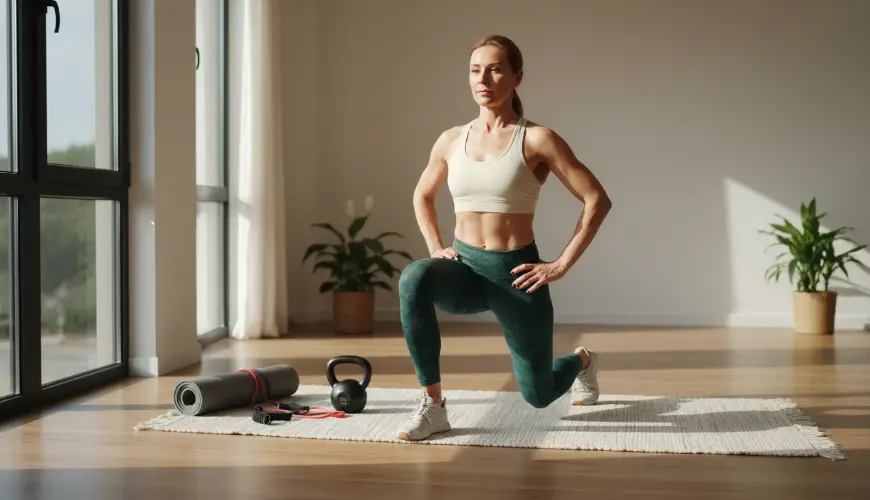
Start in an upright stance, feet hip-width apart, shoulders pulled back and down, gaze directed forward. Then take a controlled step backward with one foot – approximately far enough that both knees form roughly a ninety-degree angle when lowered. The front knee should remain approximately above the ankle, and should definitely not extend past the toes. The rear knee slowly lowers toward the floor without necessarily needing to touch it. The body's center of gravity remains over the front foot, and the torso stays upright.
When returning to the starting position, push off with the front foot and bring the rear foot back. The entire movement should be slow and controlled, without jerking or losing balance. This control of movement is one of the reasons reverse lunges are popular in rehabilitation – they require you to work with your body consciously and with focus.
For beginners or those returning from injury, it's advisable to start without weights, using only bodyweight. Only once the movement is confident and pain-free should you gradually add load – first light dumbbells in the hands, later perhaps a kettlebell or a barbell on the shoulders. Progression should be slow and respectful of the body's current condition.
There are also several useful variations that can enrich training or adapt it to specific needs:
- Reverse lunge with front knee elevation – after returning to standing, you raise the front knee to hip height, engaging the deep stabilizing system and improving balance.
- Bulgarian split squat – a variation where the rear foot rests on an elevated surface, further isolating the front leg and increasing the intensity of the exercise.
- Reverse lunge with torso rotation – adding rotation toward the front leg engages the oblique abdominal muscles and improves coordination.
- Reverse lunge with resistance bands – a suitable variant for rehabilitation, where the degree of resistance can be precisely controlled.
The Muscles That Reverse Lunges Actually Work
One of the greatest advantages of reverse lunges is their complexity. This is not an isolated exercise for a single muscle – on the contrary, they engage the entire posterior and anterior chain of the lower body. The quadriceps, gluteal muscles, and hamstrings work primarily, with the degree of engagement of individual muscles varying depending on step length and depth of descent.
A longer step backward generally activates the gluteal muscles and hamstrings more, while a shorter step places greater demand on the quadriceps. This is great news for those who want to adapt the exercise to their specific goals – whether shaping the glutes, strengthening the front of the thigh, or correcting muscle imbalances.
Secondarily, the calf muscles, adductors, and the entire core are also engaged during reverse lunges, as they must constantly stabilize the spine and maintain balance. It is precisely this stabilizing function that makes reverse lunges a far more functional exercise than, say, a leg press machine – you train not only strength, but also coordination, balance, and proprioception.
As physiotherapist and musculoskeletal specialist Stuart McGill, one of the world's leading researchers in spinal and lower limb biomechanics, noted: "Functional movements that mimic the natural patterns of the human body are incomparably more valuable for long-term joint health than isolated machine exercises."
Reverse lunges are precisely such a functional movement. They mimic natural movement patterns – walking, climbing stairs, getting up from the floor – and strengthen the body in a way that translates into everyday life.
It is no coincidence that reverse lunges appear in the training plans of elite athletes as well as in the rehabilitation protocols of physiotherapists. They are exercises that stand at the intersection of strength, control, and safety – and for precisely this reason, they deserve a place in the training of anyone who wants to care for their knees while refusing to compromise on results.
It is also important to consider the overall context of training. Reverse lunges are not a miraculous cure for all knee problems – if you have acute inflammation, a fresh injury, or severe pain, consulting a doctor or physiotherapist always comes first. But as a preventive tool, as part of a balanced strength training program, or as a rehabilitation exercise under professional supervision, reverse lunges are one of the most valuable things you can do for your knees.
A healthy lifestyle doesn't mean training at all costs and through pain – it means training intelligently, listening to your body, and choosing exercises that build strength without unnecessary wear. And reverse lunges are in this regard a prime example of the fact that a gentler path need not be less effective. Quite the opposite.