

Chargers plugged in without a device draw unnecessary energy
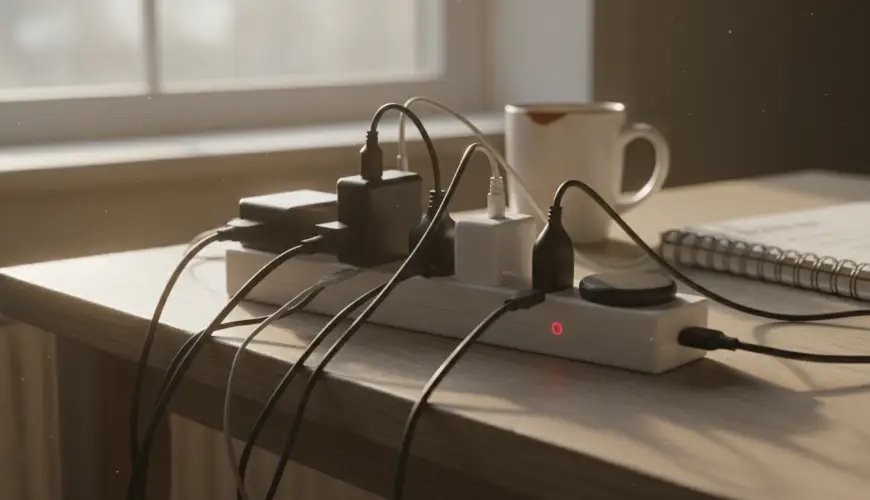
Almost all of us do it. The charger for a phone, tablet, or laptop stays plugged into the socket long after the device is fully charged or disconnected. It seems like a small thing – surely such a tiny plastic brick can't consume any meaningful energy, right? Yet this small oversight, multiplied across millions of households and dozens of devices, forms one of the largest hidden energy leak points in modern homes.
The phenomenon that energy experts call "standby power" – or standby consumption, or more colloquially "vampire energy" – is well documented. According to data from the International Energy Agency (IEA), standby power consumption from electronic devices can account for up to 10% of the total annual electricity consumption in an average household. And chargers are one of the main contributors.
Try our natural products




What is actually happening inside a charger left in the socket?
To be clear – a charger plugged into a socket without a connected device is not "switched off". It is a transformer that continuously converts alternating voltage from the grid (230 V in Europe) into lower direct voltage. Even when there is nothing on the other end of the cable, the charger still draws a certain amount of energy simply to remain "ready". This state is technically referred to as no-load consumption.
The specific values vary depending on the age, quality, and type of charger. Older, less efficient models from the pre-2010 era can consume up to 1–2 watts in standby mode. Modern chargers with Energy Star certification or meeting the European ErP (Energy-related Products) standard are significantly more efficient, with their standby consumption falling below 0.1 watts, and in the best cases even below 0.01 watts. At first glance, a negligible figure – but context matters.
Consider a specific situation: Jana works from home and has a phone charger, a laptop charger, a wireless headphones charger, and a smartwatch charger permanently plugged in her living room. Each consumes an average of 0.3 watts on no-load. Four chargers together therefore draw 1.2 watts continuously – 24 hours a day, 365 days a year. This corresponds to approximately 10.5 kWh per year just for these four seemingly harmless adapters. At the average electricity price in the Czech Republic of around 6 CZK per kWh (according to the Energy Regulatory Office), this works out to about 63 crowns per year – which doesn't sound dramatic in itself – but this is only the beginning of the story.
The problem does not lie with one charger or one household. The average Czech family today has 5 to 10 chargers of various kinds at home, with most of them remaining plugged in even when not in use. If we add other devices in standby mode – televisions, set-top boxes, microwave ovens with glowing displays, routers, printers – the total standby consumption of a household can easily reach 50 to 100 watts continuously. That translates to hundreds of kilowatt-hours and hundreds of crowns per year.
How to measure how much energy your charger actually consumes?
For anyone who wants to find out the exact consumption of their chargers and other devices, the most reliable tool is a wattmeter – a small device that is plugged in between the socket and the appliance and displays the current power draw in watts as well as the total consumption in kWh over time. They sell for a few hundred crowns and represent a very practical investment for a household interested in energy savings.
As a general rule, the older the charger, the higher the likelihood of unnecessary no-load consumption. Large, heavy adapters with ferrite cores (typically older chargers for Nokia phones or older laptops) are among the worst offenders. By contrast, modern compact chargers using GaN (gallium nitride) technology are not only smaller and faster, but also significantly more efficient – their standby consumption is minimal.
An interesting comparison was conducted by the American Lawrence Berkeley National Laboratory, which has been monitoring the standby power consumption of consumer electronics over the long term. Their research shows that the average mobile phone charger consumes approximately 0.26 watts on no-load, while a laptop charger can reach as much as 4.42 watts in standby. These values naturally vary from model to model, but they provide a good framework for estimation.
As energy advisor and journalist Vaclav Novotný once aptly remarked: "The greatest energy savings do not lie in expensive technologies, but in small habits that cost zero crowns." And unplugging chargers from the socket is one of the simplest yet most overlooked habits of all.
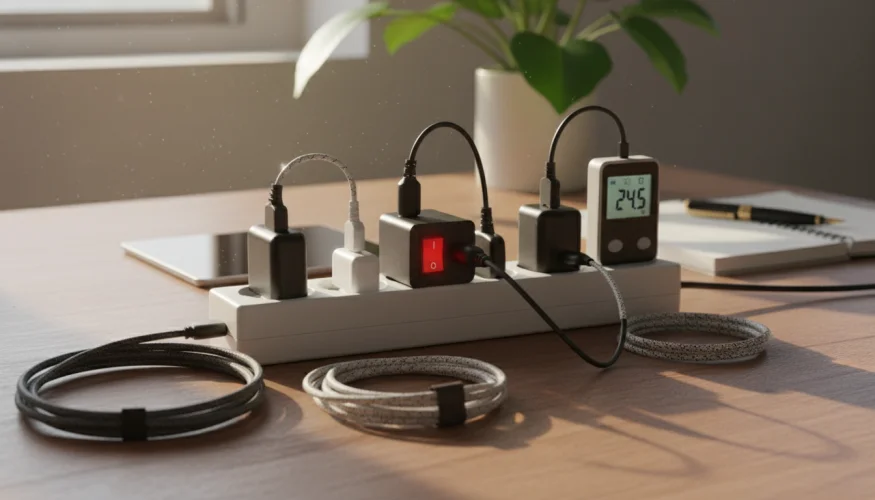
A practical solution for those who do not want to constantly think about what is and isn't plugged in is extension cables with a switch. A single press of a button disconnects an entire group of chargers at once – for example, on a bedside table or at a desk. An even more sophisticated solution is so-called smart sockets, which can be controlled via an app or programmed to switch off automatically at a set time. Such products can be found, for example, in the range of eco-focused online shops like Ferwer, which focuses on practical tools for a sustainable household.
It is also important to mention that the problem of standby consumption is not just about money. Every kilowatt-hour of electricity consumed unnecessarily in the Czech Republic contributes to CO₂ emissions – even at a time when the energy mix is gradually becoming greener. According to data from the Czech Hydrometeorological Institute and Eurostat, emissions associated with electricity generation in the Czech Republic amount to around 400–500 grams of CO₂ per kWh. Those 10.5 kWh per year from Jana's four chargers therefore correspond to approximately 4–5 kilograms of CO₂ – and that is just for the chargers, just for one household.
When these figures are scaled up to the entire Czech population, we arrive at an order of tens of thousands of tonnes of CO₂ per year, generated purely because chargers remain plugged in without purpose. This is not an abstract number – it is a real contribution to the country's emissions balance, one that could be eliminated at virtually no cost and without any reduction in comfort.
It is worth noting that the European Union is aware of this problem and is responding to it through legislation. The EU Ecodesign Regulation (ErP Directive) is progressively tightening requirements for the maximum standby consumption of appliances. Since 2013, chargers sold in the EU must not have a standby consumption exceeding 0.5 watts, and since 2016 an even stricter limit of 0.3 watts has applied. This means that newly purchased chargers are significantly better in this regard than older models – but older adapters continue to live in millions of households and no one automatically replaces them.
It is therefore sensible to occasionally look at the sockets and consider what is plugged into them and why. A charger that has been unused for four years and hangs behind a cupboard "just in case" probably does not need to be permanently connected to the grid. And similarly, a charger by the bed that simply waits through the day – it could be unplugged in the morning and plugged in again in the evening.
A change in behaviour does not have to be radical or uncomfortable. It is enough to establish simple rituals – unplug chargers when leaving home, use an extension cable with a switch at the television, avoid buying new chargers if old ones suffice, and when purchasing new ones, choose certified models with low power draw. These small steps will add up to make a difference on both the electricity bill and the household's ecological footprint.
An environmentally conscious approach to energy does not mean deprivation – it means awareness. Knowing what consumes energy, when and why, is the first step towards a more efficiently running household. And chargers left plugged in for no reason are an excellent example of how small, invisible consumption adds up to a large and unnecessary expense – both in energy and financial terms. The sooner we recognise this principle, the more easily we will be able to treat energy as a valuable resource that deserves to be handled with care.