

# Why Ankle Mobility Affects Your Knees and Back
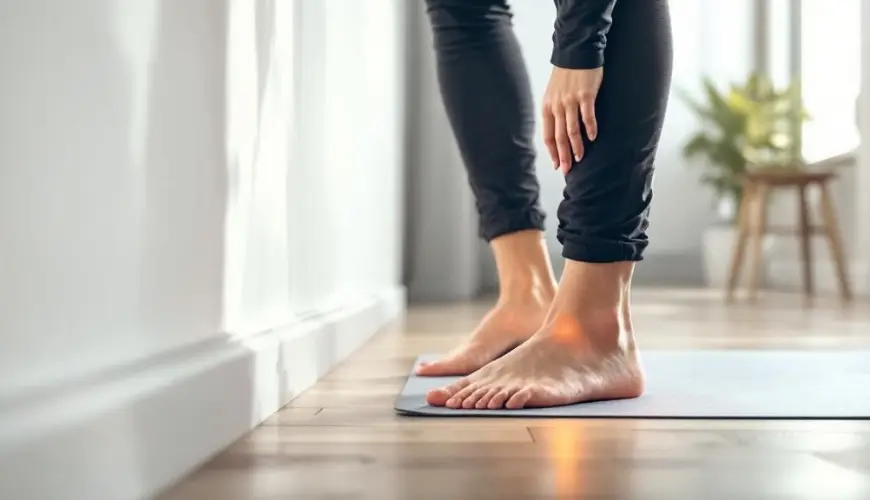
Ankles are one of the most overlooked joints in the human body. Yet it is their mobility that determines how well we walk, run, squat, or stand on one leg. When the ankle functions properly, the entire body moves efficiently and without unnecessary strain. But when ankle mobility is lacking, the body begins to find compensatory solutions – and these typically lead to pain in the knees, hips, or back.
Many people try to improve their squat by working on thigh strength or hip mobility, while completely overlooking that the problem lies one level lower. Limited dorsiflexion of the ankle – that is, the ability to pull the toes toward the shin – is one of the most common reasons why heels rise off the ground during a squat, why the torso leans excessively forward, or why the knees collapse inward. This is not merely an aesthetic problem during exercise. It is a functional deficit that manifests in everyday movement.
Try our natural products




Why ankle mobility matters so much
Imagine a simple situation: you get out of bed in the morning, walk down the stairs, or get into a car. Each of these movements requires a certain degree of ankle flexibility. If you lack it, the body will manage somehow, but at the cost of compensations that accumulate over time in the form of overloaded muscles and joints. Physiotherapists describe this as a domino effect – one stiff joint triggers a chain of dysfunctions throughout the entire musculoskeletal system.
According to experts in movement medicine, ankle dorsiflexion is crucial not only for athletic performance but also for injury prevention. Research published in the Journal of Orthopaedic & Sports Physical Therapy repeatedly shows that limited ankle mobility is directly associated with a higher risk of sprains, heel pain (plantar fasciitis), and Achilles tendon overload. In other words, investing in ankle mobility pays off on many fronts at once.
Modern lifestyles are not particularly conducive to ankle mobility. Long hours of sitting shorten the calf muscles, inappropriate footwear with high heels or overly rigid soles restricts the natural movement of the foot and joint. The result is ankles that can bear the body's weight but move within a narrowly limited range. And that is precisely the moment when it is time to start working on them.
Before you begin exercising, however, it is important to know exactly where you stand. There are several simple tests that will show you how your ankles are doing – and which also serve as a starting point for tracking progress.
5 tests and exercises for better ankle mobility
The wall ankle test is a classic way to measure the range of dorsiflexion. Stand sideways next to a wall, place your big toe approximately 10 centimetres from it, and try to touch the wall with your knee without lifting your heel off the floor. If you manage it, move your toe further away. If not, shorten the distance. The resulting distance of your toe from the wall at which your knee can still reach the wall tells you everything you need to know. Less than 9 centimetres indicates significant limitation, which is likely manifesting in everyday movement as well.
The second test is even simpler and requires no equipment. It involves a deep squat. Stand with feet shoulder-width apart, toes slightly turned out, and slowly try to get into as deep a squat as possible with your heels firmly on the ground. If you cannot do this without your heels rising or your torso leaning excessively forward, ankle mobility is likely one of the limiting factors. This test is popular among physiotherapists and trainers alike, as it reveals functional deficits in real movement – not just on paper.
The third test is heel walking. Try to walk a few steps on your heels only, with your toes raised as high as possible. This sounds simple, but for many people with stiff ankles it is a surprisingly demanding task. This test also engages the front of the lower leg – the tibialis anterior muscle – whose weakness often accompanies limited dorsiflexion.
The fourth test focuses on symmetry. Perform the wall ankle test for each leg separately and compare the results. An asymmetry of more than 1–2 centimetres between the right and left foot may indicate unilateral overloading or an old injury that has not yet been fully rehabilitated. The body compensates for asymmetries, and if it does so over a long period, it creates structural imbalances.
The fifth test is single-leg standing with a slight forward lean. Stand on one leg, slightly bend the other, and slowly lean your torso forward – as if you were trying to reach the toes of your standing leg. Observe whether the knee of the standing leg follows the direction of the toes, or whether it collapses inward. If the knee falls inward, the ankle likely lacks sufficient range of motion, and the body compensates through rotation at the knee – which is precisely the mechanism that leads to injuries.
Now comes the more interesting part – what to do about it. Each of the tests described above can also be used as an exercise. Regularly repeating the wall ankle test with gradually increasing distance from the wall is itself an effective mobilisation exercise. Similarly, a deep squat with support (for example, holding onto a door frame) helps the ankle learn to work through a greater range of motion under controlled load.
In addition to these functional exercises, there are also specific exercises targeting the release of structures limiting ankle mobility. Calf stretching in a lunge position is among the most effective. Step into a lunge position, rear leg extended, front leg bent. Slowly shift your weight forward so that the front knee extends beyond the toes – the heel must remain on the ground. You will feel a pull in the calf of the rear leg. Hold for 30–60 seconds and repeat three times on each side. This exercise stretches the gastrocnemius – the large superficial calf muscle that is shortened in most people.
To release the deeper layer – the soleus muscle – a modification is needed: slightly bend the rear knee. The soleus passes through the knee joint differently than the gastrocnemius, and therefore responds to a different angle of stretching. The soleus plays a key role in dorsiflexion during walking and squatting, so releasing it is often crucial for improving ankle mobility.
Ankle mobilisation with a resistance band is also a very effective method. Tie a resistance band around the ankle (or use a sturdy strap), and attach the other end low to a fixed support. Stand so that the band pulls the ankle slightly backward, and perform movements with the knee forward over the toes. The band creates traction in the joint and helps release the joint capsule – a structure that becomes shortened after injuries or prolonged inactivity and restricts movement mechanically, not just muscularly. This technique is used by physiotherapists as part of so-called IASTM and manual therapy, and research confirms its effectiveness in improving range of motion.
How long does it take for ankle mobility to genuinely improve? That depends on the cause of the limitation. If the primary issue is shortened muscles, regular stretching will produce results relatively quickly – on the order of weeks. However, if the problem lies in the joint capsule or scarring from an old injury, it may take longer, and working with a physiotherapist is often appropriate. As a general guideline, consistent work of 10–15 minutes per day over 6–8 weeks produces measurable improvement in most people.
One example to illustrate: Jana, a 34-year-old accountant and recreational runner, had long struggled with knee pain while running. After visiting a physiotherapist, she discovered that the cause was not the knee itself, but limited dorsiflexion of the left ankle following a forgotten sprain from her youth. After eight weeks of targeted ankle mobility work – the wall ankle test, soleus stretching, and band mobilisation – the knee pain subsided, without ever directly addressing the knee.
As physiotherapist and movement medicine populariser Kelly Starrett said: "Movement is medicine, but only when the body knows how to perform it correctly." And correct performance begins at the foundation – at the ankles, which bear the weight of the entire body with every step.
What to do for long-term results
Improving ankle mobility is not a one-time affair. It is more of an ongoing practice, similar to dental care or regular exercise in general. The key is to incorporate mobilisation exercises into your daily routine – ideally in the morning after waking up or as part of a warm-up before sport.
Footwear choice also plays an important role. Minimalist footwear or barefoot shoes support the natural movement of the ankle and strengthen the small muscles of the foot that are barely used in conventional rigid footwear. The transition to such footwear should be gradual – an abrupt change after years of wearing rigid shoes can lead to overloading of the Achilles tendon or plantar fascia. But as a long-term goal, moving as naturally as possible makes sense.
Just as important as stretching is strengthening the muscles around the ankle. Toe raises, single-leg calf raises, or resistance band exercises in various directions of movement build strength that stabilises the joint and protects it from injury. Mobility without strength is not safe – a mobile but unstable joint is vulnerable.
Ankles are the unsung heroes of every movement. They do not hurt – until we begin to overload them. They do not attract attention – until they start complicating our squat, walking, or running. And that is precisely why they deserve a little more care than most of us give them. The five simple tests and exercises described above are a good starting point – and the results will soon be felt not only on the exercise mat, but also on the staircase, on a walk, or when getting up from a chair every day.