
# Single-Leg Deadlift Exercise for Stability and Strength
There are exercises that look simple but reveal weaknesses you never knew you had on the first attempt. The single-leg deadlift is precisely such an exercise – a movement widely used by physiotherapists, athletic coaches, and functional training enthusiasts around the world. At first glance, it seems straightforward: you stand on one leg, lean forward, and return to an upright position. In reality, however, this exercise engages dozens of muscles simultaneously, demands balance, coordination, and posterior chain strength, while also exposing asymmetries that would otherwise remain hidden beneath the surface.
At a time when most people spend long hours sitting at a computer, stability issues and unilateral muscle imbalances are becoming increasingly common. Lower back pain, unstable knees, or a tendency to sprain an ankle – all of these can stem from the body learning to compensate for weaknesses on one side with the strength of the other. The single-leg deadlift eliminates these compensations, forcing each side of the body to work independently and honestly.
Try our natural products





Why is unilateral movement so important?
Most classic strength exercises – such as squats, conventional deadlifts, or leg presses – work both legs simultaneously. While this is effective for building overall strength, it carries one significant drawback: the dominant side of the body naturally takes on a greater share of the load. The result is a gradually deepening imbalance that can lead to joint overload or injury during sudden movements in everyday life.
Unilateral exercises, such as the single-leg deadlift, disrupt this dynamic. Each leg must bear the body's weight and any additional load independently, with no opportunity to "hide" behind the stronger side. Research published in sources such as the Journal of Strength and Conditioning Research has repeatedly shown that incorporating unilateral exercises into a training programme significantly reduces injury risk and improves athletic performance across a wide range of disciplines – from running and ball sports to martial arts.
It's not just about sport, either. Think about everyday situations: getting up from the floor, picking objects up, climbing stairs, or carrying a shopping bag. All of these movements require the ability to stabilise the body on one leg and transfer force through the entire kinetic chain. The single-leg deadlift not only strengthens these patterns but directly trains them.
The exercise has another less frequently mentioned benefit: it significantly activates the deep spinal stabilising muscles. While the superficial back muscles are easily visible and measurable, the deep stabilisers work quietly in the background, maintaining spinal integrity with every movement. It is precisely their weakening that underlies many of the chronic back problems that plague modern people.
How to perform the exercise correctly
Correct execution of the single-leg deadlift is crucial – not only for maximum effect, but above all for safety. Poor technique can strain the lumbosacral region or overload the knee, and that is exactly what we want to avoid.
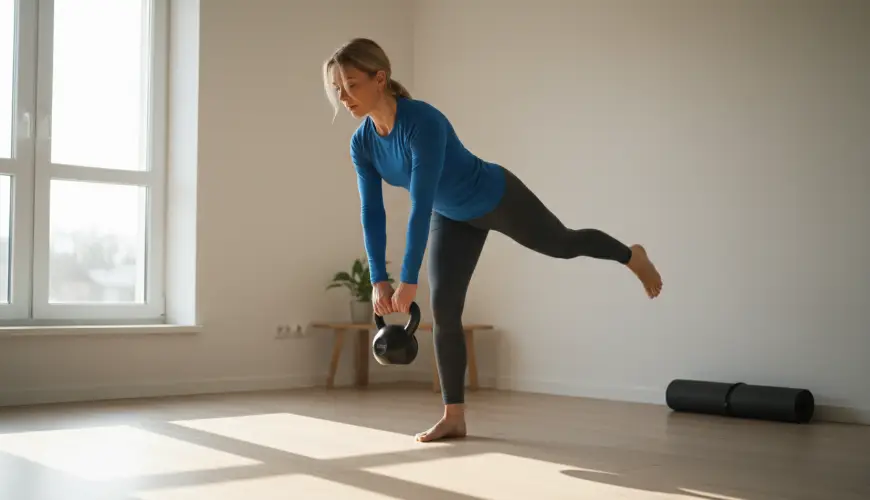
The starting position is as follows: stand upright with your weight evenly distributed across both feet, shoulders pulled down and back, and your spine in a neutral position. Then shift your weight onto one leg – let's say the right – and slightly release the other. Take a deep breath, brace your core, and begin to hinge forward at the hips, not the waist. The left leg rises behind the body as a counterbalance, with the torso and left leg forming an approximately straight line parallel to the floor. Your gaze is directed slightly ahead of you towards the ground – neither straight down nor straight forward. At the lowest point of the movement, pause, exhale, and return to the starting position in a slow, controlled manner, actively pressing through the heel of the standing leg.
Imagine Markéta, a thirty-year-old accountant who sits at a computer all day and attends a group fitness class once a week. After reading an article about functional training, she decided to incorporate the single-leg deadlift into her morning workout. Her first attempts were shaky – her body swayed, her standing leg trembled, and she felt as though she might fall. After three weeks of regular practice, however, she found that her balance during everyday movements had improved significantly and the chronic lower back pain that had troubled her for years had subsided. Her story is not exceptional – on the contrary, it is very typical of people who discover this exercise and stick with it.
When performing the exercise, it is worth watching out for several common mistakes. Rounding the spine is probably the most widespread problem – it occurs when a person hinges forward at the hips without sufficiently bracing the core. Equally problematic is rotating the pelvis to the side, where the hip of the raised leg lifts upward instead of remaining parallel to the floor. Finally, there is the issue of moving too quickly – the single-leg deadlift is an exercise that rewards slowness and control, not speed and momentum.
As for load, beginners should first master the exercise using their own bodyweight. Only then does it make sense to add a weight plate, kettlebell, or dumbbell. A particular variation involves holding a weight in the hand on the same side as the raised leg – this version engages the trunk stabilisers even more and is popular among advanced practitioners.
The muscles the exercise engages, and how to incorporate it into training
The single-leg deadlift is by nature a complex movement that engages the entire posterior chain. The primary muscles at work are the hamstrings – the muscles at the back of the thigh – and the gluteus maximus. These two muscle groups are chronically weakened and shortened in modern society, as sitting keeps them in a passive position for hours on end. The single-leg deadlift is therefore one of the most effective ways to wake them up and strengthen them through their natural range of motion.
Secondary muscles engaged include the adductors of the thigh, the calf muscles, the spinal erectors, and – as already mentioned – the deep core stabilisers. The ankle and foot of the standing leg function as the active foundation of the entire structure, and their stability determines the quality of the entire movement. It is therefore no surprise that physiotherapists make extensive use of this exercise in rehabilitation following ankle or knee injuries.
So how should the exercise be incorporated into a training programme? It depends on the goal. For strength and muscle mass development, three to four sets of six to eight repetitions with adequate load are effective, with longer rest periods between sets – two to three minutes. For improving stability and coordination, it is better to work with bodyweight or light load, but with a higher number of repetitions – ten to fifteen – and shorter rest periods. In both cases, the exercise is best placed at the beginning of a training session, when the muscles are still fresh and the nervous system is fully focused, as the coordinative demands of the movement require complete attention.
As leading functional trainer Gray Cook – whose Functional Movement Screen (FMS) system is used by athletes and physiotherapists worldwide – once noted: "Don't add strength to dysfunction." In other words, first learn the movement correctly, then add load. This principle applies doubly to the single-leg deadlift.
For athletes involved in running, cycling, or ball sports, the exercise is a natural training complement, as it directly strengthens the movement patterns specific to these activities. Running is essentially a series of single-leg hops, and each of those hops requires precisely the combination of strength, stability, and coordination that the single-leg deadlift trains. It is therefore no coincidence that it features in the preparation of footballers, basketball players, and skiers, among others.
For older adults, the exercise is particularly valuable from a fall prevention perspective. The World Health Organization states that falls are one of the leading causes of injury in people over 65, with a large proportion resulting from weakened balance and muscular coordination. Regular exercise focused on stability – and the single-leg deadlift is one of the most effective such exercises – can significantly reduce this risk.
An interesting option is also the eyes-closed variation, which places even greater demands on proprioception – the body's ability to sense its position in space without visual feedback. This version is more challenging and belongs more in the repertoire of advanced practitioners, but the results are remarkable: after several weeks of training, proprioceptive abilities improve significantly, manifesting in better responses to uneven terrain, sudden changes of direction, or unexpected losses of balance.
The single-leg deadlift is one of those exercises that combines seemingly contradictory qualities – simplicity of execution and depth of effect. It requires no expensive equipment or access to a gym. All that is needed is sufficient space, a solid floor, and a willingness to pay attention to every detail of the movement. And that is precisely where its true value lies: it teaches the body and mind to work as a whole, with focus and awareness of every moment of movement. That is a quality that transfers into everyday life far more readily than one might expect.