

Caramelized onion as the base of five different dishes
There are ingredients that chefs around the world consider absolute kitchen staples – and caramelized onions undoubtedly belong among them. The brown, glossy, incredibly fragrant mass that forms from ordinary kitchen onions after long, patient cooking over low heat has the ability to transform even the simplest dish into something worth remembering. Yet many home cooks overlook it or avoid it, thinking the preparation is too time-consuming or complicated. In reality, it is one of the simplest and most versatile staples you can have on hand in the kitchen.
The entire magic of caramelization lies in a chemical process in which the natural sugars contained in onions break down and transform under heat. The result is a deep, complex sweetness complemented by a slightly bitter note and intense umami. According to the science-focused culinary portal Serious Eats, which has long devoted itself to the chemistry of cooking, the key to truly good caramelized onions is time – at least thirty to forty minutes over medium-low heat, with occasional stirring and patience. No shortcuts pay off, and anyone who has ever rushed and turned up the heat knows all too well that the result is burnt rather than caramelized onions. It is precisely the slow process that transforms ordinary vegetables into a cornerstone of world cuisine.
Interestingly, caramelized onions appear in various forms across world cuisines – from French onion soup to Alsatian tarte flambée, through Middle Eastern moussaka or Indian biryani. This alone speaks to how universal this ingredient is. And that is precisely why it makes sense to prepare it in larger quantities at once – it keeps in the refrigerator for up to five days and in frozen form for several months – and then draw on it as a reserve of flavor when cooking various dishes throughout the entire week.
Try our natural products





Five dishes that caramelized onions will elevate to a new level
Let us imagine a specific situation: it is a Sunday afternoon and a large pan full of sliced onions is slowly bubbling on the stove. The house smells like a bistro. An hour later it is done – golden brown, silky soft, sweet and deep. What to do with it all? The answer is surprisingly rich.
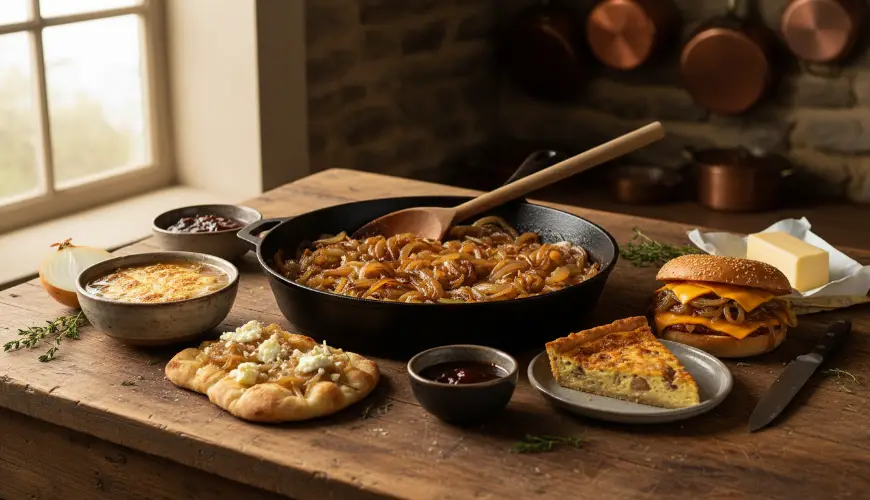
French onion soup is perhaps the most classic example of how caramelized onions can be the centerpiece of an entire dish. Simply cover them with quality beef or vegetable stock, add a little dry white wine or cognac, season with thyme and a bay leaf, and let everything simmer. A toasted slice of bread and a generous layer of grated Gruyère cheese, broiled until golden, are then added to the bowl. The result is a dish that is simultaneously humble and celebratory – and without caramelized onions, it simply would not exist. This recipe, whose roots reach back to 18th-century France, is living proof of how a simple ingredient can carry an entire dish.
By contrast, pizza or flatbread with caramelized onions shows how wonderfully this ingredient works as a substitute for traditional tomato sauce. Thin dough brushed with a little olive oil, topped with a layer of caramelized onions, pieces of goat cheese or gorgonzola, fresh rosemary, and perhaps a few slices of pear or fig – and the result is a combination that is surprisingly elegant, even though the preparation takes just a short while. This is where caramelized onions truly show themselves as a staple in the fullest sense: they carry the flavor, bring sweetness, and hold the entire dish together.
Another option is a quiche or savory tart, where caramelized onions form one of the key elements of the filling. Mixed with eggs, cream, and cheese, they create a filling full of depth that is suitable for a Sunday lunch, a picnic, or as a cold dish the next day. Quiche with caramelized onions and bacon is a classic of French cuisine, but a vegetarian version with goat cheese and spinach works equally well. The important thing is that the onions do not fade into the background in such a tart – on the contrary, their sweetness permeates the entire filling and gives the dish character.
A less obvious but all the more interesting option is to use caramelized onions as a base sauce for meat or pasta. Blended or simply roughly mashed, complemented with balsamic vinegar, a little butter, and stock, they transform into a rich sauce suitable for steak, chicken thighs, or even gnocchi. Such a sauce needs no thickeners or complicated procedures – the onions themselves provide sufficient consistency and flavor. Chef Yotam Ottolenghi, whose approach to vegetables as the star of a dish has gained worldwide recognition, writes about similar techniques in his books and repeatedly emphasizes that patience when cooking vegetables is an investment that always pays off.
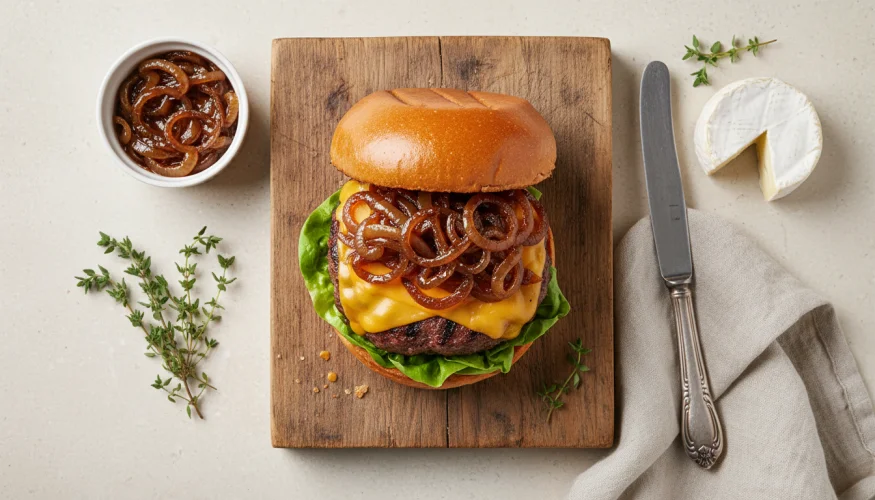
And finally, perhaps the most surprising of the five options: caramelized onions as part of a sandwich or burger. This use is particularly widespread in American and British cuisine, where caramelized onions have become an almost obligatory component of premium burgers. But they work equally well in a simple sandwich with smoked meat, cheddar, or brie. Their sweetness balances the saltiness of the meat and cheese, while the soft texture creates a pleasant contrast with the crispy bread. It is no wonder that caramelized onions have become a symbol of what distinguishes a homemade burger from an average fast food offering.
How to prepare a supply of caramelized onions that will last the whole week
The entire idea stands or falls on whether a person actually has caramelized onions prepared and ready. And that is precisely why it is worth changing your approach and starting to view them not as a component of a specific recipe, but as a basic ingredient, similar to stock or pesto sauce – something that is prepared once and then serves you throughout the entire week.
The process is simple: slice a large onion (ideally yellow, which is naturally sweeter) into thin half-rings. Place a tablespoon of butter and a tablespoon of olive oil in a pan, add the onion, a pinch of salt, and leave it over medium-low heat. Stir every five to ten minutes, do not let it dry out, and add a tablespoon of water or stock if needed. After thirty to forty minutes, it should be dark golden brown, soft, and smell of caramel. Some cooks add a tablespoon of balsamic vinegar or brown sugar at the end for even greater depth – that is a matter of personal taste.
Onions prepared this way can be stored in a glass jar in the refrigerator, where they will keep without any problem for four to five days. If there is a larger quantity, they can be frozen in smaller portions – silicone ice cube trays are ideal for this, as they allow you to remove exactly as much as needed. Anyone who has tried this approach has appreciated it: having a supply of caramelized onions on hand means always having an immediate way to elevate any dish.
This is precisely where it becomes clear how closely good cooking is connected to planning. It is not about complex techniques or expensive ingredients – it is about having the basics prepared. Caramelized onions are an exemplary case in this regard: they are inexpensive, readily available, and yet capable of transforming an ordinary evening in the kitchen into something the whole family looks forward to.
People interested in sustainable cooking and minimizing food waste will also appreciate that onions are among the longest-storing vegetables, and that caramelization makes use of those that are starting to get a little soft and would not be ideal in a salad. Preparing caramelized onions in larger quantities is therefore not only practical from a flavor standpoint, but also from the perspective of a sustainable approach to food – nothing is thrown away, everything is put to use.
Whether one opts for an elegant French soup, a rustic flatbread, or a quick sandwich for dinner, caramelized onions always bring what modern hurried cooking most often lacks: depth, character, and the feeling that the food was truly cooked with care. And that is precisely the reason why experienced cooks never let them be absent from their refrigerator.