

Slow parenting as a rescue from burnout
Every parent knows it. Monday morning starts in chaos – children refuse to get up, there's no time for breakfast, the after-school club starts in twenty minutes, and you still haven't found the car keys. Then Tuesday comes, Wednesday, Thursday – every day filled with the same rush, noise, and feeling that you can't keep up. You are not alone. Parental burnout has in recent years become a topic discussed by psychologists, paediatricians, and parents themselves who dare to admit they are exhausted. And it is precisely this condition that the philosophy known as slow parenting responds to.
This is not a passing trend or a nostalgic return to the past. Slow parenting is a conscious approach to raising children that emphasises the quality of time spent together, natural play, and space for both the child and the parent. At a time when children are overwhelmed with after-school activities, parents are overburdened with work responsibilities, and entire families live in a constant state of acceleration, this philosophy offers something precious – permission to slow down.
Try our natural products






What exactly is parental burnout and why is it so widespread?
Experts in the field of psychology, including Belgian researcher Moira Mikolajczak, who studies parental burnout systematically, describe this condition as chronic exhaustion caused by an overload of parental responsibilities. This is not merely fatigue after a demanding day. It is a deep sense of emptiness, emotional detachment from one's own children, and a loss of meaning in the parental role – and these are symptoms that many parents carry within themselves for years without being able to name them.
Modern parenthood has brought, alongside its advantages, enormous pressure. Social media displays perfect families with organic snacks, creative activities, and smiling children in neatly ironed clothes. Research repeatedly shows that comparing oneself to other parents on social media significantly contributes to feelings of inadequacy and stress. Add to this the culture of overflowing schedules, where a child's worth seems to depend on the number of activities they attend, and you have a recipe for the systematic exhaustion of the entire family.
It is no wonder that parents are looking for an alternative. And slow parenting offers one – not as a perfect system with a manual, but as an attitude towards life.
What does this look like in practice? Take the example of a family from Brno, where a mother of two children aged six and nine works full-time and the father travels for work. Every day was a logistical puzzle – a morning English class, afternoon football training, evening tutoring. Weekends turned into a marathon of activities that left everyone exhausted. They eventually decided to experiment: for three months, they cancelled half of the activities and left free afternoons truly free. The result? The children started playing outside, inventing their own games, and reading books of their own accord. And for the first time in a long while, the parents experienced a weekend afternoon with nowhere to rush.
How slow parenting works in everyday life
The philosophy of slow parenting is not built on prohibitions or strict rules. Its core is conscious presence – being with your child truly here and now, not merely physically present while thinking about work emails or a shopping list. Psychologist Carl Honoré, author of In Praise of Slow, which was at the origin of the entire slow living movement, says: "Fast isn't always best. Sometimes the quickest way to reach your goal is to slow down." And this idea applies doubly to parenting.
Slow parenting in practice means, for example, that instead of organised activities, children are given space for free play. Research by the American Academy of Pediatrics clearly shows that free play is absolutely essential for a child's healthy development – it develops creativity, social skills, problem-solving ability, and resilience to stress. Yet in a world of packed schedules, free play is becoming increasingly rare.
Another pillar is accepting imperfection – both in the child and in oneself as a parent. Slow parenting rejects the pressure for performance and perfection that is so strongly present in contemporary child-rearing. A child does not need to be the best in the class, the fastest on the pitch, or the most creative at art club. They need space to be themselves – and this includes boredom, failure, and disappointment, which are a natural part of childhood and key experiences for future life.
Slow parenting also places great emphasis on time spent in nature. Experts speak of the phenomenon known as "nature deficit disorder" – a condition in which children spend most of their time indoors, in front of screens or in organised activities, and lose their natural connection with the outdoor environment. Contact with nature demonstrably reduces stress, improves concentration, and supports both physical and mental health – and this applies equally to children and adults.
Closely related to this is the topic of sustainability and conscious consumption, which slow parenting naturally encompasses. Families who slow down and reassess their priorities often find that they do not need as many things – toys, clothes, gadgets – and begin to prefer quality over quantity. Instead of ten plastic toys, they buy two carefully chosen ones that genuinely bring the child joy and are produced with consideration for the environment. This shift in thinking then naturally permeates the family's entire lifestyle.
Practically speaking, transitioning to slow parenting does not have to mean a dramatic overnight change. It is enough to start with small steps – one free afternoon a week without planned activities, one meal a day at a shared table without phones, one walk in the forest instead of driving to an after-school club. These seemingly small changes have, taken together, a huge impact on the wellbeing of the entire family.
An important part of slow parenting is also listening to your child – truly listening, not merely waiting for the child to finish speaking so you can tell them what to do. Children who have space to express their feelings and needs grow into more confident and emotionally resilient adults. And parents who allow themselves to listen draw closer to their children in a way that no club or activity can replace.
It is interesting how slow parenting resonates with traditional approaches to child-rearing that once functioned entirely naturally. Our grandparents' generation had no concept of "enriching activities for children" – children simply played outside, helped around the house, got bored, and used their imagination. And yet they grew into people capable of independent thought and decision-making. This is not about idealising the past, but about a reminder that a child does not need constant stimulation and organisation for healthy development – they need time, space, and a present parent.
Slow parenting does not mean that parents abandon ambitions or their children's education. It is more about reassessing what truly contributes to a child's development and what is merely a response to social pressure. Clubs and activities have their place – but only when the child genuinely wants them and enjoys them, not when they are a tool for fulfilling parental expectations or a means of easing one's own conscience.
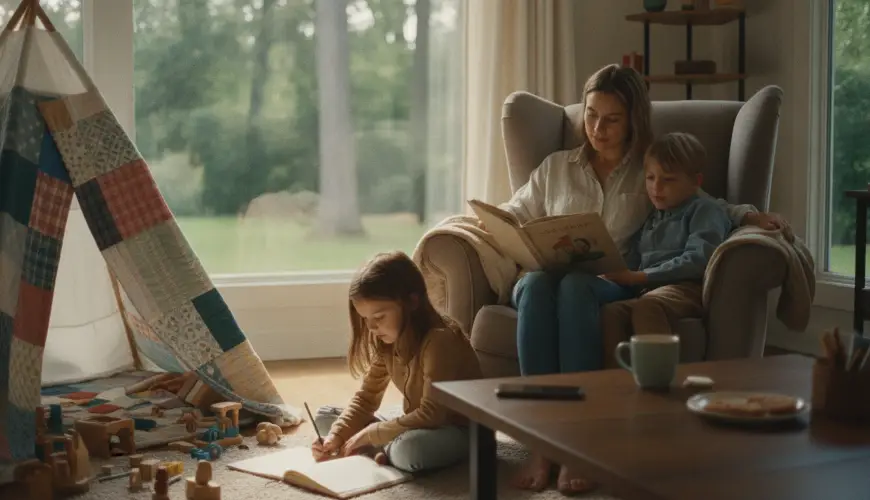
For parents who find themselves on the verge of burnout, slow parenting can also be a path to rediscovering the joy of parenthood. Burnout very often stems not from the fact that parenting is hard – it is – but from the fact that parents strive to meet unrealistic expectations while losing touch with what is truly beautiful about parenthood. And what is beautiful is precisely those quiet, unassuming moments: a child laughing while baking bread together, an afternoon reading on the sofa, a walk through an autumn forest with nowhere to rush.
Slowing down in parenthood requires courage – the courage to say no to another activity, the courage to ignore neighbours' advice about everything your child should be able to do, the courage to accept that a good parent is not the most organised one, but the most present one. And perhaps that is the hardest step of all: to believe that less can truly be more – fewer activities, less rushing, less pressure, and more real life lived together.