
# How to Manage Cleaning with Small Children at Home Without Stress Cleaning with small children at
Every parent knows that moment. You've just tidied the living room, turned away for five minutes to go to the kitchen, and come back to find toys scattered across the entire floor, juice splashed on the carpet, and a tower of pillows collapsing over the laundry you just folded. Keeping a tidy home with small children is one of the greatest everyday challenges of family life – and yet it's a topic that rarely gets enough attention. Most advice about home organisation assumes ideal conditions that simply don't exist when you have toddlers and preschoolers around.
The good news is that there are ways to make cleaning easier, more sustainable, and even more enjoyable – without it turning into an all-day ordeal or a source of family conflict. The key isn't perfection, but smart organisation and realistic expectations.
Try our natural products


Why the Traditional Approach to Cleaning with Children Is Doomed to Fail
Most adults grew up with the idea that cleaning is a one-off, comprehensive activity – the big Saturday clean, after which the house gleams. This model may have worked back when there were no children in the household. But as soon as small family members are added to the equation, the whole system collapses like a house of cards. Children live in the present moment, they have no qualms about leaving chaos in their wake, and their natural curiosity means that every stored item is a potential toy or material to explore.
Psychologist and author on family dynamics Becky Kennedy points out that parents who try to maintain a perfectly clean home with small children are unconsciously setting the bar in a way that leads to chronic exhaustion and a sense of failure. It's not about giving up on tidiness entirely – it's about reconsidering what tidiness actually means at this particular stage of life.
The practical consequence of this shift in thinking is that instead of one big clean once a week, it is far more effective to switch to a system of small, regular cleaning rituals spread throughout the day. Five minutes in the morning, a moment after lunch, a quick tidy before bed – these mini-intervals prevent mess from accumulating to unmanageable proportions, while not consuming an entire morning or afternoon.
Another fundamental shift in mindset is accepting the fact that with small children at home, there will always be a certain baseline level of mess. This is not failure. It is a normal reflection of the fact that living, active, and curious beings inhabit the house. The goal is not a sterile environment, but a functional and acceptably organised home in which the whole family feels comfortable.
Involving Children in Cleaning – Utopia or a Real Possibility?
One of the most frequently discussed questions among parents is whether and how to involve small children in the actual cleaning. The answer is clear: yes, children can and indeed should be involved – but with appropriate expectations and the right approach.
Research shows that children who participate in household chores from an early age develop a sense of responsibility, independence, and self-confidence. According to a study published by the University of Minnesota, children who regularly help around the house are more successful in adulthood and better able to cooperate with others. So it's not just about having a helper – it's about genuine educational value.
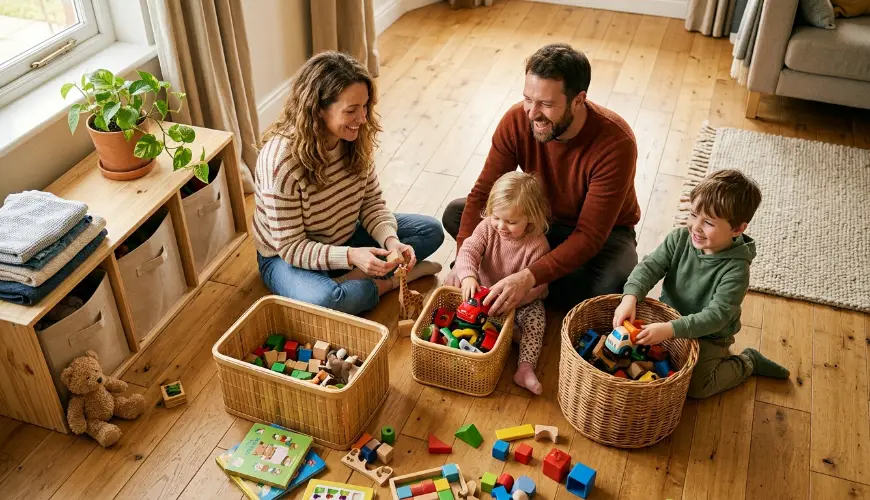
How does this work in practice? Take the example of a family from Brno, where the mother of two children aged three and five introduced a simple system of coloured baskets. Each child has their own basket, and every evening before bath time, their task is to collect their toys from the living room into it. At first it was chaos – the older child collected things conscientiously, while the younger one mostly just moved toys from place to place. After a few weeks, however, the routine took hold, and the evening "collecting into the basket" became a natural part of the day that the children now even remind each other about.
The key to success is making cleaning a game or a ritual, not an obligation. A timer that turns tidying up into a race against the clock can transform putting away toys into an exciting competition. Singing songs while sweeping, a contest over who can fold the most items of laundry, or a sticker reward system – these are all tools that work because they respect the way children naturally function.
It is important, however, not to forget about age-appropriateness. A three-year-old can manage to put toys into a box or carry their plate to the sink. A five-year-old can dust low shelves, help fold towels, or water plants. Children aged seven and above are capable of handling more complex tasks, such as vacuuming or wiping down the table. Assigning tasks appropriate to the child's age and abilities is a fundamental prerequisite for making cooperation during cleaning work, and for preventing it from becoming a source of frustration on both sides.
Smart Home Organisation as the Foundation of Stress-Free Cleaning
Alongside involving children and changing the approach to cleaning itself, the physical organisation of the home also plays a crucial role. A well-organised space is easier, quicker, and less effortful to clean – and this is doubly true in families with small children.
One of the most effective principles is minimisation. The fewer things there are in the home, the fewer things can be in a mess. This doesn't mean children should have a minimum of toys – but toy rotation is a brilliant way to keep chaos under control. Some toys are stored away in a cupboard or storage room and swapped after a few weeks with those that have been in active use. Children always have an appropriate amount of stimulation, and they also look forward to the "new" toys that are in fact simply the ones that were put away.
Another key element is making storage spaces accessible to children themselves. If a child is to put away their toys, they need somewhere to put them. Low shelves, open boxes, hanging organisers, or simple baskets – these are all solutions that enable children to tidy up independently without adult help. Investing in eco-friendly storage solutions made from natural materials, such as rattan baskets or bamboo organisers, is not only functional but also aesthetically pleasing and environmentally friendly.
The principle of "everything has its place" is quite literally golden in families with children. If every item has a clearly defined place where it belongs, it is much easier to return it there – and to teach children to do the same. This principle works best when the places for things are intuitive and logical: toys in the living room, books on the shelf in the children's room, shoes in the rack by the door. No complex systems, no categories that nobody remembers.
A very practical tip is also the so-called "lost things basket" – a large basket or box placed in a central location in the home, into which items left in the wrong place are deposited. Once every day or two, the basket is sorted through and things are returned to their proper places. This system prevents the minor displacement of items from becoming a source of daily arguments and searching.
When choosing cleaning products, it is worth noting that in a household with small children it is advisable to favour eco-friendly and non-toxic alternatives. Children are closer to floors, touch surfaces more frequently, and tend to put things in their mouths – aggressive chemical cleaning products therefore pose a greater risk to them than to adults. Vinegar, bicarbonate of soda, or certified eco-friendly cleaning preparations are equally effective for everyday cleaning, while being safer for the whole family and for the environment.
Care for the parents themselves is also enormously important. As an old saying goes: "You can't pour from an empty vessel." An exhausted parent trying to maintain perfect order at the expense of sleep and rest is neither a good role model nor an effective household manager. Accepting help from a partner, grandparents, or friends, dividing household tasks fairly, and lowering standards when necessary – these are all legitimate and healthy decisions.
Planning cleaning around the rhythm of children's days is another practical step. The most productive time for more substantial cleaning is generally when children are asleep – whether during toddlers' afternoon naps or in the evening hours after the children have been put to bed. Morning hours, when children are full of energy, are better suited to quick maintenance tasks rather than a thorough clean.
Technology can also be an ally in this context. Home management apps, shared to-do lists, or simple weekly plans pinned to the fridge help the whole family keep track of what needs to be done, who is responsible for what, and what has already been completed. Visual planning works brilliantly for older children too, giving them a clear picture of their responsibilities without the need for constant reminders from parents.
Finally, perhaps the most important thing of all is perspective. The years when children are small and the home is full of their presence – the noise, the laughter, the toys, and the occasional chaos – are incredibly short. Research in positive psychology repeatedly shows that people look back on these periods in later life with nostalgia, not with regret over the fact that the floor wasn't always perfectly swept. Managing cleaning with small children at home doesn't mean always having a perfectly clean house. It means finding a system that works for your particular family, involving children in it in an appropriate way, and maintaining your composure and joy in everyday family life throughout.