
How to Naturally Teach Children About Nature When You Have Little Time and Live in the City
Children and nature naturally go hand in hand – yet in practice, they are often separated by haste, screens, safety concerns, and the feeling that "there's nowhere to go outside anymore." However, teaching children to connect with nature doesn't have to be another task on the calendar or a project requiring special equipment. Often, it's more about what a typical day looks like: the route home, what happens along the way, whether there's room for questions, and whether adults allow nature to be a little unkempt, wet, muddy – in short, real. And perhaps the answer to the question of how to teach children to relate to nature naturally lies precisely here: not through lectures, but through experience, shared attention, and small rituals that repeat.
It's good to remember one simple thing: children learn primarily from what they see. When adults talk about the forest as a place where "you have to be careful not to get dirty," the child receives a message about the world. But when adults can say: "Look how the wet soil smells," or "Let's stop for a moment; there's a bird singing here," a different picture emerges. Not idealized, but alive. And a living relationship is always stronger than well-intentioned lectures.
Try our natural products


Why a Natural Relationship with Nature is So Important (and Why It Can't Be Forced)
A relationship with nature is not like school material that can be recited and checked off. It's more about the habit of noticing, being able to spend time outside without a schedule, and gradually realizing that one is part of a broader world. Children who spend time outdoors build not only knowledge ("this is a spruce, this is an ant") but also something less measurable: confidence in movement, resilience to discomfort, and the ability to calm down and focus. The connection between contact with the natural environment and mental well-being and stress is often discussed in professional contexts; interesting insights are offered by the World Health Organization's overview materials on healthy environments and well-being on the WHO website.
However, precisely because it's about a relationship, it can't be forced. A child can be in the forest yet "not be in the forest" – if they're constantly rushed, scolded, or if the outing is set up as a performance ("we have to reach this and that point"). Naturalness means giving space to curiosity. A child often needs to sit in the grass and watch a bug for twenty minutes. To an adult, this might seem like a delay, but for a child, it's deep concentration and the first form of respect: "Someone small is living their life here and is worth noticing."
Here, a sentence often repeated among educators and parents comes in handy: "We don't teach children to love nature by telling them everything about it, but by allowing them to experience it." In practice, this means fewer corrections ("don't touch that") and more of a safe framework ("come, let's look together"). Less haste and more time on the journey, because the journey is often the most important part.
How to Teach Children to Relate to Nature Naturally in Everyday Life
A significant part of parental uncertainty arises from the idea that "proper" nature education looks like weekend hikes, knowledge of Latin names, or tending a garden. All of this can be beautiful, but it's not a requirement. Children and nature meet even in the city: in parks, among shrubs in housing estates, by the river, in community gardens, on school grounds. What's important is that the meetings are regular and that adults don't convey the hidden message to children that nature is merely a "backdrop" to walk through and move on.
It starts with small things: opening the window and noticing the weather, letting the child choose if they want a raincoat or an umbrella, and not worrying if they get a little wet. Explaining that rain is not an enemy but part of the cycle. If a feather is found on the way home from school, it doesn't need to be thrown away immediately; it can be a prompt for a question about which bird might have lost it. Similarly, "urban" discoveries work: moss on a wall, an anthill by the sidewalk, dandelions on the lawn. A relationship is built through repetition – and repetition needs to be easy.
The way things are talked about at home also has a strong impact. When sorting waste, it's nice if it's not just a command but a brief, understandable context: "Plastic goes here, so it can be reused." When saving water, it doesn't have to be a reproach ("you're wasting again"), but a joint agreement ("we'll turn off the tap when brushing our teeth"). This way, the child connects ecological behavior with everyday life, not with guilt. And that's crucial: the relationship with nature isn't about fearing disasters but about the ability to act considerately because it makes sense.
It's also useful to give children real responsibility, even if it's small. Watering a plant, refilling water for birds in dishes on the balcony, putting seeds in the feeder (when it makes sense), or helping with compost. Children love having "their" task, which isn't just play-acting adulthood but genuine help. And if something goes wrong – if the plant dries out or if watering is forgotten – it's not a reason for punishment but for understanding connections. Nature teaches patience and that some things can't be undone with a click.
A strong effect is also achieved when seasonality is cultivated in the family. It doesn't have to be perfect organic farming; it's enough for the child to notice that strawberries have their time and that leaves rustle in the fall. Visiting the market, picking apples at grandma's, ordinary baking with what's currently growing – all of this connects nature with joy and taste. And if a conversation about where food comes from is added, the child gains one of the strongest bridges to nature: food as a story of the landscape. For basic orientation in sustainability and consumption topics, the overview page of the UN Environment Programme can be helpful, which clearly shows why everyday choices matter.
And then there are outings. Not as a performance, but as a routine: once a week a longer walk, even if it's always in the same direction. Children love repetition because it allows them to recognize changes. On the same path, they might see the first buds, a blooming tree, or fallen leaves. And that's how relationships are built: "I know this place. Something is happening here. I belong here."
Real-Life Example: The "Boring" Walk Home That Changed the Rules of the Game
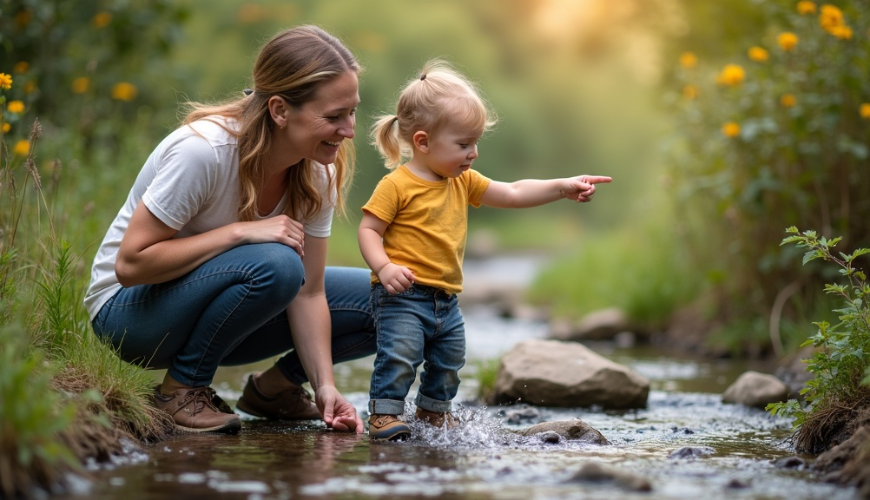
In a typical city home, parents tried for a long time to plan "outdoor" weekends, but it often ended in fatigue and arguments because everyone had a different pace. The breakthrough came surprisingly on a weekday. Instead of taking the shortest route home from school, they started going a ten-minute longer route past a small stream and a weedy meadow between houses. At first, the child only noticed sticks and stones, then started bringing home questions: why does the water sometimes flow more, why are there holes on the bank, what are these tracks in the mud? After a few weeks, there was no need to "motivate" for outdoor time. It was enough to say: "Shall we go by the stream?" and the child wanted to see if anything had changed.
This story is actually ordinary, and that's why it's important. It shows that raising children to have a relationship with nature doesn't have to be based on exceptional events. Just one piece of "wilderness" within reach and regular time when there's no rush. The relationship then starts to build itself – from small observations, from silence, from questions that the adult might not always know the answer to. And that's okay. Sometimes it's enough to say: "I don't know, let's find out."
When Things Get Rough: Fear, Mess, Boredom, and Screens
Many parents want their children to be close to nature but encounter practical obstacles. One of them is fear – of ticks, allergies, or the child falling. Safety is, of course, important, but sometimes it becomes an excuse for "better not to go anywhere." It helps to set simple rules: appropriate clothing, checks after returning home, explaining that in the grass, you walk slowly. The child learns caution, not anxiety. And the adult gains peace of mind that the risks are managed reasonably, not excessively.
Another obstacle is mess. Mud, wet pants, sand in shoes – all of these can spoil even well-intentioned plans. Here, it's beneficial to change perspective: dirt is not failure, but evidence that something happened. When there's a prepared place for changing clothes at home and when it's expected that clothes will sometimes get ruined, the pressure eases. The child is then not constantly held back by the phrase "be careful," which often ultimately means "don't move."
Boredom is a chapter in itself. Adults sometimes feel that the child needs to be constantly entertained. However, nature works differently than a playground with attractions. It doesn't impose a program. And that's its strength. Boredom outside often isn't the end, but the beginning – a moment when the child starts looking for their own activity. A stick turns into a boat, a stone into a treasure, a leaf into a map. If the adult can endure the first ten minutes of "doing nothing," often a game begins that no adult would have thought of.
And then there are screens. There's no need to make them the enemy, but it's good not to let them be the only place where the child feels competent. Nature offers a different type of "reward": slower, but deeper. It helps when outdoor time isn't a punishment ("now you'll go outside"), but a normal part of the day, like dinner. When something happens outside that the child can look forward to – like checking a "secret place," building homes for insects, observing birds – it creates continuity that competes with the digital world.
If a single list is needed, then it's more as inspiration than as obligations. All these little things work precisely because they are easily achievable:
Small Ideas That Make a Big Difference
- "One thing we notice" on the way home (clouds, buds, a track in the mud) and a short discussion about what it might mean
- Pocket magnifying glass or observation cup (and then returning everything back to where it was)
- Collecting natural items only sparingly – more often photographing and drawing, so the child gets used to the idea that nature isn't a souvenir shop
- Micro-ritual based on the season: looking for the first flowers in spring, observing insects in summer, leaves and fruits in autumn, tracks in winter
- Joint care of a "piece of life": a plant, herbs in a box, a dish of water for birds in the heat
What's important is that these ideas don't create pressure for performance. Once natural contact becomes an obligation, children quickly sense that it's not about joy, but about a project.
In the end, it all comes back to one question: what kind of relationship with nature will the child carry into adulthood? One based on prohibition and fear, or one built on curiosity, respect, and the feeling that it's good to be outside even without big plans? If it succeeds that child and nature have the opportunity to be together often and effortlessly, the relationship starts to build itself – from wet shoes, from pockets full of chestnuts, from quiet cloud-watching, and from an ordinary walk by the stream that suddenly no longer seems "boring." And maybe that's the most convincing form of sustainability: not the one that's enforced, but the one that's lived.