

What to Do with Children When They Are Bored, and Why It's Actually Beneficial for Them
Parenting in recent years often takes place under a peculiar tension: on one hand, there's increasing talk about mental well-being and balance, while on the other hand, children's free time seems to have become a project that needs to be managed, evaluated, and constantly improved. Calendars fill up with activities, weekends are packed with "meaningful" trips, and even an ordinary afternoon at home sometimes seems suspicious—as if it were not enough. But this is precisely where it's worthwhile to pause and ask a simple question: do children really need a perfect program, or do they rather need time, space, and peace to play, create, and get bored in their own way?
The idea that a good parent is one who can constantly come up with new programs is tempting. It brings a sense of control and quick "results": the child is not bored, is occupied, learns something. Yet, the child's world does not develop solely through external stimuli. An important part of growth happens in quiet moments when nothing "big" is happening. Boredom can be beneficial—and for many children and adults, it's a surprisingly liberating realization.
Try our natural products



Why Children Don’t Need a Perfect Program (and Why It's Not Resignation)
The desire to give children the best possible childhood is understandable. The problem arises when it becomes a race. A perfect program—varied, developmental, ideally "Instagram-worthy"—can ultimately bring more stress than joy. Children often do not assess the value of a day by how many activities were completed, but by whether they felt safe, accepted, and free.
When the program is constantly prepared, the child might learn that fun comes from outside. That someone else invents, organizes, and decides what happens next. Yet, one of the key life skills is being able to manage on one's own: to invent a game, start creating, overcome the first wave of "I don't know what to do." And this is precisely what is practiced in moments when the plan is not followed, but space is created.
At the same time, it's worth remembering that a child's brain needs not only stimulation but also rest. According to recommendations from expert institutions like the American Academy of Pediatrics, both activity and free play and regular sleep schedules are important for healthy development. Sometimes, the word "program" hides overload—and this can manifest as irritability, fatigue, trouble falling asleep, or more frequent conflicts at home.
A perfect program often assumes perfect conditions: time, energy, money, transportation, logistics. In real life, however, families function amidst work, school, illnesses, and everyday duties. When the bar is set too high, good intentions can easily become pressure. And pressure is contagious. Children sense it, even if it's not spoken about.
Perhaps that's why the phrase parents pass among themselves as quiet reassurance rings so true: "A child doesn't need an entertaining program; they need a content adult." This doesn't mean resigning from shared time. Rather, it means it's not necessary to constantly "fill it." Quality often arises in simplicity.
What to Do with Children When You Don’t Want to Plan Every Hour
When people say "what to do with children," most imagine a specific activity: a trip, a playground, crafting, a museum visit. All of these can be great. Yet sometimes the biggest change is in turning the question around: what to do so that the child has a chance to be themselves—and the adult doesn't have to be a permanent entertainer?
The approach "offer, but don't direct" works very well. At home, a few open possibilities can lie around: papers, crayons, building blocks, old boxes, fabrics, strings. Not as a perfectly prepared creative workshop but as an invitation to their own idea. Children often don't need complex tools; they need the feeling that they can try and that it's okay if something doesn't work out.
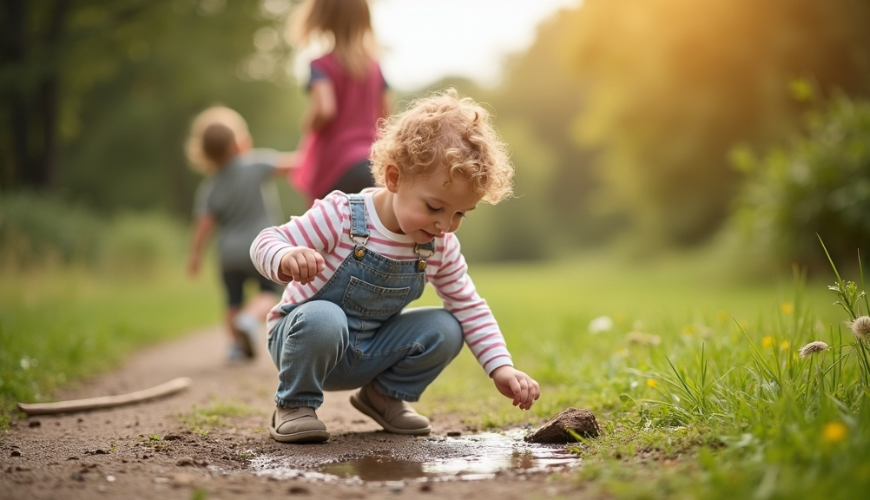
Similarly outside: instead of a goal like "we must walk five kilometers and have ice cream," sometimes just going for a short walk and letting the child decide where to stop is enough. Suddenly, a stick becomes more important than a view, a puddle than a monument. And that's okay. In a child's world, significant things often happen in detail.
A real example from an ordinary day: a family planned a "big" trip for Saturday. But the morning brought fatigue, a bad mood, and minor quarrels. Instead of salvaging the program at all costs, they stayed home. The children initially protested that it was boring. After half an hour, though, blankets, clothespins, and chairs appeared, creating a bunker in the living room with a "secret library." The afternoon naturally flowed into baking simple cookies, and the evening ended with reading. It wasn't a day easily marketed as an "experience," but it was a day the children remembered even a week later—because it was theirs.
Perhaps here lies the key to what program often works best for children: one that has rhythm but isn't overcrowded. One that acknowledges a child also needs time "without a task." And where an adult can be present without constantly entertaining.
If having a few simple inspirations on hand is helpful (without turning them into a list of obligations), perhaps this single "mix" can work, covering most situations:
- A short outdoor stay (even if just around the house) + free play at home + one shared ritual (reading, cooking, board games, evening stretching)
This unassuming model has one advantage: the child is assured of shared time, but also has space for their own world.
Why Boredom is Good: The Quiet Engine of Children's Creativity and Resilience
Boredom has a bad reputation. It's often seen as a signal that something went wrong—that the parent didn't provide a program, that the child lacks stimuli, that the day was "wasted." Yet, boredom is also a natural state. And in reasonable amounts, it can be useful.
When a child is bored, their brain lacks a clear external stimulus. This is the moment when internal initiative can arise: "What could I do?" The child begins to search through their own ideas, memories, possibilities in the surroundings. Boredom often opens the door to what is known as free, independent play—which is extraordinarily important for child development.
Expert texts on child development repeatedly emphasize the importance of play that is not directed by adults. For example, UNICEF reminds us that play supports creativity, problem-solving, and the ability to manage emotions. And boredom can be the trigger that guides the child into play. Not always immediately. Sometimes it's necessary to get past the first wave of resistance when the child tries to "coax" a program from an adult. At that moment, it's tempting to quickly offer a screen or immediate entertainment. But if this is done every time, the child doesn't learn to overcome that initial discomfort.
Of course, there's boredom that is more a cry for help—when a child is long-term lonely, without contact, without support. Such boredom is not spoken of as "healthy." Healthy boredom is more a short space where nothing is happening, but the child has safety, available stimuli, and choice around them. It's similar to silence in music: it's not emptiness, but a pause that gives meaning to what follows.
Moreover, boredom teaches one more subtle thing: resilience to discomfort. Today's world offers immediate distraction practically at a click. This makes it all the more important to be able to endure a while until one's own idea emerges. A child who occasionally "sits through" boredom and then emerges from it independently is training a skill that will be appreciated in adolescence and adulthood: the ability to be without stimuli for a moment, not to panic, not to replace every discomfort with a quick fix.
And when talking about programs, it's worth adding another dimension. A perfect program is often based on performance: to see something, to learn something, to reach somewhere. Yet, a child's life is not a project. Children also need ordinariness: repeating rituals, familiar streets, the same playground, the same bedtime reading. In this ordinariness, certainty is built. And certainty is the soil from which the courage to try new things grows.
Perhaps that's why it is so comforting when family time shifts from "we must" to "we can." We can go outside, but we don't have to. We can create, but we don't have to. We can just sit down, have tea, and watch out the window for a while—and the child will scribble something next to us or just rummage through pebbles from their pocket. It sounds banal, but in these moments, something significant often happens: the child learns that the world doesn't always have to be noisy and that quiet is not empty.
When this mindset succeeds, the question "what to do with children and how to plan a program" begins to sound different. Not as pressure, but as an offer. And the answer can then be surprisingly simple: sometimes less is enough—less planning, less performance, less fear of boredom. Children don't need a perfectly organized childhood. They need a childhood with enough space for play, their own pace, and also moments when not much happens… and yet everything important is there.