

How to Talk to Children About Death Sensitively and Honestly
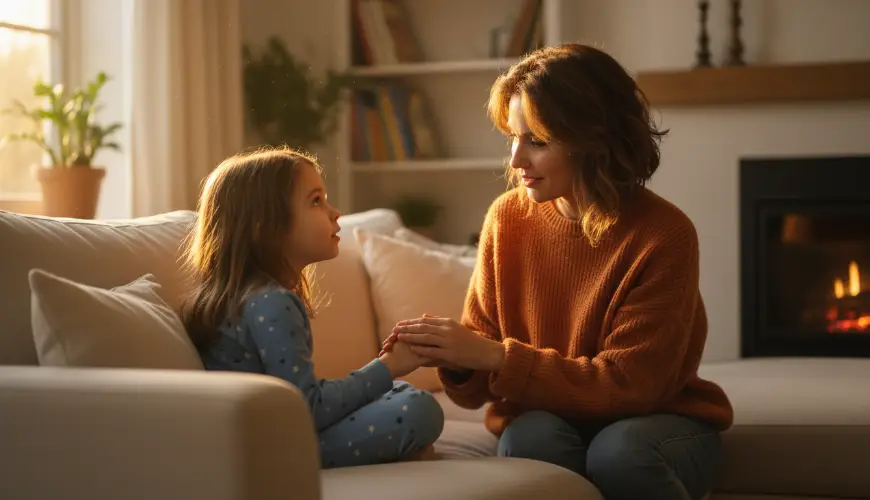
There are moments that catch every parent, grandparent, or caregiver completely off guard. A child is sitting at dinner, twirling a fork in their pasta, and out of nowhere asks: "Mommy, are you going to die someday too?" Your heart stops for a moment, the spoon hangs suspended in mid-air, and a whirlwind of thoughts races through your mind – what to say, how to say it, how much to reveal, and above all, how not to cause harm. These situations are among the most difficult parenting challenges, even though they're discussed far less in parenting groups than, say, sleep training or the first day of preschool. Yet the way we talk to children about death, illness, and fear shapes their emotional resilience for life.
Death, serious illness in the family, fear of the dark, or fear that something bad will happen to loved ones – these are all topics that children process differently than adults. They don't yet have the conceptual framework to name their feelings precisely, and they often express them through behavior: restlessness, regression, nightmares, refusing food, or conversely, exaggerated cheerfulness that masks inner turmoil. Ignoring children's questions or brushing them off with "you're too young for that" may briefly relieve the adult, but the child fills in the gaps in the narrative on their own – and their imagination is often far more terrifying than reality. So how do you talk to children about death, illness, and fear calmly and without causing trauma? The answer isn't simple, but there are several principles rooted in developmental psychology and the practice of child therapists that truly anyone can use.
Let's start with what goes on in a child's mind. Developmental psychologist Maria Nagy described as early as the mid-20th century that children up to approximately age five perceive death as something temporary and reversible – similar to when a character in a fairy tale "falls asleep" and then wakes up. Between ages six and nine, they begin to understand that death is irreversible, but they often personify it as a figure (a skeleton, a ghost), and only around age ten do they accept the concept of death as a universal biological phenomenon. Each developmental stage therefore requires a slightly different approach and different words, but one rule applies across all age groups: age-appropriate honesty is always better than silence. The American Academy of Pediatrics (AAP) repeatedly emphasizes in its recommendations that children need truthful, simple, and understandable information to help them make sense of what is happening around them.
Let's imagine a specific situation. Six-year-old Vojta comes home from preschool and says that Mark's grandma "went to heaven" and that Mark spent the whole day staring out the window. Vojta's mom knows that her own mother is currently undergoing chemotherapy, and suddenly she faces a decision: should she tell Vojta about his grandmother's illness, or protect him from worry? She chooses a middle path. She sits down with Vojta on the couch, takes his hand, and says: "You know, Grandma is sick right now and she's going to the doctor so he can help her. Sometimes she's tired and needs to rest more, but the doctors are doing everything they can." Vojta thinks for a moment and then asks: "Is she going to die?" Mom swallows and replies: "We hope not. But even if something sad happens, we'll be here together and we'll take care of each other." Vojta nods, is quiet for a moment, and then asks if he can watch a cartoon. And that's okay – a child's psyche processes difficult information in small doses, like a sponge that absorbs only as much water as it can hold.
Try our natural products






Why It's Important Not to Underestimate Children's Fear
Fear is a completely natural and evolutionarily useful emotion in children. The problem arises when adults trivialize children's fear with phrases like "that's nonsense" or "big boys aren't scared." Research published in the journal Child Development shows that invalidating children's emotions leads children to learn to suppress their feelings rather than process them in a healthy way. And suppressed emotions tend to come back – often in a more intense form and at a less convenient time.
When a child is afraid, they first and foremost need to feel that their fear is legitimate. The sentence "I can see you're scared, and that's okay" can work wonders. It doesn't add to the fear, as some parents worry, but rather reduces it by naming it. Neuroscientist Dan Siegel, author of The Whole-Brain Child, calls this principle "name it to tame it." When a child hears that their feeling has a name and that it's normal, the brain regions responsible for emotion regulation are activated and stress levels decrease.
This of course doesn't mean we should overwhelm children with detailed descriptions of illnesses or confront them with information they're unable to process. There is a fundamental difference between honesty and overload. A child asking about the death of a pet doesn't need an explanation of the physiology of dying. It's enough to say that the hamster's body stopped working, that it no longer feels pain, and that it's normal to be sad. The key is to answer what the child is actually asking and not add information they haven't requested. Most children will ask again if they need to – and that is exactly the right rhythm.
Interestingly, the culture we live in doesn't prepare us very well for these conversations. Death has been gradually pushed out of everyday life in Western society – people die in hospitals, funerals are held in small circles, children are often "spared" and don't attend the ceremony. Anthropologist Margaret Mead once remarked: "When a child can participate in the grieving process, they learn that sadness is a part of life, not its end." And this is precisely the idea that resonates with modern approaches in child psychology. Children who have the opportunity to say goodbye, place a drawing on a grave, light a candle, or simply be present in the adults' grief learn that pain is manageable and that relief comes after it.
Of course, there are situations where professional help is needed. If a child persistently refuses to eat after the loss of a loved one, cannot sleep, withdraws into themselves, or exhibits significant behavioral changes lasting more than a few weeks, it's appropriate to seek out a child psychologist or therapist. Organizations such as Linka bezpečí (116 111) offer support not only to children but also to parents who are unsure how to proceed in a given situation.
Practical Guidelines for Conversations About Difficult Topics
Although there is no universal guide, several proven principles can help anyone who finds themselves in a situation where they need to talk to a child about something painful:
- Use clear words. Instead of euphemisms like "passed away" or "fell asleep forever," it's better to say "died" or "their body stopped working." Euphemisms can cause confusion in young children – if Grandma "fell asleep," why shouldn't the child be afraid of falling asleep?
- Let the child lead the conversation. Answer the questions they ask and don't force additional information on them. If a child isn't asking, it doesn't mean the topic doesn't interest them – they may just need time.
- Be available repeatedly. One conversation isn't enough. Children return to difficult topics, often at unexpected moments – in the bath, on the way to school, before bedtime.
- Show your own emotions in appropriate measure. When a child sees that an adult is sad but managing, they learn that sadness isn't a threat. Conversely, a completely "bulletproof" parent may send the child a signal that emotions shouldn't be shown.
- Offer a ritual or a specific activity. Drawing a picture for the sick person, planting a flower in memory, creating a "memory box" – all of this gives the child a sense that they can do something and reduces feelings of helplessness.
These principles aren't just theoretical. They are based on the work of professionals such as the therapists at the Dětské krizové centrum (Children's Crisis Center), who encounter children going through difficult life situations on a daily basis. Their experience confirms that children with whom difficult topics are discussed openly and sensitively demonstrate a higher level of psychological resilience later in life.
The role of books and stories is also worth mentioning. There is a wide range of quality children's books that help open a conversation about death or illness in a way that feels natural to children. Czech titles include, for example, Jak to je, když je někdo nemocný (What It's Like When Someone Is Sick) from the Portál publishing house, or the translation of The Memory Tree by Britta Teckentrup, which gently addresses the theme of loss. Stories function as a safe space – a child can experience emotions "on a trial basis" through a character and then return to the topic at their own pace.
Many parents also ask whether it's appropriate to take children to visit a sick relative in the hospital. There is no definitive answer, as it depends on the specific situation, the patient's condition, and the child's age and temperament. Generally, however, if the patient is conscious and wishes for the visit, a short and well-prepared visit can be healing for both sides. It's important to inform the child beforehand about what they will see – "Grandma will be lying in bed, she'll have a tube on her hand, but don't worry, it's helping her" – and after the visit, give them space for questions and silence.
Fear that is unrelated to a specific event but is part of normal child development is a special chapter – fear of the dark, of monsters under the bed, of thunderstorms, or of parents not coming back. The same principle applies here: name it, accept it, don't judge it. A child who hears "it's nothing, monsters don't exist" receives the signal that their inner experience is wrong. A child who hears "I understand you're scared, let's look under the bed together" receives the signal that their feeling is okay and that they're not alone with it.
Ultimately, it's not about finding the perfect words. Perfect words don't exist, and none of us talks to children as if reading from a textbook. It's about being present, honest, and kind – and not being afraid to admit that we simply don't know some answers. The sentence "I don't know, but I'm here with you" holds far greater value for a child than the most beautifully formulated explanation that is emotionally empty. Children don't read our words as carefully as they read our tone of voice, our facial expressions, and whether we're truly holding their hand – both literally and figuratively. And that is precisely where the most important lesson lies: you don't need to be a perfect parent; it's enough to be a parent who isn't afraid to be human.