
Crawling on all fours is truly crucial for a child's healthy development
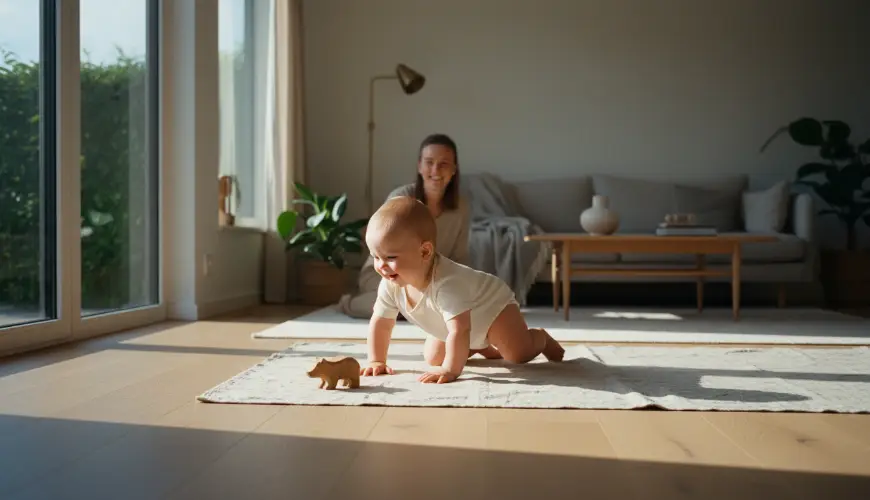
Modern parents today are overwhelmed with advice, recommendations, and trends related to their children's development. One topic that has been increasingly coming to the forefront of attention among pediatricians, physiotherapists, and researchers in recent years is the question of crawling on all fours – that phase of motor development when a child explores the world on hands and knees before walking. Why should parents pay so much attention to this seemingly ordinary movement? And what actually happens when a child skips or shortens this phase?
Crawling on all fours is not just an adorable stage that parents love to photograph and share on social media. It is a key developmental milestone with a profound impact on a child's physical, neurological, and cognitive development. Although some experts previously considered crawling an optional developmental stage, modern research is increasingly convincingly showing that it is a phase a child ideally should not skip.
Try our natural products





What happens in the brain and body of a crawling child
When a child moves on all fours, it seems like a simple mechanical movement. In reality, however, it is an extraordinarily complex neurological achievement. Crawling is what is known as a contralateral movement – the right hand moves simultaneously with the left leg and vice versa. This pattern activates both hemispheres of the brain simultaneously and strengthens the connections between them through a structure called the corpus callosum. It is precisely this inter-hemispheric communication that forms the basis for later abilities such as reading, writing, movement coordination, and concentration.
Research in the field of neuroscience suggests that sufficiently developed connections between brain hemispheres directly influence how easily a child learns at school. According to experts from the American Academy of Pediatrics, motor development in early childhood is inseparably linked to the development of cognitive functions – and crawling plays a completely fundamental role in this process.
Beyond the brain, crawling works intensively with the entire musculoskeletal system. It strengthens the muscles of the shoulders, arms, wrists, chest, and spine. With every movement, the child learns to distribute body weight, maintain balance, and coordinate the movements of all four limbs simultaneously. This also develops the deep stabilization system – a group of muscles around the spine and pelvis that is essential for proper posture in later life. Physiotherapists repeatedly point out that children who skipped crawling more frequently experience problems with posture, back pain, or reduced muscular coordination in preschool and school age.
Crawling also significantly develops proprioception – the brain's ability to perceive the position of one's own body in space. This sensory function is the foundation for motor dexterity, but also for the ability to sit still, concentrate, or manage everyday movement tasks. A child with well-developed proprioception more easily learns to ride a bicycle, engage in sports, or simply walk on uneven terrain.
The development of vision should not be overlooked either. While crawling, a child naturally alternates between looking close up and into the distance – watching the ground directly in front of them, then lifting their head and focusing on a more distant target. This rhythmic eye movement strengthens the ability to focus and coordinate the eye muscles, which has a direct impact on the later ability to read and write.
When crawling should begin and how to support it
Most children begin to crawl somewhere between the seventh and tenth month of age, although individual variation is quite large. Some infants move on all fours as early as six months, while others don't start until the end of their first year. More important than the exact date, however, is whether the child is truly actively using crawling and whether they skip it too quickly in favor of walking.
Pediatricians and physiotherapists recommend that a child ideally crawl for at least several months before standing up and beginning to walk. The longer and more actively a child crawls, the stronger and more balanced foundation for further development they build. Parents can actively support this phase in several natural ways. The so-called "tummy time" is essential – time spent on the tummy – which should begin in the first weeks of life. The prone position strengthens the neck, shoulder, and back muscles, which are a necessary prerequisite for later crawling.
Equally important is creating a safe floor space for the child where they can freely explore their surroundings. Excessive use of walkers, bouncers, jumpers, and other aids that hold the child in an upright position before they are physically ready can slow down or shorten the development of crawling. These aids are not necessarily harmful in themselves, but if they replace time spent in free movement on the floor, they may deprive the child of part of their natural movement experience.
Motivation is another key factor. A child crawls toward whatever interests them – a toy, a parent, a sound, or a light. Parents can harness this natural curiosity and gently motivate the child to crawl by placing interesting objects out of their reach but still within their field of vision. The natural desire to reach a goal is the best engine of motor development.
There are also children who skip crawling entirely – transitioning directly from sitting to walking, or moving on their bottom instead of on all fours. Such behavior is not automatically a cause for panic, but it is certainly worth consulting with a pediatrician or pediatric physiotherapist. A specialist can assess whether the child's development is balanced and whether any supportive interventions are needed.
As renowned physiotherapist and child development expert Magda Krejčí says: "Crawling is to a child what a solid foundation is to a building – without it, the building may stand, but it will never be as resilient as it could be."
What can happen when a child skips crawling
Skipping the crawling phase does not automatically mean that a child will have problems. Many children who did not crawl develop completely normally. Nevertheless, there are a number of studies and clinical observations that suggest certain recurring patterns in children who skipped this stage.
One of the most frequently mentioned consequences is difficulty with fine motor skills – that is, movements of the hands, fingers, and wrists. Crawling intensively strengthens the small muscles of the palm and fingers and develops palm sensitivity. These abilities are directly connected to later writing, drawing, or manipulation of small objects. Children who did not crawl long enough sometimes have difficulty in preschool age with gripping a pencil or with the precision of hand movements.
Another recurring theme is attention and concentration disorders. Because crawling builds inter-hemispheric communication in the brain, its absence may – though not necessarily will – contribute to this communication not being as strong as it could be. Some experts in the field of education and neurology link insufficient crawling with a higher susceptibility to reading difficulties, such as dyslexia, or with concentration problems. This is, of course, a complex issue in which many factors play a role, but crawling is one piece of the puzzle.
Consider a specific example: seven-year-old Thomas started first grade full of enthusiasm, but it soon became apparent that he had difficulty with writing – he held the pencil tensely, his hand tired quickly, and his handwriting was unsteady. After visiting a pediatric physiotherapist, his parents discovered that Thomas had practically skipped crawling as an infant – he moved on his bottom and transitioned to walking very early. The therapist recommended a series of movement exercises focused on strengthening the shoulder girdle and coordination – precisely the areas that crawling naturally develops. After several months, Thomas's handwriting improved significantly.
This example shows that even if a child skips crawling, all is not lost. The human movement system is remarkably plastic, especially in early childhood, and many deficits can be corrected or reduced through targeted care. Nevertheless, prevention is always easier than correction – and supporting the natural crawling phase is the simplest prevention that parents can give their child.
It is also worth mentioning that crawling has a positive influence on a child's emotional and social development. Moving on all fours gives the child their first real autonomy – for the first time they can get to where they want to go on their own, without the help of adults. This experience of independence and success strengthens self-confidence and motivation to continue exploring the world. Crawling is therefore not only a physical, but also a psychological milestone.
Parents who want to help their child as much as possible during this period can reach for quality aids that support natural movement – for example, floor mats made from natural materials that are gentle on the child's skin and the environment, or toys from sustainable sources that stimulate curiosity without unnecessary electronic effects. Such products are part of a broader approach to conscious parenting that respects the natural rhythm of a child's development.
Crawling on all fours is one of the most important gifts that natural development can provide a child. It is a brief but extraordinarily rich stage that leaves its mark on the brain, muscles, senses, and psyche for an entire lifetime. Giving a child the space, time, and motivation to crawl is one of the simplest and at the same time most valuable things parents can do for their child – and for that, they need nothing more than a clean floor and a little patience.