

# The Secret to Preparing Rose Hip Tea Rich in Vitamin C

Rosehips are among the most abundant natural sources of vitamin C in the world
The fruits of the wild rose, which adorn copses and hedgerows throughout Central Europe every autumn, contain up to twenty times more of this vitamin than citrus fruits. And yet most people prepare rosehip tea in a way that loses a large portion of these valuable substances before it ever touches their lips. The question, then, is: why bother collecting or buying rosehips if you end up creating nothing more than a colourful drink devoid of nutritional value?
The answer to how to properly prepare rosehip tea so that it retains the maximum amount of vitamin C is not particularly complicated — but it does require knowing a few basic rules that most people simply don't know. And it is precisely these rules that determine whether you drink a truly nutritious beverage or merely fragrant water tinted red by the remnants of plant pigment.
Try our natural products
Why vitamin C in rosehips is so vulnerable
Vitamin C, chemically known as ascorbic acid, is among the least stable vitamins of all. Unlike vitamin D or vitamin A, which tolerate heat relatively well, ascorbic acid breaks down very easily — and under the influence of several factors simultaneously. Heat, air and light are the three greatest enemies of vitamin C, and it is precisely during tea preparation that we encounter all three at once.
According to research published in the scientific journal Food Chemistry, significant loss of vitamin C occurs at temperatures above 60 °C. At boiling water temperature, around 100 °C, up to 80% of the original vitamin C content can be destroyed in just five minutes. This is a figure that should give every rosehip tea enthusiast pause for thought.
Even more insidious is the fact that vitamin C does not break down solely due to temperature, but also through oxidation. As soon as rosehips are cut or crushed, their cells open and the contents come into contact with atmospheric oxygen. The longer such processed rosehips wait before preparation, the more vitamin C is lost even before hot water enters the picture. For this reason, the way rosehips are processed is just as important as the steeping temperature itself.
The material of the vessels used also plays a significant role. Vitamin C breaks down readily upon contact with certain metals, particularly copper and iron, which catalyse oxidation. Glass, ceramic or stainless steel containers are therefore the ideal choice, while older metal pots with scratched surfaces are not suitable for preparing rosehip tea.
How to properly prepare rosehip tea step by step
Preparing rosehip tea in a way that truly preserves vitamin C differs from conventional preparation primarily in two key respects: water temperature and steeping time. Experienced herbalists and natural medicine experts recommend the so-called cold or lukewarm infusion as the most gentle method, but even hot tea can be prepared in a way that avoids unnecessary loss of valuable substances.
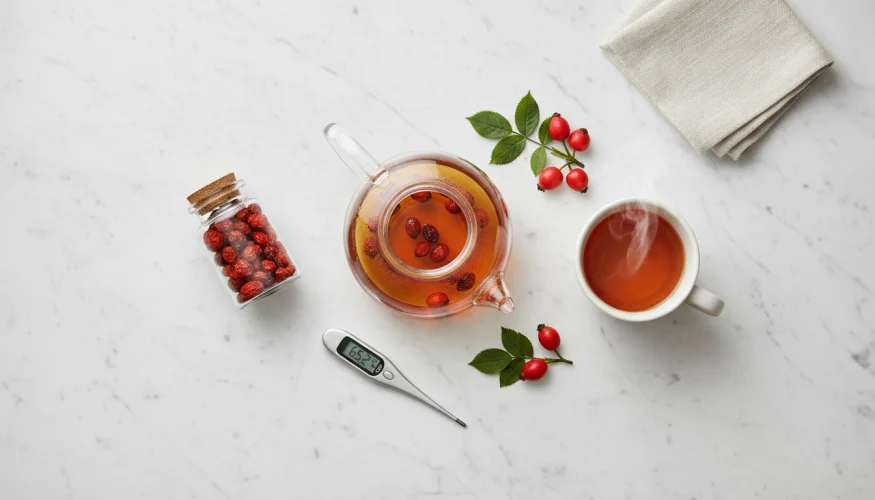
If we want to preserve as much vitamin C as possible while still enjoying a warm drink, the key is not to exceed a temperature of 60 to 70 °C. The water should therefore not be boiling, but merely hot — the kind into which you can briefly dip a finger without immediately burning yourself. This temperature can easily be estimated, or a kitchen thermometer can be used. The rosehips are then left to steep covered for 10 to 15 minutes, with covering the vessel being important as it prevents both heat loss and oxidation.
An even gentler method is the cold infusion. In this case, the rosehips are covered with cold or room-temperature water and left to steep overnight, ideally for 8 to 12 hours in the refrigerator. The resulting drink contains significantly more vitamin C than classically prepared tea, although it differs somewhat in taste — it is less intense, but refreshing. With a cold infusion, you obtain not only vitamin C but also a range of other bioactive substances that would likewise break down at higher temperatures.
A practical example is the experience of Hana, a 42-year-old teacher from Olomouc, who collects rosehips near her home every autumn and prepares supplies for the entire winter. For years she dried them and then poured boiling water over them — until a friend studying nutrition pointed out that this was destroying most of the vitamin C. "I switched to a lukewarm infusion and honestly, the tea tastes just as good to me now. I just need to prepare a batch the day before," says Hana. A change that costs no money and requires no special effort, yet makes a fundamentally different result.
It is also important to know how to process rosehips before preparation. Whole dried rosehips steep more slowly and less intensely, but oxidation during their preparation is minimal. Crushed or ground rosehips release more flavour and active substances more quickly, but they must be processed immediately before making the tea, not ground in advance and left to stand. When using fresh rosehips, it is recommended to halve them before preparation and remove the seeds and the fine hairs inside, which can irritate mucous membranes — but here too, they should be processed just before use.
For those who want to be certain that their rosehip tea contains as much vitamin C as possible, an excellent option is to reach for high-quality dried rosehips or ready-made tea blends from trusted sources. At Ferwer.cz you can find, for example, organic rosehip tea made from gently processed fruits, prepared with care to preserve the natural active substances — and nothing stops you from preparing it using the correct method at home.
Myths and misconceptions that rob your tea of nutritional value
Several widespread misconceptions about rosehip tea are worth naming directly. The first is the notion that the longer tea is steeped, the healthier it is. The opposite is true — prolonged steeping in hot water gradually destroys vitamin C, while the flavour may intensify, the nutritional value declines. The optimal steeping time in hot water (up to 70 °C) is 10 to 15 minutes; for cold infusion, 8 to 12 hours.
The second misconception is the belief that adding lemon juice to tea somehow "repairs" the damage caused by boiling water. Lemon certainly also contains vitamin C and adds it to the drink, but it cannot replace what has been lost from the rosehips. Moreover — if we add lemon to hot water, its vitamin C breaks down quickly as well. If we want lemon juice as an addition, we should add it only to lukewarm or cooled tea.
The third and perhaps most widespread misconception is the assumption that dried rosehips are less nutritious than fresh ones. Properly dried rosehips retain a large proportion of their vitamin C and other active substances — the key lies in the drying method. Rosehips should be dried at temperatures not exceeding 40 °C, ideally in a well-ventilated space away from direct sunlight. Industrially dried rosehips processed at higher temperatures may indeed lose some of their vitamin C, which is why it is worth checking how a product has been processed.
As the German physician and pioneer of phytotherapy Sebastian Kneipp said: "Nature is the best pharmacy, but we must learn to read from it correctly." This thought applies precisely to the preparation of rosehip tea — rosehips have enormous potential, but only if we treat them with respect for their natural character.
Also worth mentioning is the effect of storage on vitamin C content. Dried rosehips should be kept in sealed, preferably dark containers, away from light and moisture. Plastic bags are not an ideal choice, as they allow air and light to pass through more readily than glass jars with lids. Properly stored rosehips will retain most of their active substances for one to two years, while poorly stored fruits can lose a large proportion of their vitamin C within just a few months.
Rosehip tea deserves attention also because vitamin C is far from the only substance rosehips contain. They are rich in bioflavonoids, which enhance the absorption of vitamin C in the body, as well as beta-carotene, B-group vitamins, tannins and pectins. These substances act synergistically, and their combination is one of the reasons why rosehip tea is considered one of the most effective natural remedies for supporting immunity. By preparing it correctly, we therefore protect not only vitamin C but the entire complex of valuable substances that rosehips have to offer.
For those looking for a practical way to incorporate rosehip tea into everyday life without compromising on quality, it is worth knowing that a cold infusion can be prepared in the evening and gently warmed in the morning to a pleasant temperature — still without exceeding the critical threshold of 60 °C. Tea prepared in this way is an excellent alternative to coffee or conventional tea, and gives the body precisely what we expect from rosehips: a natural, readily absorbable dose of vitamin C at the time when the body needs it most.
Autumn and winter are the seasons when rosehip tea makes the most sense. But it only makes sense when prepared correctly. A small change in approach is all it takes — lower water temperature, shorter or longer steeping depending on the method, the right vessels and gently processed rosehips — and an ordinary ritual becomes a truly nourishing habit.