
Practical solution for storing bags, lids, and boxes
Anyone who has ever rummaged through a chaotic drawer full of plastic bags, searched for a pot lid that seemed to have vanished into thin air, or tried to stack plastic containers into a pyramid without the whole thing crashing to the floor knows exactly what we're talking about. Kitchen chaos is one of the most widespread household frustrations of all – and yet it can be prevented in surprisingly simple ways. Organised storage of bags, lids and containers is no great science, nor is it the exclusive domain of lifestyle influencers with perfectly arranged homes. It is a practical skill that anyone can master.
Interestingly, the problem rarely lies in a lack of space. According to surveys by the National Association of Productivity & Organizing Professionals, most households suffer from an excess of things rather than a shortage of storage space. In other words: it's not your kitchen that's failing – it's the quantity of things you store in it and the way they are arranged.
Try our natural products





Why kitchen chaos is so common (and how to stop it)
Take, for example, a family with two children who cook every day. Jar lids pile up in one drawer alongside rubber bands, spare batteries and mysterious objects of unknown origin. Lunch containers are stacked haphazardly, with their lids lying somewhere completely different. Zip-lock bags are crumpled and stuffed into a corner of a lower cupboard. The result? Every morning, preparing packed lunches is unnecessary stress.
The key to change is adopting a simple principle: everything has its place and every place has its thing. This seemingly trivial approach underpins the methods of Japanese organiser Marie Kondo as well as the Scandinavian concept of "lagom" – that is, moderation and balance. The goal is not to have a museum of cleanliness at home, but to have your home serve you, rather than the other way around.
Before you begin organising, it is worth going through your supplies and getting rid of what you genuinely don't need. How many zip-lock bags do you actually use in a month? How many containers without lids or lids without containers are rattling around in your cupboards? This initial review tends to be liberating – and at the same time reveals what you actually need to organise.
Storing bags: from carrier bags to zip-lock bags
Carrier bags and plastic bags are perhaps the most problematic category. Their shape prevents them from stacking naturally, they tend to crumple and take up a disproportionate amount of space. The most elegant solution is a so-called bag holder or dispenser, which can be hung inside a cupboard or attached to the door. A surprisingly large number of bags can be stuffed into such a dispenser, and each one can easily be pulled out with one hand.
An alternative is to fold carrier bags into a triangular shape – a method popularly known as "folding like origami" – which allows bags to be stored in any box or basket without overlapping, making them easy to retrieve. There are dozens of tutorials on YouTube showing how to do this, and once you've learned the technique, it will save you hours of unnecessary rummaging.
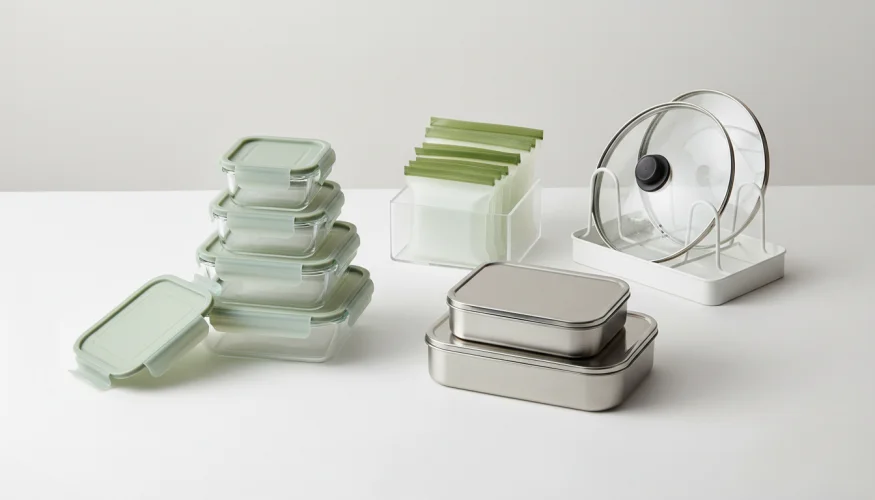
Zip-lock bags of various sizes deserve their own compartment or stand. Vertical organisers are extremely practical – individual sizes of bags are slotted in upright, like books on a shelf. This makes it immediately clear what you have available, and the bags don't get crumpled. If you prefer more eco-friendly alternatives to single-use plastic bags – and there are many reasons to do so – you might consider silicone zip-lock bags or fabric drawstring bags, which are washable, durable and significantly cheaper in the long run.
Making the transition from plastic to sustainable alternatives doesn't have to be dramatic. It's enough to start gradually: when your stock of single-use bags runs out, replace them with reusable ones. Zero Waste Europe reports that the average European household uses hundreds of plastic bags a year – most of which end up in landfill or in the environment.
Lids: the greatest mystery in every kitchen
Lids are a special category in their own right. There are lids for pots, lids for jars, lids for plastic containers – and each comes in a different size, shape and material. It's no wonder they so easily get lost or pile up in chaotic heaps in kitchens.
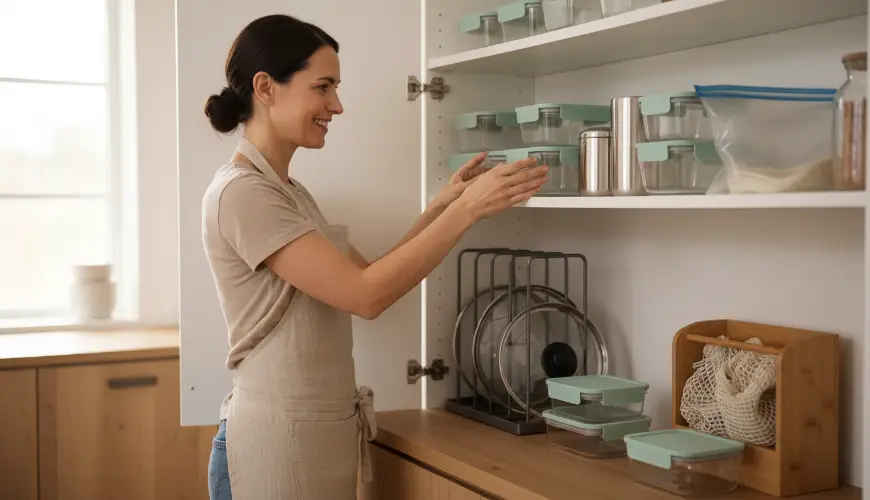
For pot and pan lids, specially designed racks or organisers work best – these can be placed in a drawer or screwed to the inside of a cupboard door. These racks have slots or compartments into which lids slot upright – neatly, accessibly and without the risk of the whole pile toppling over when you reach for the one at the bottom. If you don't want to invest in a dedicated rack, an improvised solution could be a simple dish-drying rack placed directly inside the cupboard.
Jar and preserving jar lids deserve their own drawer or box, ideally sorted by size. A practical trick is to stick labels on the bottom of the box with the diameter of the lids – that way you immediately know where everything belongs and don't have to try each lid by trial and error. Lids for plastic lunch or food containers are best kept directly with their matching container, or at least in the same section of the cupboard.
As American professional organiser Julie Morgenstern says: "Organisation is not about perfection. It's about efficiency, reducing stress and saving time." This thought applies doubly to lids – there's no need to have each one perfectly arranged; it's enough to know roughly where to look.
Containers and boxes: to stack or not to stack?
Plastic, glass or metal food containers are another source of kitchen chaos. Stacking them seems logical at first glance – they take up less space. But if the lids are stored separately and the containers are piled on top of each other, you'll always reach for the one on top, and the ones at the bottom will never see the light of day.
The most practical approach is to store containers together with their lids as complete units, if space allows. Yes, they take up a little more room, but they'll save you the frustration of hunting for the right lid for the right container. If space doesn't allow for this approach, the key is at least to group lids and containers by size and store them in close proximity to one another.
An increasingly popular trend is switching to modular storage systems, where all containers are the same shape – typically square or rectangular – and their lids are interchangeable. Such systems are available in many variants, from glass and stainless steel to quality BPA-free plastic. The advantage is obvious: no searching for the right lid, easy stacking, and a clear overview. Investing in a unified system pays off in the long run, both financially and in terms of peace of mind.
For those who prefer eco-friendly solutions, glass containers with silicone lids or stainless steel boxes are ideal. They are durable, do not react with food, are easy to clean and don't look worn even after years of use. Unlike cheap plastic, they don't absorb food odours or colours, and their lifespan is measured in decades rather than months.
When choosing a storage system, it's also worth thinking about how you use the containers. Do you take them to work or school? Then you'll appreciate lighter materials and secure closures. Do you use them primarily in the fridge or freezer? Then temperature resistance and airtight sealing are important. Do you put them in the microwave? Then opt for glass or plastic certified for microwave use.
Practical tips for maintaining order
A tidy kitchen is not a one-off project – it's a habit. And like any habit, it requires a certain degree of conscious effort until it becomes automatic. A few simple rules can make a significant difference:
- A regular review of supplies every few months will reveal containers without lids, lids without containers and bags that are too damaged for further use.
- Labelling is an underrated helper – a brief description of the contents or size on a compartment or box saves time and prevents things from getting mixed up again.
- The "one in, one out" principle applies to kitchen equipment too: every new item that enters the kitchen should be offset by removing an old one.
- Involving the whole household is essential – if other family members don't know where things belong, the system will quickly fall apart no matter how well it's designed.
Finally, it's worth noting that a well-organised kitchen has a direct impact on what and how we cook. Research published in the academic journal Environment and Behavior suggests that a chaotic environment leads to poorer decision-making – including decisions about food. A tidy kitchen, where you know what you have to hand, naturally encourages cooking at home, less food waste and an overall healthier lifestyle.
Organising your kitchen is therefore not merely an aesthetic matter. It is an investment in everyday wellbeing, a saving of time and money, and – perhaps surprisingly – also one of the small steps towards a more sustainable way of life. Because when you know what you have at home, you don't buy unnecessary extras, you throw less away and you make better use of what you own.