
# Correct Child's Pose Position in Yoga and Mistakes Most People Make
When someone first hears the name "child's pose," they probably imagine something very simple. After all, what could be complicated about kneeling on a mat and leaning forward? Yet this apparent simplicity is the greatest trap that beginners and advanced yogis alike regularly fall into. Balasana – as child's pose is called in Sanskrit – is in fact one of the most underestimated and most frequently incorrectly performed poses in all of yoga. And yet it can be the key to releasing tension in the back, hips, and mind, if performed correctly.
Child's pose appears literally everywhere in yoga classes – as a rest break between demanding sequences, as an opening release, or as a standalone restorative pose. Precisely because instructors assign it so often and so casually, most practitioners never receive proper instruction on how to actually perform it. The result is that people spend minutes in a position that brings them no real benefit – or worse, causes unnecessary tension and discomfort.
Try our natural products

Why balasana is so important
To be clear about what is actually at stake: balasana is not merely a break where you rest until something "real" comes along. Correctly performed child's pose actively stretches the lumbar spine, releases the sacral area, opens the hips, and stimulates the nervous system in such a way that the body shifts from stress mode into recovery mode. Research published in the Journal of Alternative and Complementary Medicine has repeatedly confirmed that forward-bending and trunk-release positions have a direct influence on activating the parasympathetic nervous system – the one that calms us and helps the body recover.
However, this only works when the pose is truly performed correctly. Otherwise it is a mere illusion of rest, with muscles remaining in latent tension and the spine receiving far less space than it could.
Let us therefore look at exactly where people go wrong – and what to do about it.
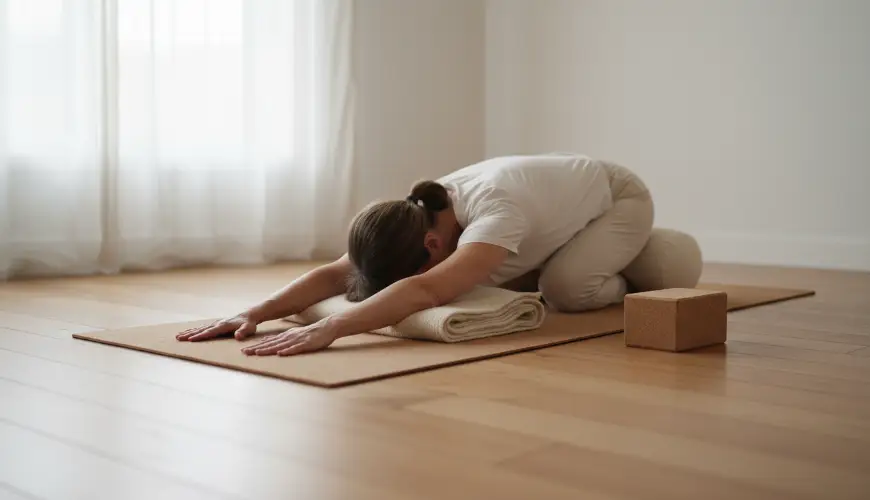
The most common mistake number one is trying too hard to get the forehead to the mat. It sounds absurd, but it is true. Many people, especially those with tighter hips or shorter torsos, try at all costs to put their head down – and in doing so unintentionally round the spine in a way that distorts the entire pose. Instead of the lumbar spine being stretched, excessive bending occurs in the thoracic spine and neck, while the lumbar area remains contracted and disengaged. The solution is simply to support the forehead with a block or folded blanket. The head must be supported so that the neck is naturally lengthened, not compressed.
The second major mistake concerns the position of the hips. Many practitioners believe that the hips must sit directly on the heels – and when they cannot manage this, they feel they are "not doing the pose right." In reality, this is an anatomical matter that varies from person to person. People with narrower hip joints or more prominent calves simply cannot achieve a full seat on the heels without compensating elsewhere. Instead of the body struggling unnecessarily, it is enough to place a folded blanket or cushion under the hips. In this way the body immediately releases and the pose begins to function as it should.
How to finally perform child's pose correctly
The third problem is less visible, but all the more insidious – it is tension in the shoulders and arms. When people extend their arms forward in the so-called extended variant of balasana, they tend to push their shoulders up towards their ears and actively "pull" themselves forward. This is the exact opposite of what the pose requires. The shoulders should drop away from the ears, the shoulder blades gently spread apart, and the arms should rest on the mat without any active effort. If this is not possible, the solution is again to use support – this time under the arms or under the forehead.
One specific example to illustrate: imagine a middle-aged woman, let us call her Jana, who has been attending yoga for six months. Jana has a sedentary job and chronic tension in her lower back. In every class where the instructor assigns child's pose, Jana complies, bends forward – and after thirty seconds returns to an upright position because her knees hurt and she feels nothing at all in her back. No one ever told her that it is enough to support the knees with a folded blanket and the hips with a cushion. No one pointed out that she should focus on actively lengthening the spine with each exhalation, rather than simply lying there passively. Once Jana applied these simple adjustments, she described the sensation as "my back finally opened up." Yet these were minimal changes with maximum impact.
This is precisely where the core of the entire problem lies: child's pose looks passive, but correct performance requires conscious engagement of attention. Each exhalation should be an opportunity for the spine to lengthen a little more, the belly to release softly, and the body to come closer to the mat. It is not about strength – it is about conscious release. And that is paradoxically harder than many strength-based poses, because our bodies are far more accustomed to active effort than to conscious letting go.
The breath plays an absolutely fundamental role in balasana, and yet most practitioners pay it no attention whatsoever. In child's pose, the breath should flow primarily into the back – into the kidney area and the lower part of the ribcage. When you inhale and consciously direct the air into the back, you will feel this area gently expand and release. With the exhalation, the body naturally deepens into the pose. This technique, sometimes referred to as three-dimensional breathing, is entirely natural – most people have simply never tried it consciously.
There are also two basic variants of child's pose that serve different purposes, and confusing them is another source of confusion. The narrow variant – where the knees are together and the body rests on the thighs – places greater emphasis on stretching the spine and is suitable for people with tighter hips. The wide variant – where the knees are spread apart and the belly sinks between the thighs – opens the hips and groin more deeply. Neither is "better" – it depends on what a particular body needs at a given moment.
As B.K.S. Iyengar, one of the most significant yoga teachers of the 20th century, said: "Yoga is a mirror to look at ourselves from within." Child's pose is perhaps the most direct mirror of all – it immediately reveals whether we are capable of truly releasing, or whether we are merely pretending to rest while our mind and body remain on alert.
It is also important to mention for whom child's pose may not be suitable without modifications. People with knee problems, particularly damaged menisci or post-surgery, should be cautious and consult a specialist about how to perform it. Pregnant women should likewise opt for the wide variant and consult a prenatal yoga instructor if needed. Pain in the knees is always a signal that must be respected – not overcome through willpower.
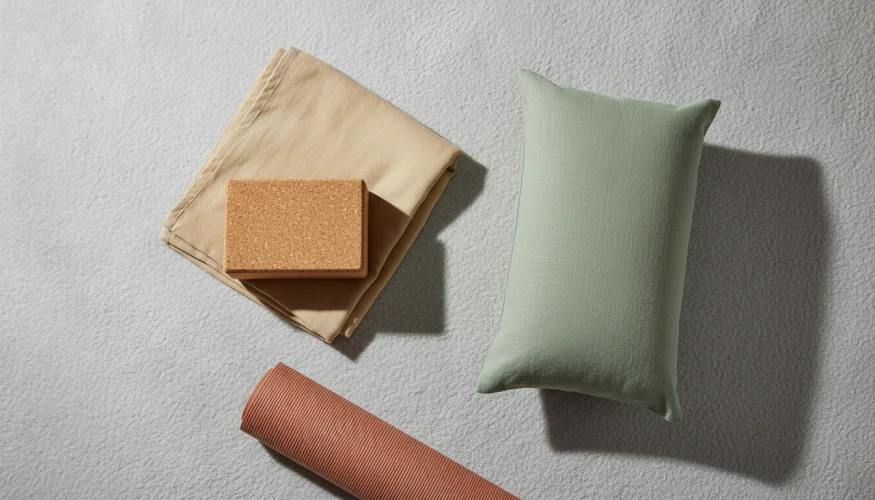
For those who want to get the most out of child's pose, it is useful to know that there are also supportive props that will significantly improve the entire experience. Yoga blocks, blankets, bolsters – these are not props for beginners or for those who "cannot do it." They are tools that make the pose accessible to every body and allow genuine release rather than tense endurance. On the Yoga Journal blog you will find detailed photographs and instructions for various variants and modifications that can help you find the right version for your body.
If you are interested in improving your yoga practice in everyday life and are looking for props to help you do so – from quality yoga mats to bolsters and eco-friendly blocks – at Ferwer you will find products made with sustainability and the real needs of practitioners in mind.
Let us return, however, to one more thing that is rarely mentioned in discussions about child's pose: its mental dimension. Balasana is considered in the yoga tradition to be a pose of surrender. It symbolically recalls the position of a foetus in the womb – a state of complete safety and trust. This is precisely why it can be surprisingly emotional for many people. A body that is accustomed to being constantly on alert may initially have great resistance to truly releasing. This is entirely normal and is in itself valuable information about the state we are in.
Perhaps this is why child's pose is so underestimated – because genuine release is perceived in our performance-oriented culture as less valuable than active effort. Yet the ability to consciously release and slow down is a skill that has a direct impact on health, sleep quality, and overall wellbeing. And balasana, correctly performed, is one of the most accessible ways to train this skill – without equipment, without special conditions, any time and anywhere.
So next time an instructor assigns child's pose, it is not enough to simply slide mechanically downward and wait for it to pass. It is an invitation – to conscious breath, to intentional release, and to a little of that self-care that each of us deserves.