

Nordic walking is walking with poles that engages the whole body and does not damage the joints.
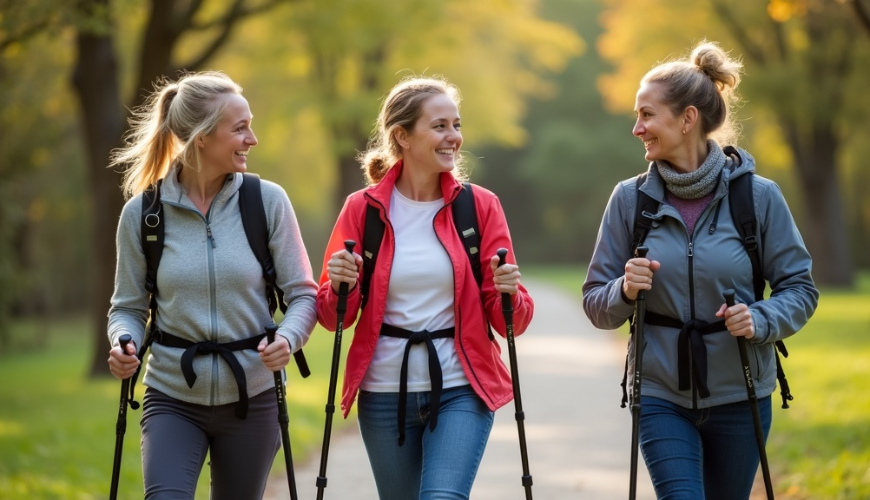
A few years ago, nordic walking was more of a rarity in Czech parks. Today, walking with special poles is not just associated with "poles for seniors," but increasingly with a pleasant way to move the whole body, clear the mind, and avoid unnecessary strain. Perhaps this is its charm: it's an activity that can be done almost anywhere, looks inconspicuous, but can surprise by engaging many muscles. In a time when many people are trying to find a sustainable rhythm of movement—without overexertion and without feeling the need to "break records"—the question arises: what is nordic walking and why is it spoken of as one of the most natural paths to better fitness?
Try our natural products
What is Nordic Walking and Why It’s More Than Just a Fast Walk
The essence of nordic walking is walking with poles, which is derived from cross-country skiers' summer training. However, it's not a scaled-down version of skiing or hiking with support. The key is the push-off with the poles and the work of the arms to involve the upper body in the movement. This is what sets nordic walking apart from ordinary brisk walking: the body moves more dynamically, steps naturally lengthen, the chest opens up more, and the walk gains a rhythm resembling a sportier "march."
It sounds simple, but it has clear logic. When a person pushes off correctly, they don't just transfer weight from one foot to the other but "push" forward with the upper body as well. This engages the muscles of the back, shoulders, arms, and core. That's why nordic walking is often talked about as an activity that can be surprisingly intense—of course, depending on how fast and technically it is done.
Its popularity is also evidenced by its inclusion in recommendations for a healthy lifestyle. For general context and health implications of movement in preventing lifestyle diseases, it's useful to refer to information from the World Health Organization (WHO) on physical activity, which emphasizes the importance of regular, sustainable movement for the general population. Nordic walking fits perfectly into this: it is easily dosable, accessible, and yet effective.
Perhaps the biggest advantage is psychological. Many people who don't "see themselves" in a gym or on a running track find that walking with poles is pleasantly inconspicuous. It doesn't require a special environment, doesn't feel performance-oriented—and yet it can move the body more than expected.
Who is Nordic Walking Suitable For and When It Can Be Most Helpful
When considering who nordic walking is suitable for, the answer is suspiciously broad: almost everyone. And it's true—just with the caveat that "for everyone" doesn't mean "the same." The advantage is that it can be very easily adapted. Someone might go for a half-hour brisk walk on a cycle path, while another person might take a one-hour route with hills, and nordic walking suddenly becomes a solid workout.
It's often chosen by people who want to start moving without shocking their joints. Walking is a natural movement and the poles help distribute the load. Nordic walking is thus popular among those with sensitive knees, higher weight, or those returning to activity after a long break. At the same time, it is also suitable for athletes as supplementary training—perhaps during a period when running is not appealing, or when the goal is to strengthen the core and improve posture.
It also has practical use for people who spend a lot of time at the computer. A typical image of today’s times: hunched back, stiff shoulders, head pushed forward. Proper nordic walking can "open" the body, naturally activate the shoulder blades, and remind us that hands are not just for the keyboard. Of course, it's not a magic pill for everything, but as a regular habit, it can be surprisingly effective.
And then there's another group that is sometimes less talked about: people who need movement but are also looking for a social aspect. Nordic walking is often done in pairs or groups because the pace can be matched, and conversations can happen. It's not a sport that "cuts you off" from your surroundings. Quite the opposite—it can naturally fit into a weekend program, where you go to the woods, exchange a few words, and return home with the feeling that the body has done something good.
A real-life example? In many cities, community groups meet after work. Imagine a common scenario: a woman around fifty, with a sedentary job, occasionally suffers from back pain, no desire to run. She buys poles, feels a bit embarrassed at first, but after two weeks, she finds that regular outings not only improve her sleep but also make it easier to breathe uphill, and her shoulders aren't as "locked." And perhaps most importantly: it didn’t stop after one enthusiastic week, because the activity is pleasant and sustainable.
Of course, there are situations where caution is advised. In cases of acute pain, post-surgery, or significant issues with the musculoskeletal system, it is wise to consult a physiotherapist or doctor about the appropriate type of load. While nordic walking is gentle, it is still a movement that requires technique and can be done incorrectly.
How to Do Nordic Walking Correctly: Technique, Poles, and Common Mistakes
The question of how to do nordic walking correctly is often underestimated because "it's just walking." Yet, technique matters in determining whether it becomes a pleasant activity for the whole body or just a walk with poles that get in the way. Good nordic walking looks smooth and natural—and when done correctly, one notices that the body moves as a whole.
The basic principle is simple: the arm and leg move in opposition, just like in regular walking. When the right foot moves forward, the left arm does too. The pole is planted roughly at the heel level of the front foot (not in front of the toe), followed by a push-off backward. Importantly, the pole is not "pulled" forward; instead, you lean into it and push off. Shoulders stay down, the neck is long, and the chest is open. What do many beginners do wrong? They hold the poles tightly and keep their arms perpetually in front of the body, as if pushing a shopping cart.
A helpful visualization: the arms are pendulums. They swing forward and backward naturally, not sideways. In the backward phase of the movement, the hand can even relax for a moment—that's why nordic walking poles have a typical loop/glove that allows the pole to be "released" and safely caught again. This detail often determines whether the triceps and back are engaged, or just the forearms.
A big topic is the correct pole length. A common guideline is the formula height × 0.68 (sometimes 0.7 depending on style and fitness). But it's just a guideline. Shorter poles tend to be more comfortable for beginners and for a calmer walk, while longer ones can "pull" more into a sporty expression. The important thing is for the elbow, when leaning on the pole, not to be unnaturally raised nor fully extended. If possible, it's worth getting the length advised in a store or during a lesson with an instructor—even one trial lesson can save months of bad habits.
Surface? Nordic walking is versatile, as it can be done on forest paths, gravel, field tracks, and asphalt. Rubber "booties" are used on hard surfaces to prevent the poles from slipping and making noise. And shoes? Ideal are comfortable sports shoes with a flexible sole and good heel support, nothing too heavy. One should feel the foot rolling and the step being smooth.
In practice, it helps to follow a few simple principles that make the difference between random waving and real technique:
- The step is longer but natural—no exaggerated "stretching" that breaks the pelvis.
- The pole is planted diagonally backward and aids in the push-off, not leaning forward.
- Arms work from the shoulders, not just the elbows; elbows are not glued to the body.
- The body is upright and the gaze is forward, not down to the ground.
These might sound like details, but they determine the effects of walking with poles. When done technically well, one often feels a pleasant effort in the area between the shoulder blades and in the arms—and that's a sign that more than just the lower body is engaged.
One more thing that is sometimes overlooked: pace. Nordic walking doesn't always have to be "fast walking." Ideally, days of brisk walking with more push-off are alternated with days of more relaxed, regenerative walks. This way, the body improves without overloading, and the activity remains enjoyable in the long term.
When talking about health, it's fair to rely on authoritative sources. In terms of the general benefits of walking and regular movement for the heart, metabolism, and psyche, a good guide is the overview of information from the CDC on the benefits of physical activity. Nordic walking fits these recommendations as a form of aerobic activity that also adds work for the upper body.
"It's not about walking as much as possible, but walking in a way that makes the body feel stronger even in a month," say trainers who teach technique to beginners. And that's a good summary: nordic walking isn't about a one-time performance, but about a rhythm that can be maintained.
The effects usually don't show overnight, but they are noticeable: better fitness when walking up stairs, more comfortable posture, a feeling of a "stretched" chest, and often a greater desire to move more frequently. When combined with reasonable recovery, sleep, and regular body care, it's exactly the type of movement that easily becomes part of life—without big plans, without drama, just with poles leaning by the door, ready for the next walk.