

Why Walking is the Best Exercise You Can Manage Even in a Busy Week Without Stress
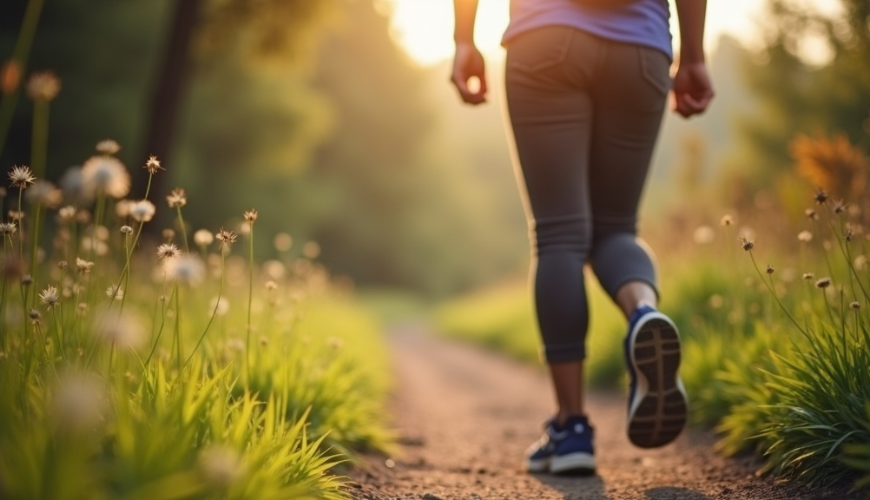
Walking seems almost inconspicuous. It doesn't have the aura of a "real workout," doesn't require a gym membership or special equipment, yet people keep returning to it when they want to improve their fitness, clear their minds, or simply feel better in their own bodies. Perhaps the answer to why walking is the best exercise for so many different life situations lies in its simplicity. It's a natural movement that the body knows from childhood and can easily become a regular part of the day. And when you add the effect that walking has against stress, it becomes something that strengthens both the body and mind—without grand gestures but with long-term impact.
When talking about exercise, it often turns into a competition: who runs more, who lifts heavier weights, who "works out" more often. But the human body is not a performance machine, and neither is the psyche. In an ordinary week, where work, family, obligations, and sometimes even fatigue and overload alternate, walking is one of the few types of movement that can be done regularly without consuming time or mental energy. This is why it is increasingly spoken about in the context of a healthy lifestyle—not just as a way to burn calories but as a tool to return to oneself.
Try our natural products






A natural movement that the body understands (and doesn't need excuses for)
Walking is one of the most basic skills for humans. The body works comprehensively during it: muscle chains alternate, the stabilizing system engages, the rhythm of breathing changes, and circulation improves. It's not just about the legs. In natural, brisk walking, the glutes, core, muscles around the spine, and arms that maintain rhythm and balance are activated. This "whole-body" aspect is often underestimated—until you try a longer route or hilly terrain and realize the next day that even your shoulder blades are aware of it.
The advantage of walking is also that it is gentle. For many people, running or intense training is too harsh a start—the joints protest, the body resists, and motivation quickly fades. Walking, on the other hand, allows for a gradual, safe return to movement. Especially if the goal is a long-term change and not a short "action" for a few weeks.
In expert recommendations, walking regularly appears as a suitable form of activity for a wide population. For example, the World Health Organization (WHO) has long emphasized the importance of regular physical activity for health and provides framework recommendations that can be fulfilled with brisk walking. Similarly, the NHS (National Health Service in the UK) describes walking as a simple way to improve health and fitness without complicated logistics. This is key for everyday life: the best exercise isn't the "ideal" one, but the one that actually happens.
When people hear "walking," they often imagine slow strolling. Yet changing the pace and posture can turn walking into an activity with a clear effect. Brisk walking slightly raises the heart rate, speeds up breathing, warms the body, and remains pleasant. It's not a punishment. It's not an obligation. It's a movement one can enjoy.
Walking as a regular part of the day: small decisions, big effect
The crucial question isn't whether walking is "enough." It's more about: how to incorporate it into life so it doesn't disappear during the first challenging week. And here, walking wins hands down. It can be inserted between meetings, on the way from work, during a phone call, while waiting for children at an activity, or as a short break between tasks. It doesn't require a shower, planning, or special clothing—just comfortable shoes and the willingness to take a few extra steps.
In practice, completely ordinary changes often work. Getting off a stop earlier. Walking to get bread, even if it's "just" ten minutes there and ten back. Taking the stairs instead of the elevator. It sounds banal, but it's precisely the banalities that form the routine. And routine is what ultimately decides how one feels.
A real example: in an office in Brno, a team introduced a simple rule—every day after lunch, a ten-minute walk around the block, without exception. It wasn't about performance; no one measured steps. Just a short mental refreshment and conversation away from screens. After a few weeks, it turned out that people "fell" less into afternoon fatigue, focused better, and paradoxically felt that the day passed more calmly. None of them would probably call it training, but that's exactly the point: walking as a regular part of the day can become a quiet pillar of health without having to present itself as a project.
Moreover, walking works well for people who don't like the "sporting identity." Not everyone wants to see themselves as a runner, yogi, or someone who spends evenings in the gym. But almost anyone can walk. And once walking becomes a given, often the desire for other movements follows—a bit of strengthening, stretching, a hike, cycling. Walking is, in this sense, an entry gate: inconspicuous, friendly, and open.
One thing makes a huge difference: environment. In the city, it can sometimes be difficult to find peace, but even there, "green corridors" can be discovered—parks, riverbanks, alleys between houses. And if there's an opportunity to head to the forest or a country path, both body and mind often react even better. It's not magic, more a combination of movement, rhythm, and space. Once someone lifts their eyes from notifications and begins to perceive where they are, the internal tempo changes.
And what if there's no time? Walking demonstrates that time often isn't found but composed. Two short ten-minute sessions during the day may be more realistic than an hour-long workout that keeps getting postponed. Additionally, walking can be combined with what already exists in life: shopping, commuting, meetings, calls. Natural movement thus returns to an ordinary day, instead of being postponed to "free time" that sometimes never comes.
Walking against stress: when the body calms, the mind can breathe
Stress is almost the default setting today. Not necessarily dramatic, more the quiet type: constant switching between tasks, pressure to perform, information overload, the feeling of always catching up. In such a state, the body often remains tense—shoulders up, shallow breathing, a head full. And this is precisely where walking against stress proves to be effective.
Walking is rhythmic. The repetitive step-by-step gives the nervous system a signal that it can calm down. Breathing naturally deepens, muscles warm up, and the body "moves" from a state of tension. Moreover, walking often takes a person out of the environment that triggers stress—away from the monitor, noise, endless to-do lists. It's not an escape, rather a reset.
It's no coincidence that in both psychology and everyday life, there's a recommendation to "go for a walk" when someone is overwhelmed or agitated. Emotions often process better in movement. Thoughts don't circle as tightly as when sitting, the body has something to do, and thus space is freed. Sometimes twenty minutes is enough, and the world doesn't seem so hopeless. Other times a longer route is needed, but the principle remains similar: the step gives thoughts rhythm.
One sentence captures it simply: "When a person moves, the problems don't disappear, but they stop being so heavy." It may seem suspiciously simple, but anyone who has ever gone for a walk with a head full of worries and returned somewhat calmer knows there's something to it.
Walking also has a gentle social dimension. Sometimes it's helpful to walk with someone—not necessarily to talk about the problem, but to be together in movement. Other times, it's best to walk alone and let thoughts flow. And then there's a third option that has proven effective in recent years: walking without a phone. Not as a strict detox, but as a small experiment. What happens when a person looks around for ten minutes instead of at a screen? How much tension is released when one stops "filling up" with more information?
From a health perspective, the impact of regular activity on sleep, mood, and overall resilience is often mentioned. Walking is ideal for this because it is sustainable. It doesn't exhaust to the point where one can't function the next day, but it's noticeable enough for the body to gradually adapt. And adaptation is the foundation: strengthening the whole body and mind isn't a one-time moment but a process.
Another important aspect enters here: walking as a way to be more "present." Noticing details—the color of trees, the texture of the sidewalk, the change of light during the day—is not just poetry. It's a way to return attention from chaos to reality, which is here and now. And that is often an antidote to stress: not another solution, but a brief return to what is real and tangible.
When walking becomes regular, physical changes begin to appear that aren't dramatic at first glance but are profound: better posture, less back stiffness, better stamina on stairs, more stable energy throughout the day. And with that comes a mental change—a feeling that the body is not an enemy or "project," but a companion that can be cared for without extremes.
Perhaps this is ultimately the biggest reason why walking is one of the best exercises: it's a return to something natural to human beings. It doesn't require a perfect plan or perfect discipline. Just take the first step and then another. And if you manage to repeat it tomorrow—perhaps just on the way to the tram or during an evening loop around the block—it begins to form a quiet but firm assurance that natural movement has its place in everyday life.
And isn't that what is most missing today? Not another performance, but a simple habit that keeps a person grounded—literally and figuratively. All it takes are comfortable shoes, an open door, and the willingness to slow down for a moment, to be able to move forward.