

Nano cleaning can simplify housekeeping when you know where it really works.
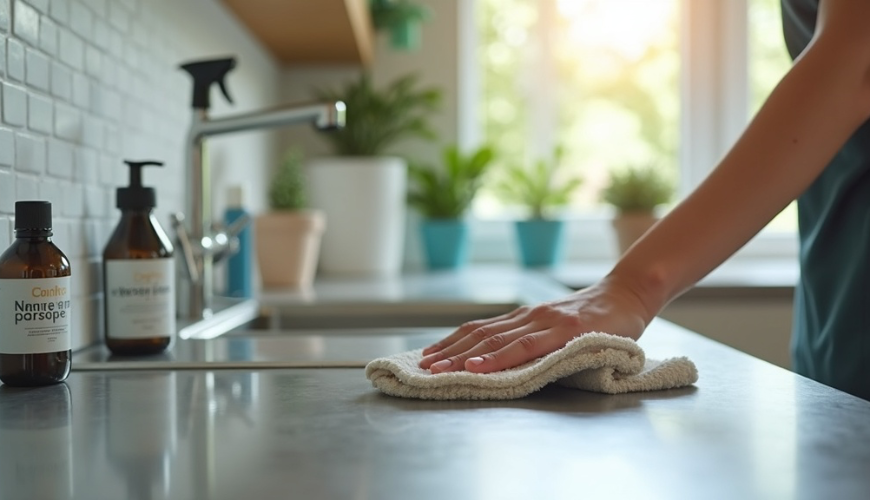
In recent years, nano cleaning has become a topic that has transitioned from laboratories and industry into everyday households. Bottles labeled "nano," cloths promising miracles, and impregnations that supposedly make water "run away" from surfaces—all these products appear enticing. But what exactly does it mean when we talk about what nanotechnology is, and why should it affect how quickly a bathroom is cleaned or how long windows stay clean? And more importantly: does cleaning with nano products and tools really work as often advertised, and how does it fit into an eco-friendly household?
To start, it's good to state one thing without marketing: "nano" is not a magic word. It refers to working with extremely small particles and structures—and that's why in some situations, it can bring very practical advantages. In others, it's more of a clever packaging that tries to appear modern. A sensible approach isn't an enthusiastic "I'll take everything nano," nor an automatic "nano is a scam." It's more about asking: where does it make sense, where doesn't it, and how to use it in a way that's truly gentler on the household and the environment?
Try our natural products
What is nanotechnology and why is it mentioned in cleaning
When discussing what nanotechnology is, it usually refers to working with materials on the nanometer scale—that is, a billionth of a meter. For perspective: a human hair is approximately tens of thousands of nanometers thick. At this scale, the properties of surfaces and materials can change: water behaves differently, dirt adheres differently, and some organic residues decompose differently. It sounds abstract, but in practice, it often means one thing: a surface can be modified so that dirt adheres less or can be wiped off more easily.
The basic principles on which nano in cleaning typically stands are twofold. The first is surface modification (such as impregnating glass, ceramics, or stainless steel), which creates a very thin layer with certain properties—often hydrophobic (water-repellent) or conversely hydrophilic (water spreads evenly into a thin film). The second principle is the mechanics and structure of nano fibers or particles in tools (such as some cloths), which, due to their very fine structure, are better at capturing dust and grease.
It's fair to add that nanotechnology is not a "new invention" of the last two years. It has been used in medicine, electronics, and materials research for a long time. You can get a clear overview, for example, through a basic explanation of nanotechnology on the Encyclopaedia Britannica website, which helps separate the general principle from advertising shortcuts. And if someone is looking for a perspective from the field of public health and chemical regulation, it's worth following the frameworks of European chemical policy (such as ECHA – European Chemicals Agency, which also deals with the safety and information on substances introduced to the market).
But in households, the issue is usually not about nanometers, but a simple question: is cleaning really better with nano?
Nano cleaning in practice: when it helps and when it's just a promise
Under the term nano cleaning, several different categories of products are hidden today. Sometimes it's about nano impregnation for glass and shower enclosures, other times it's "nano" products for stainless steel, tiles, or upholstery, and sometimes it's tools like cloths or mops. If the debate is to be fair, it's good to distinguish what to expect from what.
The most common and most visible effect for the average household is usually impregnations on smooth surfaces. A typical situation: a shower enclosure where warm water, soap, and hard water with minerals alternate. The result is usually limescale, spots, and a matte coating that's hard to remove. A nano protective layer can cause water droplets to cling less, run off faster, and leave fewer marks. It doesn't mean the shower "cleans itself," but that dirt doesn't "bite" into the surface as quickly. And that's a difference that almost everyone appreciates in real life.
It's similar with glass and mirrors: if dust and grease adhere less, less aggressive intervention is often sufficient. Instead of a strong degreaser, a milder product and a quality cloth can suffice. In this sense, nanotechnology can paradoxically lead to using less chemistry—and that already touches on the topic of ecology.
But then there's the other side. A nano coating or impregnation is still a product that needs to be manufactured, packaged, and applied. Sometimes it contains solvents, sometimes other additives that are not ideal for sensitive households. Moreover, the layer gradually wears off and needs to be renewed. Therefore, it makes sense to think about where the benefit is the greatest: most often where the most "force" is usually consumed—time, friction, water, and cleaning agents.
This is nicely illustrated by an example from a typical household. A family in an apartment with a shower enclosure solves the daily operation: a quick shower in the morning, kids in the evening, weekend cleaning. The enclosure is cleaned often because the spots are visible immediately. When a protective layer is applied to the glass and a simple habit is introduced—wiping down the water with a squeegee after showering—something surprisingly "non-nano" usually happens: less cleaning is needed because dirt doesn't have time to settle. The nano layer can play a role, but the decisive factor is the combination of surface protection and a small daily ritual. In practice, a gentle cleaner is enough from time to time, instead of reaching for a strong descaler every week.
And what about "nano" cloths and tools? Here, it's good to be cautious. Some modern textiles (such as very fine microfibers) really work excellently mechanically: they collect dust and grease with less water. However, it's not always necessary for it to be "nano" in the true sense—often a quality and properly used cloth is enough. If a product promises to clean burnt grease on a stove without any agent, healthy skepticism is warranted. For grease and burnt residues, sometimes time, heat, soda, or a gentle degreaser—and above all, patience—are needed.
The debate also includes the question of whether some nano products are merely renamed regular products. Marketing knows how to work with the impression of "science." The real benefit, however, is best recognized by the household based on whether the frequency of scrubbing is reduced and the consumption of cleaning agents decreases after application. If neither happens, the nano label alone solves nothing.
"The best cleaning is the one that doesn't have to be done as often," is sometimes said in households seeking a balance between cleanliness and time. And this is where nano often has the greatest chance: not in replacing cleaning, but in moving it to a more pleasant level.
How to use nanotechnology in the household and how to align it with an eco-friendly household
The question of how to use nanotechnology in the household can be answered simply: wherever it pays to protect the surface and limit the repeated use of aggressive agents. Most often, this involves the bathroom, kitchen, and textiles.
The bathroom is a classic: shower enclosures, tiles, faucets, screens. Protective layers can reduce the adherence of limescale and soap residues, leading to less pressure on "strong chemicals." In the kitchen, stainless steel (fingerprints), glass surfaces, and sometimes even countertops are often addressed. For textiles and upholstery, impregnations appear that aim to reduce liquid absorption and make stain removal easier.
However, particularly with textiles and items that come into contact with skin (children's car seats, pillows, clothing), it's worth reading the composition and manufacturer information very carefully. An eco-friendly household isn't just about "less scrubbing," but also about what gets into the air, water, and onto the skin. If a product contains problematic substances or its use is associated with a significant smell of solvents, caution and the search for a more environmentally friendly alternative are warranted.
A crucial detail: an eco-friendly household is not a competition in perfection. It's more a set of sensible decisions that together create a smaller footprint and less unnecessary burden. Nano can fit into such an approach, but only when used purposefully and moderately. Ideally, the result will be:
- less water and cleaning agents during regular cleaning,
- longer lifespan of surfaces (less scratching from scrubbing, less chemical "erosion"),
- fewer disposable tools (paper towels, disposable cloths).
This is, by the way, often an overlooked ecological aspect: when surfaces are easier to clean, there's a greater chance that the household can do without repeatedly buying strong specialized cleaners for every room. And if a quality reusable tool (cloth, brush, squeegee) is added, the overall impact can be pleasantly lower.
It's also good to remind that "eco" doesn't mean "ineffective." There are gentle agents that work excellently, but they sometimes need to be used more cleverly: let them work, use warm water, wipe them off with the right tool. Nano protection can be something like prevention in such a household: it helps delay the moment when intensive solutions are needed.
And now to the question many people ask: does cleaning with nano products and tools work without compromises? The answer is "sometimes yes, sometimes no"—and it depends on expectations. If it's expected that a nano spray will spray a shower once and there will never be limescale again, disappointment will follow. If it's expected that thanks to surface protection, cleaning will be faster and gentler, it often works out.
From a credibility standpoint, it's useful to also observe how manufacturers communicate safety and usage. A serious product has a clear manual, information on suitable surfaces, a warning about ventilation, and possibly even a safety data sheet. If the description is vague and relies mainly on superlatives, it's a signal to slow down. And if someone wants to get a general understanding of chemical substances, it makes sense to have an authoritative source like ECHA at hand, where a range of information about substances and their classification can be found.
In an eco-friendly household, a simple rule works well: prevention and mechanics first, then chemistry. Nano protection is in this respect a unique category—it's "chemistry," but in the service of prevention. When used sensibly, it can reduce the need for further interventions. If overdone and everything gets impregnated, including things that don't need it, the effect gets lost in the amount of consumption and waste.
One more practical note, which often determines whether people say "nano works" or "doesn't work": application. The surface must be really clean and degreased before applying the protection, otherwise, the layer won't adhere evenly, resulting in streaks, spots, or no effect. And this is where nano sometimes paradoxically disappoints—not because the principle doesn't work, but because a step was skipped that is "forgivable" in ordinary cleaning but crucial for a protective layer.
All in all, nano cleaning is not a miraculous shortcut, but it can be a smart helper for households that want to clean less aggressively, with fewer agents, and without endless scrubbing. Combined with simple habits—ventilating the bathroom, using a squeegee after a shower, immediately wiping spills in the kitchen, and using quality reusable tools—it can make very good sense. And if a healthy dose of critical thinking is added when selecting products, "nano" can transform from a trendy word into a practical thing that fits naturally into an eco-friendly household: not as a replacement for care, but as a way to do it with less effort and less burden.