

Dancing as great cardio and stretching is a way to move without boredom and pressure.
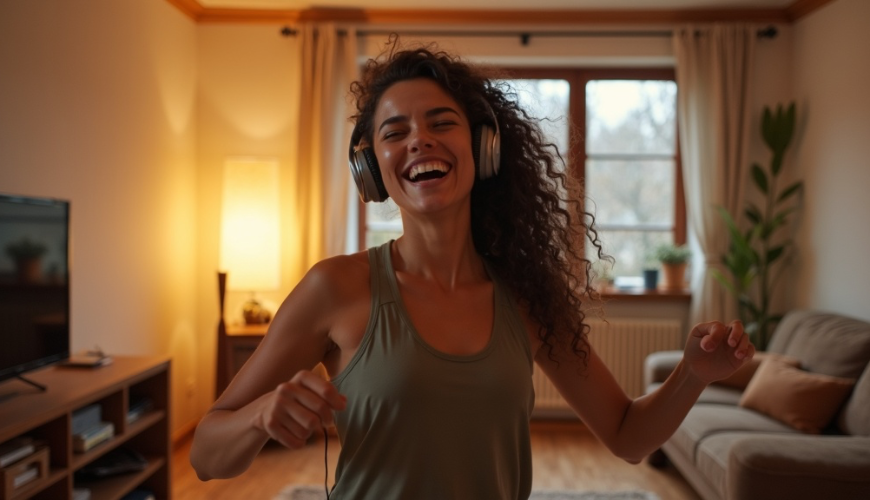
When people hear "cardio," many envision a treadmill, panting to the rhythm of beeping watches, and counting down the minutes until it's over. However, a movement that raises the heart rate, gets the joints moving, and even improves mood doesn't have to look like a workout. Dancing is great cardio and stretching, and it also offers something in one package that is hard to find in traditional exercise: ease, playfulness, and the feeling that the body is working "as it should" without having to force oneself. It's no coincidence that dance classes and home "living room dancing" are making a comeback—at a time when many spend all day at the computer, natural, rhythmic walking and torso rotation are almost a small miracle.
Dance is often considered an evening entertainment or a social skill. However, when viewed through the lens of a healthy lifestyle, it starts to make sense as dance instead of exercise—not because it should replace everything, but because it can cover a large part of what people want from movement: better fitness, more flexible body, stronger core, and more natural posture. Plus, it adds the bonus of joy, which keeps a person engaged in movement longer than any app plan.
Try our natural products

Why Dancing is Great: Cardio That Doesn't Ask for Performance
Dance raises the heart rate similarly to brisk walking, running, or cycling—with the difference that the intensity naturally fluctuates with the music and mood. This "wave" is surprisingly pleasant for the body: it picks up for a while, slows down, and sometimes speeds up to the chorus. In practice, this means that even without a strict regime, dance can be good for cardio and gradually improve endurance. It's not just a subjective feeling of getting winded—regular aerobic activity is long associated with heart and vascular health, and general recommendations for physical activity are summarized by organizations like the World Health Organization (WHO).
What's interesting is how quickly dance engages the whole body. Running is great, but it relies on a repetitive pattern. Dance, on the other hand, alternates directions, heights, tempo, and arm work, thus naturally activating more muscle groups. Cardio doesn't happen "in the background," but flows through the entire body—from the feet through the calves, thighs, and buttocks to the torso and shoulders. And when you add music that you enjoy, the performance often increases on its own. Who would want to hold back when their favorite song is playing?
Besides physical fitness, dance has another significant aspect: psychology. Fun is not just a pleasant bonus, but often the key to regularity. It's fun that helps the body from the inside and outside—from the inside by moving circulation and boosting energy, from the outside by improving flexibility, coordination, and overall "body expression." In times when stress accumulates in the shoulders and jaw, rhythmic movement can be a way to safely release tension. As a quote circulating the dance world aptly puts it: "When the body moves, the mind moves too."
Although dance is sometimes spoken of as a "lighter" activity, it's important not to underestimate it. Try doing three songs in a row without a break and with full effort—and it quickly becomes clear that dance as cardio is not a metaphor. Moreover, it can be easily scaled: someone might start gently, with a smaller range of motion, while another opts for an energetic style, jumps, and quick direction changes. Everyone can find their own intensity without feeling like they're "doing something wrong."
Dance as Stretching, Mobility, and Posture Without Boredom
When people think of stretching, many imagine static positions where they wait for it to "release." In dance, stretching is often a byproduct: the body extends to the sides, rotates, raises arms, lengthens the spine, and doesn't stay still. That's why it's fair to say that dance is great cardio and stretching—in one moment, it speeds up the heart rate, in the next, it opens the chest or relaxes the hips.
Modern life almost programmatically shortens certain areas: sitting closes the hips, the chest curls forward, the head protrudes towards the screen. Dance naturally counters this because it often works with the opposites of these patterns: a step to the side, torso rotation, arm movement backward, chest "up," weight on the whole feet. Dance is good for mobility and posture also because it's based on spatial and rhythm perception—teaching a person to stand in a way that allows smooth weight transfer and breathing.
Especially interesting is how dance teaches the body coordination. It's not just about "moving somehow," but about synchronizing movement with music, with steps, with hands, with balance. This improves proprioception, or the awareness of body position in space. The result often shows up even outside the dance floor: more confident walking, less "stiffness" in the back, better stability in everyday activities.
Here's a real-life example that surprisingly many people know. Imagine someone working all day at a computer and feeling "stuck" in their shoulders and hips by evening. The gym doesn't appeal to them, running bothers their knees, so they play a ten-minute dance video or just their favorite playlist at home and start moving. It's not about choreography for a competition, more about waking the body: a few steps to the side, shoulder circling, slight pelvic tilting, arm stretching overhead. After a few weeks, something subtle but important often happens—a person notices they sit better during the day, straighten up more frequently, and feel less "pulled" by the neck. It's not an overnight miracle, but rather the sum of small movements that finally make it into the body regularly.
Dance is good for cardio, mobility, and posture because it naturally alternates stability and dynamics. At one moment standing on one foot, then transferring weight, followed by a turn or a step back. This engages the deeper muscles that keep the spine and pelvis in a "decent" position. And when conscious work with posture is added to the dance—long neck, relaxed shoulders, active core—it can become an understated school of healthier stance.
Dance Instead of Exercise: How to Start and Stick With It for Effectiveness
The idea of dance instead of exercise might sound like an enticing shortcut, but it's actually more of a change in approach. It's not about "cheating" on movement, but finding one that is sustainable. Dance has the advantage of being adjustable in terms of time and energy. Sometimes ten minutes between work and dinner suffices, other times a half-hour in the evening when one wants to air out. Regularity is important—and it's often ensured precisely because dance is enjoyable.
To make dance truly beneficial for fitness and the body, it's helpful to adhere to a few simple principles, without excessive rules or the feeling of having to "push hard." Dance as great cardio and stretching happens best when the body has space to warm up, get slightly winded, and then relax as well.
The Only Practical List That Makes Sense
- Start slowly and give the body 5 minutes to warm up: calmer song, smaller range of motion, warming up the neck, shoulders, and hips.
- Alternate intensity: one faster, one medium—heart rate rises but doesn't burn out at the start.
- Think about feet and knees: softer landing, knees not hyperextended, footwear or barefoot dancing depending on the surface.
- End with a few slow movements: pelvic circling, arm stretching, back relaxation—the body will appreciate it.
If someone doesn't want to learn choreography, it's not a barrier. Even free dance has value. The important thing is to move in a way that's safe and pleasant. If, on the other hand, someone enjoys learning from videos, it's good to choose ones that fit their fitness level and don't unnecessarily strain the joints. In this respect, it's worthwhile to heed the body's signals: pleasant fatigue is okay, sharp pain is a stop sign.
For many, the environment is also crucial. Dancing can be done at home, outdoors with headphones, in a class, at a community event. Each option has its benefits. At home, there's no shyness, in a class, the group's energy and guidance help. And when a social aspect is added—like swing, salsa, or ballroom dances—movement becomes a way to meet people. Meanwhile, it still holds true that why dancing is great often reveals itself over time: a person starts looking forward to it because it's not just a "health task," but an event.
A healthy lifestyle is not only about training but also about how one feels in their own body. Dance can improve the relationship to movement itself. Instead of control and performance, it brings curiosity: how does the body move when we allow it? How does breathing change when the ribs straighten and the shoulders relax? And what happens to the mood when a person stops monitoring themselves for three minutes?
Those who want to connect dance with broader body care often find that small things make a big difference: comfortable clothing made of pleasant materials that don’t constrict and allow free movement, hydration, room ventilation, and also recovery. Dance is playful, but it's still a load—and the body deserves to be treated considerately. In this regard, it's useful to stick to verified recommendations for movement and health, which are long summarized by authorities like the Centers for Disease Control and Prevention (CDC) or the NHS.
And perhaps most importantly, dance makes sense even in periods when one doesn't feel like "exercising." Fatigue, a long day, bad weather—these are all classic reasons why a workout gets postponed. But playing one song is mentally much easier than changing clothes and planning. Often it starts with one track and ends with three. And even if it doesn't, it was still movement that got the blood flowing, relaxed the back, and reminded us that the body isn't just a transport vehicle for the head.
Dance thus ultimately works as a subtle answer to the question hanging in the air: does healthy movement have to be a grind? Dance as great cardio and stretching shows that it doesn't have to be. All it takes is music, a little space, and the willingness to take the first step—literally. And then it often takes off on its own because the body remembers that movement can be natural, joyful, and surprisingly effective.