

Which foods are good for the brain when you want to support memory and concentration
The brain is a peculiar organ: it weighs roughly as much as a small melon, yet it controls everything—from mood and memory to how quickly one makes decisions. And although we often hear about training the mind, getting quality sleep, or practicing digital hygiene, one thing is often unjustly sidelined: what regularly ends up on the plate. It's not about miracle pills or "hacking" the body. It's more about long-term, subtle support, consisting of small decisions—having breakfast instead of skipping it, choosing water over a third coffee, and eating foods that truly nourish the brain.
When someone asks, which foods are good for the brain, the answer will never be just one "best" option. The brain is demanding: it consumes a surprising amount of energy and is sensitive to the condition of blood vessels, blood sugar stability, and levels of inflammation in the body. This is why the topic of superfoods and their effects is so frequently discussed today—not as magic, but as nutrient-dense foods that make sense in a real-life diet.
Below are five "brain" superfoods that can be eaten regularly in everyday life, along with some ideas for meals to cook for better brain function and thinking. It's not about perfection; it's about rhythm.
Try our natural products




What "brain food" actually means and why it matters
The brain loves stability. When eating irregularly, consuming lots of sweets or ultra-processed foods, a typical scenario often occurs: a quick surge of energy, a short wave of "performance," followed by a crash—irritability, lack of focus, a craving for more sweets. This isn't laziness or weak willpower; it's biology.
Brain nutrition is primarily based on three pillars: quality fats (the brain tissue is literally interwoven with them), micronutrients (vitamins, minerals, and antioxidants), and good circulation (because nothing functions without oxygen and nutrients). Those looking for proven connections can start, for example, on the Harvard T.H. Chan School of Public Health website or check out the reviews on omega-3 fatty acids at NIH – Office of Dietary Supplements. These aren't the "only sources of truth," but they're solid starting points.
There's also another aspect that's discussed less: food affects mood. The gut and brain communicate (the gut-brain axis is often mentioned), and even though popular texts sometimes exaggerate, the basic idea is simple: when the body is long-term deprived of nutrients, the brain adapts—usually not in a way one would desire.
5 brain superfoods worth keeping on hand
1) Fatty fish: salmon, sardines, mackerel (and even herring)
If one topic is repeated over and over in connection with the brain, it's omega-3 fatty acids (EPA and DHA). Not because a person can't think without them, but because they are an important part of cell membranes and relate to how "smoothly" nerve cells communicate signals. Fatty fish are also practical: just one or two servings a week can advance the diet significantly.
In everyday life, the biggest challenge is often that people don't know how to prepare fish without stress. Yet it can be simple: fillets on baking paper, a bit of olive oil, lemon, salt, pepper, and herbs. Ready in 15 minutes. Add some potatoes in their skins and a salad, and the brain gets a combination that is filling, stable, and nutritious.
It's also worth mentioning a more practical alternative: sardines. They are cheaper, often more sustainable, and wait in a can for when there's no time. Sardines with whole grain bread, sauerkraut, and a bit of mustard might sound plain, but for a "brain" day, it's a very decent choice.
2) Walnuts: a small snack, a big service
Walnuts rightfully appear on brain food lists. They contain unsaturated fats, including plant-based omega-3 (ALA), and a range of antioxidants. They're also easily portable, which can be crucial. The brain often "crashes" not because one eats poorly, but because one doesn't eat at all, then reaches for the first quick sweet fix.
A real-life example from office life: around three in the afternoon, a deadline, meetings, a head full of tasks. In the kitchen, there's only a cookie or a vending machine. But in the drawer awaits a jar of nuts and a few pieces of dark chocolate. Those few minutes spent eating something real often do more than another coffee—because energy is boosted without a sharp sugar spike. Plus, it's a habit that's easy to maintain.
Just watch the quantity: nuts are nutritious but also calorie-dense. An ideal serving is a small handful. Regularly, not sporadically.
3) Blueberries and other dark berries: antioxidants that make sense
When talking about superfoods and their effects, berries are one of the few examples that are both popular and well-defensible: they contain a range of antioxidants (anthocyanins are often mentioned), which support cell protection against oxidative stress. For the brain, it's interesting mainly because it's a food that can be eaten often and naturally—in porridge, yogurt, smoothies, or just by themselves.
Blueberries (and similarly blackberries, blackcurrants, or aronia) have another advantage: they help "sweeten" the diet without needing to reach for sugar. Those who get used to adding a handful of berries to their breakfast often find they don't need to add much sweetener anymore.
And if fresh isn't available? Frozen berries are a great choice. In winter, they are often more practical than "tired" fruit from long transport.
4) Leafy greens: spinach, kale, arugula, Swiss chard
Leafy greens might be less "sexy" than exotic powders, but for the brain, they make excellent sense. They provide folate, vitamin K, other micronutrients, and fiber, which helps stabilize energy throughout the day. And importantly: leafy greens can be eaten even when one isn't in the mood for big cooking.
Simply "sneak" them into everyday meals: into an omelet, pasta, soup, or legume salad. Those who love quick dinners will appreciate a simple combination: in a pan garlic, olive oil, a handful of spinach, chickpeas, lemon, and salt. In ten minutes, the meal is ready, and it's precisely the type of dinner after which you can still read, work, or focus—instead of falling into a "food coma."
As often quoted, the phrase that shows up in various forms: "The brain is not separate from the body—it is part of it." And leafy greens are one of the simplest ways to supply the body with what often lacks in a fast-paced routine.
5) Cocoa and quality dark chocolate: if sweet, then smarter
Yes, chocolate can belong on the list of "brain" foods—if we're talking about quality dark chocolate with a higher cocoa content. Cocoa contains flavonoids and other compounds being studied in connection with circulation. From a practical standpoint, it has another advantage: it helps people stick to a better regime by satisfying a sweet craving with a smaller amount.
It's not about eating a bar a day. More about a small ritual: two squares after lunch, ideally with nuts or fruit. Combined with coffee, it is a pleasant alternative to a dessert that would otherwise bring more sugar and less benefit. And if pure cocoa is used in porridge or homemade pudding, it can be sweetened lightly—perhaps with a banana or a bit of honey.
What meals to cook for better brain function and thinking (without complicated recipes)
When "brain food" is mentioned, many people imagine either a strict plan or, conversely, exotic ingredients. But the most significant effect often comes from a simple change in the structure of the day: a breakfast that satiates; a lunch after which one can function; and a dinner that doesn't weigh you down. Along with a few smart "brain" ingredients that repeat.
Meals that combine protein + fiber + quality fat work well. This simple formula helps stabilize energy and maintain focus. And then, you add some of the above-mentioned superfoods.
For specific inspiration, here are a few combinations that can be varied:
- Oatmeal with plain yogurt or curd, a handful of blueberries, and a spoonful of chopped walnuts; for those who want, add cocoa and cinnamon. The result is a breakfast that provides not just quick sugar, but also long-term fuel.
- Salad bowl: leafy greens, roasted potatoes or quinoa, a can of sardines, olive oil, lemon. It looks like a "photo meal," but it's actually one plate that can be assembled quickly.
- Pasta with leafy greens and legumes: whole grain pasta, spinach, chickpeas, garlic, a dash of olive oil. For those who want, add Parmesan. It's a meal that fills but doesn't put you to sleep.
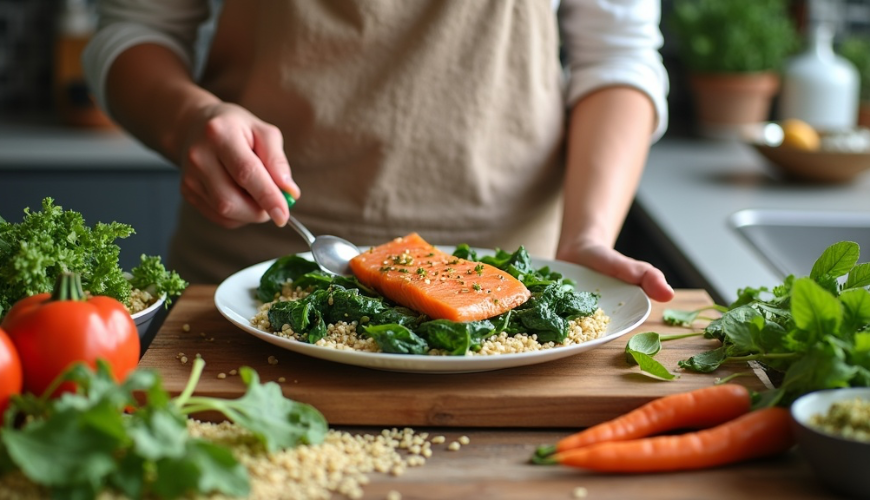
- Baked salmon with vegetables and a simple yogurt and lemon dip. If you make a tray for two days, lunch is ready the next day without effort.
Notice that it's always the same principle: nothing extreme, no prohibitions, just assembled ingredients that give both the brain and body stability.
Which foods are good for the brain outside the "top five" (and what to curb)
Five superfoods sound nice, but the brain doesn't function in an "either-or" mode. It's good to think about the broader context: a quality drinking regime, regularity, and fewer ultra-processed foods that often combine lots of salt, sugar, and low nutritional value. In the long run, it's not just about memory or creativity, but also about the condition of the blood vessels and metabolism.
Other foods often mentioned as "good for the brain" include eggs (for choline), fermented foods (for gut comfort), legumes, and whole grains (for fiber and stable energy) or olive oil. It's not necessary to "cram" them all into the diet immediately, but it's useful to notice the recurring theme: real, minimally processed food.
And what most commonly sabotages concentration? Typically a combination: nothing in the morning, then a big sweet snack, something heavy for lunch, and "catching up" on energy in the evening. The brain operates in a see-saw mode. Sometimes a small change is enough: adding nuts to a snack, swapping a sweet yogurt for a plain one with fruit, or bringing a salad to work that also includes protein.
Those who think in terms of sustainability will appreciate that many "brain" foods are also eco-friendly and practical: legumes, nuts, leafy greens, frozen berries, canned fish. In an eco-friendly household, small surrounding items are also handy—well-sealing snack containers, jars for nuts, a quality water bottle. Healthy habits are often easier to maintain when they're accessible.
The brain might not audibly ask for blueberries, but it shows otherwise: more stable energy, better attention, and less craving to "nibble" something sweet every hour. And isn't it a pleasant thought—that supporting thinking can start as simply as having a handful of nuts in your bag or adding spinach to dinner?