
Minimalism for Children: Clearing the Room to Create More Space for Real Play
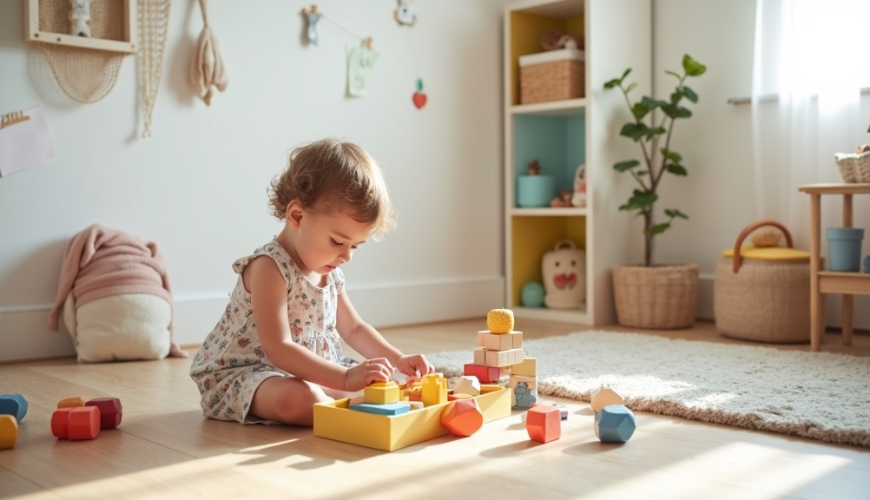
A children's room is often a special place: on a few square meters, imagination, safety, and the daily operations of the whole family meet. And also piles of things. A single visit to the grandparents, a few birthday parties, and several "just because" rewards can turn a box of blocks into a system of boxes, shelves, and bags that no one manages anymore. Yet, it is increasingly apparent that children don't really need that many toys. Not because they shouldn't play—quite the opposite. But because play needs space, calm, and the opportunity to dive into it. And that is surprisingly hard to achieve in a cluttered room.
The idea of minimalism for children doesn't have to sound like a strict regime or a prohibition of joy. It can be more of a gentle change of direction: instead of "more things," prioritize "more play." Instead of endlessly sorting through toys, offer a few that last, grow with the child, and are truly used. And most importantly—instead of a daily battle with clutter, gain a bit of lightness at home, which often reflects on the mood of all household members.
Try our natural products

Why children don't need so many toys: when "more" means "less"
It's a paradox that parents often recognize intuitively: the more toys a child has, the more often you hear, "I don't know what to play with." An excess of options is tiring. Just like adults sometimes feel uncertain in front of a long menu in a restaurant, a small child can be overwhelmed by a shelf full of colors, sounds, and different features. In such a moment, play shortens to quick dashes from one thing to another without deeper immersion.
Interesting insights are offered by research on the impact of the number of toys on concentration. A frequently cited study published in the journal Infant Behavior and Development showed that toddlers played longer and more creatively with a smaller number of available toys than with a large quantity. It makes sense: when there are fewer toys, a child explores them more, seeks new ways of using them, and can stay with one activity longer. Those interested in a broader context of how attention and self-regulation develop in young children can start with the overview materials from the American Academy of Pediatrics—an authoritative source dedicated to child development and the environment in which children grow up.
Besides concentration, the quality of play also plays a role. Many modern toys are "finished": they blink, talk, and perform the story themselves. The child then becomes more of a spectator than a creator. This doesn't mean every interactive toy is wrong, but if they prevail, there's less room for original ideas. In contrast, simple things—blocks, figures, fabrics, trains without buttons—encourage the brain to fill in, invent, and negotiate rules. And it's here that skills are born that will be useful later in school and life: patience, perseverance, problem-solving ability.
There's also a practical aspect to consider. A cluttered room complicates cleaning but mainly complicates orientation. A child has a harder time finding a favorite thing, quickly loses track, and toys become noise. Parents often end up tidying up themselves because it's faster. Yet, this deprives the child of the opportunity to naturally and gradually learn to care for their belongings. Fewer toys paradoxically mean more independence: the child knows where things belong, and tidying up ceases to be an endless punishment.
Lastly, there's the value aspect. Children notice what happens at home. When joy is regularly associated with a new thing, a simple equation arises: "when I want something, I get it." A more minimalist approach can offer a different story: that joy can be experienced without shopping, that things have their time and place, and that caring for what is already at home has value.
"Simplicity is the ultimate sophistication."
This often-attributed thought (in various forms) is surprisingly literal in the children's world: a simple environment often allows for richer play.
Minimalism in children is not about emptiness but about space for play
When the word minimalism is mentioned, many imagine a sterile apartment and white shelves without a single book. For children, it makes more sense to understand minimalism as a conscious choice: keeping what is used, what supports play, what is age-appropriate, and what the family can maintain at home.
The emotional dimension is also important. Children's items often carry not just a function but a story: a gift from an aunt, the first plush toy, a car from a trip. Minimalism for children is not a race to see who can throw away more but a sensitive search for balance. What does the child truly love? What is just "extra" because it came home automatically? And what is actually more of a burden than a joy?
Practically, it helps to view toys as a "library." A library doesn't need to contain all the books in the world—just one where you can choose, find, and read. Similarly, a child's room can function as a place where about 20–30 meaningful items are available (numbers are indicative and depend on age and space), while the rest is out of sight and rotates. The child thus experiences a sense of novelty without accumulating more and more.
A change in perspective also helps: a toy is not just an object but a commitment. Every item at home means space, maintenance, tidying up, occasional repair, and mental attention. When there are too many toys, tension grows in the family—not because parents "can't handle it," but because the system is overloaded. Minimalism in children is often not just about the children but about the overall atmosphere at home. A calmer space is a calmer mind.
And how does sustainability fit into this? Naturally. Fewer things usually mean less waste, fewer impulsive purchases, and more thoughtful choices. For instance, wooden, durable, and repairable toys, or second-hand items that have already proven to last. For a household trying to live more sustainably, this is one of the simplest steps: instead of strict resolutions, just slow down the influx of new things.
How to have fewer toys: a gentle plan that children will accept
The question "how to have fewer toys" sounds simple, but in practice, it collides with emotions, habits, and external pressure. However, there are approaches that work without drama and without the feeling that something is being taken away from someone.
It surprisingly starts with adults. If a family wants to decrease the number of toys, it first needs to clearly set how new things come into the home. It's often not about a one-time clean-up but about stopping the inflow. It's helpful to agree before birthdays: fewer gifts, but more meaningful ones, or perhaps a shared experience. In some families, a simple rule has proven effective: one larger item instead of five small ones that get lost in chaos within a week.
Then comes the actual sorting. With younger children, it's worth proceeding quickly and practically: broken items go, incomplete puzzles into a "to complete" box with a deadline to try and find them, and toys that are out of age range are stored or passed on. With older children, it's better to involve them in decision-making—but sensitively. Not in the "pick half and throw it out" style, but with questions: which toys are used? Which are favorites? Which are more of an obstacle?
In real life, it might look like this: a family with a preschooler finds that evening cleaning takes up to 40 minutes, and still, everything is scattered the next day. Meanwhile, the child most often reaches for three things: a magnetic building set, animal figures, and art supplies. So, a "test" is done over the weekend—for two weeks, only what's really used stays in the room, plus a few books. The rest goes into boxes and is stored outside the room. The first two days, the child is curious and protests a bit, but then something interesting happens: play lengthens, stories are invented, figures have block houses, and art supplies create backdrops. Suddenly, cleaning takes ten minutes, and there's more time for reading in the evening. After two weeks, it's clear that most of the stored toys are not missed by anyone. And that's precisely the moment when minimalism stops being theoretical and starts making sense in everyday life.
Toy rotation is also very effective. Some items are "in circulation," others rest in a box. After a month, they are swapped. The child feels novelty, parents have less clutter, and toys don't become stale. Moreover, this naturally reveals what has real value: some items keep returning to circulation, others never get unpacked.
When it comes to donating or selling, it's helpful to stick to simple logic: items that are complete and in good condition can bring joy elsewhere. Children often more easily accept that a toy is "going on," rather than being "thrown away." Sometimes a specific goal helps—like a charity drive, a children's home (according to the current needs of organizations), or a family of acquaintances. It's important for the child to feel that something meaningful is happening, not that a piece of their world is being taken away.
And what if a child holds onto everything? That happens too, especially with more sensitive children or during periods of change. Then the "temporary box" method can help: selected toys are stored with the understanding that if the child remembers something, they can take it back anytime. After a month or two, it's often revealed that no one asked for anything even once. No loss occurs, just space is freed up.
In practice, a few simple principles can be followed without turning the home into a project:
- Only toys that are actively played with should be accessible, the rest can rotate or wait to be passed on.
- New toys should arrive slowly and consciously (ideally with regard to quality, repairability, and long-term usability).
- Tidying up should be manageable for the child—if the system is too complicated, it doesn't work.
This brings us to the most important point: why this is important for children and how it helps them. Minimalism in children isn't just about a nice room for a photo. It's about the child gaining more space for their ideas, less distraction, greater ability to make decisions, and also a healthier relationship with things. They learn that things aren't disposable, that they require care, and that less can be surprisingly pleasant.
In the long run, a more moderate environment has another advantage that parents often realize only later: when there's no constant pressure for more purchases at home, it's easier to invest in what really works—quality shoes, healthier food, shared trips, a hobby that the child enjoys. And also in small things that make the home more sustainable: for example, reusable snack wraps, more eco-friendly household products, or durable clothing. In this sense, fewer toys are not seen as a limitation but as a shift in focus to what truly nourishes the family.
Ultimately, there’s one ordinary truth that's comforting: a child won't remember how many toys they had. They will remember whether they had time to play. Whether they had the peace to build a long track, create their own world, and invite others into it. And whether home wasn't just a place where cleaning was constant, but where you could simply live.