
Homemade granola is worth it because you have control over the sugar, fat, and quality of the ingred
Homemade granola has a special ability: it can turn an ordinary breakfast into something you look forward to all evening in just a few seconds. The crunch of oats, the aroma of nuts, the light sweetness of honey or maple syrup, and a tangy yogurt or plant-based "yogurt" – simple, yet surprisingly addictive. This brings us to a topic that is increasingly discussed in kitchens: why make homemade granola when there are so many ready-made mixes in stores?
The answer is usually simple. The homemade version gives you control over the ingredients, sweetness, and quality of the ingredients, and it's one of those recipes that easily adapts to mood, season, and pantry contents. Anyone who has ever bought "fruit" granola only to find mostly sugar, a few raisins, and flavoring, will quickly understand that a recipe for tasty homemade granola is not just a culinary pastime but quite a practical skill.
Try our natural products
Why make homemade granola: control over ingredients and fewer unnecessary additives
Ready-made granolas differ more than they seem at first glance. Some are fine, while others are more like sweet treats than everyday breakfast. Industrially made mixes often contain higher amounts of added sugar, glucose syrup, or cheaper fats, promising "extra crunchiness." You can find this on the label, of course – but who has time to decipher tiny print in the morning?
The homemade version is liberating in this regard. Just a few basic ingredients and you know what you're eating. Sweetness can be minimized or increased if the granola is planned as an ice cream topping, for example. The fat can be of high quality – often olive oil, coconut oil, or ghee, depending on individual preferences. And most importantly: you can avoid unnecessary "enhancements" that don't make sense in a home kitchen.
It's also interesting that granola often presents itself as automatically healthy. But it's only "healthy" when it makes sense in the context of the entire diet. A good guideline is offered by the World Health Organization (WHO), which has long recommended monitoring added sugars and prioritizing a varied diet with natural sources of fiber. Homemade granola can fit perfectly into this – if prepared wisely.
Then there's another surprisingly strong reason: homemade granola can reduce waste. Leftover nuts from baking, the last spoonful of seeds, opened coconut flour, dried fruit that no one will eat alone… they all find new purpose in granola. The kitchen suddenly begins to think differently: what can be utilized before it gets lost on the shelf?
Recipe for tasty homemade granola that is crunchy and doesn't burn
Good granola is based on balance: oats as the base, nuts and seeds for flavor and nutrition, a sweetener and fat as "glue," and spices that create the final aroma. Then there's the baking technique – it's what determines whether the granola will be evenly golden or if some parts will burn while others stay soft.
Below is a recipe for tasty homemade granola in its basic form, which is easy to modify. The advantage is that it almost always works – even if the ratios change slightly depending on what you have at home.
Basic homemade granola (about 1 large baking sheet)
Ingredients:
- 300 g rolled oats (a mix of fine and whole is fine)
- 80–120 g nuts (walnuts, hazelnuts, almonds...)
- 2–3 tablespoons seeds (sunflower, pumpkin, sesame, chia)
- 1/2 teaspoon salt
- 1–2 teaspoons cinnamon (or gingerbread spice)
- 80–120 ml honey or maple syrup (to taste)
- 60–80 ml oil (mild olive, canola, coconut)
- optionally: 1 egg white (for extra crunch), vanilla
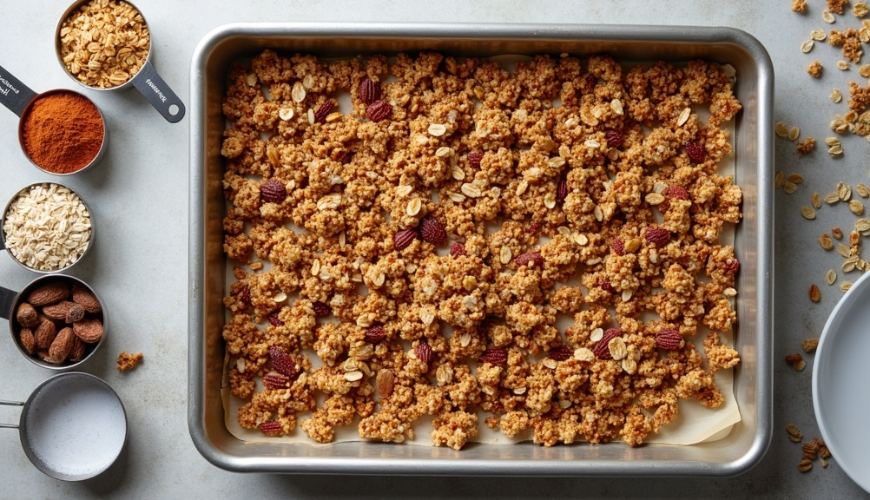
Instructions: First, preheat the oven to 160–170 °C and prepare a baking sheet with parchment paper. In a bowl, mix oats, chopped nuts, seeds, salt, and spices. In a small saucepan or bowl, combine honey/syrup with oil (coconut oil needs to be slightly melted). Pour the liquid mixture over the dry ingredients and mix thoroughly to coat as many oats as possible. For more pronounced "clusters," you can add lightly beaten egg white – it's not necessary, but it works.
Spread the mixture evenly on the baking sheet. Bake for approximately 20–30 minutes, but it's crucial to stir it periodically: after about 10 minutes, turn the granola to prevent the edges from burning. Toward the end, watch the color – granola darkens quickly and continues to "finish" after being removed from the oven. Let it cool completely before breaking into pieces. Add dried fruit (raisins, cranberries, apricots) only after the granola has cooled to prevent it from drying out and becoming bitter in the oven.
At this point, a small reminder is often useful, sounding banal but saving many baking sheets: granola becomes crunchy only after cooling. Tasting it hot and adding oven time "because it's soft" often results in burnt nuts. As they say: "Patience is the cheapest ingredient."
And now the real-life example that nicely illustrates this. In one typical household, granola began to be baked mainly because mornings were hectic: kids to school, parents to work, and the constant "we have nothing to eat." After a few tries, it became a ritual: bake a sheet on Sunday evening, fill a jar with the mix, and keep yogurt and fruit nearby. In the morning, it takes just two minutes – and instead of a cookie to go, there's a ready bowl that fills you up. The cost is often lower than quality store-bought mixes, and the taste can be adjusted so everyone at home "adds their own."
Different variations of homemade granola: seasonal, gluten-free, and almost sugar-free
Once you master the basics, there's room for different variations of homemade granola. And this is where the recipe becomes something that doesn't get boring: one time it smells of coconut and lime, another time it resembles apple pie, or it tastes "mature" thanks to cocoa and dark chocolate.
Nutty granola "like a dessert," but still breakfast-worthy
For those who like a strong flavor, increase the amount of nuts and add cocoa nibs or quality cocoa. After cooling, mix in pieces of dark chocolate. Less sweetener is needed because chocolate and nuts make the flavor richer. The result is excellent on Greek yogurt, where creaminess meets crunchiness.
Apple-cinnamon variation that smells like strudel
Add more cinnamon to the dry mix, or a pinch of ground cloves. After baking and cooling, mix in dried apples or pear cubes. Those who want can add a few extra walnuts. This variant is ideal when fresh fruit isn't as appealing, but the craving for "something cozy" remains.
Coconut granola with a tropical touch
Replace part of the oats with coconut flakes (these burn faster, so it's better to add them in the second half of baking). A pinch of vanilla works well, and after cooling, add dried mango or pineapple. Often, a milder oil and less sweetener are enough, as dried tropical fruit is sweet on its own.
Gluten-free homemade granola
Oats are naturally gluten-free, but they're often contaminated during processing. The solution is certified gluten-free oats, or a combination of buckwheat, rice, and quinoa flakes. The flavor is slightly different, but it works great with nuts and spices. It's always good to follow the specific needs of the individual and check the label on the packaging.
Lower sugar content variant (yet still tasty)
Here's a trick: part of the sweetness comes from spices and quality ingredients. Cinnamon, vanilla, cardamom, or a pinch of salt can enhance the flavor so that not much honey is needed. Part of the "glue" can be made from mashed ripe bananas or applesauce, though the resulting texture may be slightly less crisp. For those who want to keep the crunch, a smaller amount of syrup can be used and supplemented with nut butter, such as almond.
More protein-rich variant for days when breakfast needs to last longer
It's not necessary to complicate food, but sometimes it's useful for breakfast to be more filling. Adding more seeds (pumpkin, hemp), chopped nuts, and possibly a bit of peanut or almond butter to the liquid mixture helps. Protein powder is more challenging to add to granola (it can behave unpredictably in the oven), so it's often more practical to mix it into yogurt and leave the granola in its natural form.
Whatever variation you choose, it's good to follow a simple rule: bake flakes and "dry" ingredients, and add dried fruit and chocolate at the end. This keeps the flavor pure, and nothing gets burnt.
"Food we prepare at home isn't always perfect to look at, but it's often most perfect in that we know what's in it."
How to store homemade granola, so it doesn't get soggy
Granola has one weakness: moisture. Once it gets damp, the crunch disappears. That's why it's best to let it cool completely after baking and then store it in a well-sealed jar or container. In a dry pantry, it lasts about 2–4 weeks (depending on the nut and fat content), but in reality, it usually disappears faster. For larger batches, you can freeze part of it – once thawed, it's surprisingly good, or it can be "revived" in the oven for a few minutes.
Where to use it in the kitchen and beyond
Homemade granola isn't just for breakfast bowls. It's great as a topping on porridge, baked fruit, for a snack on a trip, or a quick work snack. And if there's a focus on more sustainable kitchen practices, granola is an ideal candidate for "buying in your own containers" – oats, nuts, and seeds are often available without packaging, and then you just need one or two jars at home that are constantly refilled. In the context of healthier eating and sustainability, it aligns well with recommendations long emphasized by authorities like Harvard T.H. Chan School of Public Health – that is, building a diet on quality, minimally processed foods.
In the end, homemade granola isn't an "Instagram project," but quite an ordinary kitchen habit that makes sense: a recipe for tasty homemade granola is simple, various homemade granola variations keep breakfast diverse, and the reasons for making homemade granola start to appear on their own over time – in taste, in the ease of morning, and in the fact that the pantry has fewer half-empty bags and more jars ready to serve whenever needed. And isn't it nice when something as ordinary as a bowl with yogurt suddenly tastes as if someone really cared about it?