

Learn how to stop morning overthinking right after waking up

The alarm goes off and before you even manage to open your eyes, your mind is already running at full speed. Today's meeting, yesterday's conflict with a colleague, an unpaid invoice, a shopping list... Morning rumination right after waking up is a phenomenon that a huge number of people are familiar with, yet it is surprisingly rarely talked about. And yet, how we start our day significantly influences our mood, productivity and overall health – not just mental, but physical as well.
Imagine Klára, a thirty-seven-year-old teacher from Brno. Every morning she wakes up at around six o'clock, but doesn't manage to get up until an hour later – and not because she's treating herself to some luxurious rest. She spends the entire time lying with her eyes closed while thoughts about work obligations, worries about parent-teacher meetings and feelings of guilt about things she didn't get done the day before spin through her head at dizzying speed. She then leaves for work exhausted before the day has even begun. Klára's story is not exceptional – on the contrary, it is very typical of today's world full of constant stimuli and information overload.
Try our natural products






Why does our brain immediately flood us with thoughts in the morning?
In order to understand how to prevent morning rumination or at least tame it, it is important to first understand why it occurs in the first place. The brain does not work like a computer that boots up clean and data-free after a restart. On the contrary – sleep is a period of intensive information processing for it. During the REM phase of sleep, the brain sorts, consolidates and stores experiences and knowledge from the previous day. When we wake up in the morning, this process has not yet fully ended, and the prefrontal cortex, responsible for rational thinking and planning, activates very quickly.
Contributing to this is also the level of cortisol, the stress hormone, which naturally peaks early in the morning – this is the so-called cortisol awakening response, which prepares the body for the coming day and increases the organism's alertness. Evolutionarily, this was an advantageous mechanism: our ancestors needed to quickly orient themselves in their environment in the morning and assess potential dangers. Today, however, this biological alertness collides with a modern reality full of abstract worries – emails, deadlines and interpersonal relationships – and the result is a chaotic whirl of thoughts before your feet even touch the floor.
The situation is further worsened by what psychologists call the "unfinished business effect", also known as the Zeigarnik effect: the brain remembers and actively recalls things that were not completed or resolved far more intensely than those that were. So if you postponed a decision or left a conflict unresolved the previous day, your brain will happily return to it in the morning – regardless of whether you are ready for it or not.
Morning rumination does not always have to concern negative things. Some people experience a flood of creative ideas or plans in the morning that seem exciting, but equally distract from the present moment and make getting up difficult. Whether it involves worries or dreams, the result tends to be similar: fatigue, distraction and the feeling that the day is starting in the red.
So how can this be changed? The good news is that there are a whole range of approaches that are backed by scientific evidence and are at the same time practically feasible even for people with packed schedules.
Specific ways to calm the mind right after waking up
One of the most effective tools is the so-called anchor routine – a short sequence of simple actions that teaches the brain that it doesn't have to immediately switch into problem-solving mode in the morning. This could be three deep breaths before you open your eyes, a mindful stretch of the body, or looking out the window without a phone in hand. The key is repetition: the more consistent the routine, the faster the nervous system memorises it as a signal of safety and calm.
Closely related to this is a recommendation repeated by psychologists and sleep experts around the world: don't reach for your phone first thing in the morning. Surveys show that a large proportion of people reach for their smartphone within the first minute of waking up. Social media, news and emails then immediately flood the brain with new stimuli, and worries that might not have even arisen take on a concrete form. Experts from the American Psychological Association repeatedly point out that technology and constant access to information are one of the main sources of stress for modern people – and this vulnerability is particularly pronounced in the morning.
Another approach that is gaining more and more followers is writing so-called "morning pages" – a method popularised by author Julia Cameron in her book The Artist's Way. The idea is that right after waking up, you write three pages of free-form text – anything that comes to mind, without censorship and without striving for literary achievement. This process helps to "pour out" the excess of thoughts onto paper, freeing up mental space for a calmer experience of the morning. Many people report that after a few weeks of regular writing, they wake up in the morning with a noticeably calmer head, because the brain stops functioning as a reservoir of the unspoken.
Mindfulness and meditation are another tool whose effectiveness is now supported by extensive scientific research. It doesn't have to involve an hour-long session in the lotus position – five minutes of conscious breathing is enough, during which you deliberately redirect attention away from thoughts towards physical sensations: the warmth of the duvet, sounds from the street, the feeling of your feet on the floor. This technique draws on the principles of cognitive behavioural therapy and helps to break the automatic cycle of rumination – that is, the repeated churning of the same thoughts without actually processing them. Apps like Headspace or Calm offer short morning meditations specially designed for this situation, but even simply sitting quietly without a screen has its effect.
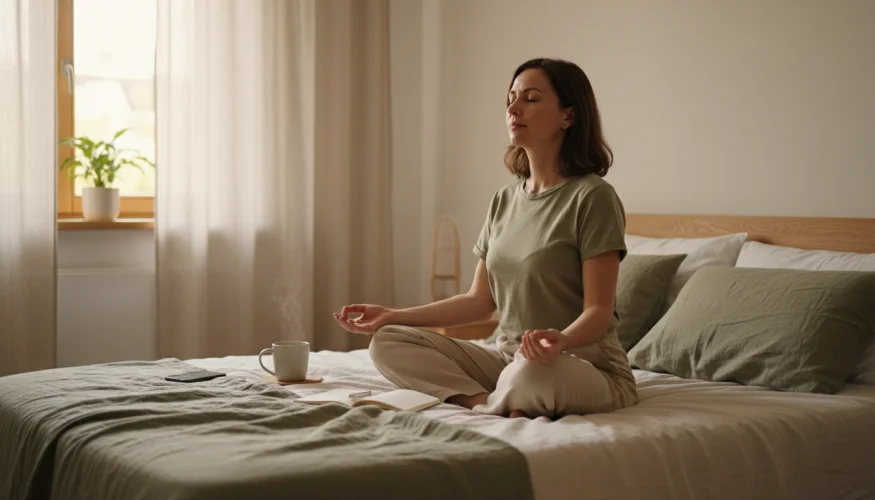
A very underrated but effective approach is movement right after waking up. It doesn't have to be an intense workout – a short yoga session, a few minutes of stretching or a brisk walk will do. Physical activity shifts the brain's attention to the body, supports the production of endorphins and serotonin and naturally interrupts the loop of rumination. As neuroscientist Andrew Huberman writes, morning exposure to natural light combined with movement is one of the most powerful biological tools for regulating mood and cognitive performance throughout the entire day.
What happens the evening before also plays an important role. If you go to bed with unresolved tasks or open questions, your brain will work on them overnight and present them as the first item on the agenda in the morning. A simple evening ritual – a brief note of three things you accomplished that day and a list of two or three priorities for tomorrow – can significantly reduce morning mental overload. By giving the brain a sense of closure, you relieve it of the need to work overtime.
Sometimes, however, morning rumination is a symptom of something deeper. If the thoughts revolve around anxiety, fear or feelings of hopelessness, and if this state persists long-term and significantly affects quality of life, it is advisable to seek professional help. Cognitive behavioural therapy has demonstrated high effectiveness in treating anxiety disorders and chronic rumination – and today it is also available in an online format, which removes many practical barriers.
Interestingly, the environment in which we wake up also bears some responsibility. Research shows that chaotic, cluttered or dark spaces increase stress and make it harder to transition into a calm waking state. Conversely, a tidy, pleasant bedroom with access to natural light and free of electronics helps the nervous system to orient itself more easily. Investing in a quality mattress, natural bedding or a diffuser with calming essential oils is not merely an aesthetic decision – it is part of an overall strategy for caring for mental wellbeing.
"The way you spend the first hour of your day sets the tone for the rest of your day." – Robin Sharma
These words are not just motivational clichés. Real neuroscience stands behind them: the brain is in a so-called hypnagogic state in the morning, when it is particularly receptive to suggestions and patterns. What we pay attention to in the first minutes after waking sets the filter through which we perceive the entire rest of the day. If that filter is stress and chaos, the day then more easily appears demanding and threatening. If it is calm and intentionality, the same events can seem manageable and meaningful.
Self-care begins before you get out of bed
Morning rumination is not a weakness or a failure – it is the biological reality of a modern person living in an overloaded era. But just as the body can be trained, so can the mind. Small, consistent changes in the morning routine have a demonstrably greater impact than a single large decision. There is no need to rewrite your entire lifestyle overnight – it is enough to start with one thing: move your phone twenty minutes further from the bed, write three thoughts in a notebook, or simply sit for five minutes by an open window with a cup of tea and without a screen.
Caring for mental wellbeing and a healthy lifestyle are not separate categories – they are two sides of the same coin. Just as we choose higher-quality foods, more ecological products or a more sustainable way of life, we can also consciously choose what we feed our minds – and when. Morning is an ideal opportunity for this. The brain is open then, the day has not yet begun, and the decisions we make in these first minutes have the power to transform not just one morning, but gradually the entire way we experience our lives.
Klára from Brno eventually gave it a try. She started with the simplest thing: she moved her phone from the bedside table to the other side of the room. Then she added three minutes of breathing. After a month, she says that for the first time in years, she looks forward to getting up in the morning.