

# How to Reduce Waste When Shopping Online and Shop Smart ## Introduction Online shopping has beco

Everyone who regularly shops online knows it. A package arrives, you unpack it, and you're left with a mountain of cardboard boxes, layers of bubble wrap, piles of paper filling, and plastic bags that don't belong anywhere. Online shopping is convenient, fast, and practical in many ways – but its ecological footprint is a topic that's being discussed more and more loudly. According to data from the European Commission, packaging waste accounts for approximately one third of all municipal waste in Europe, and the e-commerce boom over the past decade has significantly deepened this problem. So how do you reduce waste when shopping online without having to give up the comfort we've grown accustomed to?
The answer isn't simple, but it certainly exists. And it begins before we even click the "Add to cart" button.
Try our natural products




Planning your purchase as the foundation of sustainable behaviour
The biggest mistake online shoppers make isn't choosing the wrong store or an unsuitable delivery method. It's impulsiveness. Shopping in small increments – one thing today, another tomorrow, a third the day after – generates a disproportionate amount of packaging material and unnecessarily burdens transportation. Each shipment means one more vehicle on the road, one more box at the recycling centre, and in many cases one more plastic bag in nature.
The solution is surprisingly simple: shop less frequently, but more at once. Instead of four separate orders a month, try gathering everything you need into one shopping cart and placing a single order. This approach not only reduces the amount of packaging waste, but also significantly cuts emissions from transportation. Many e-shops also offer a discount or free shipping when a certain purchase value is exceeded, so you save not only the planet, but also your wallet.
Another step in planning is consciously thinking about whether you actually need the product in question. The habit of adding items to your cart and leaving them there to "sit" overnight or over the weekend works surprisingly well – some impulsive purchases resolve themselves this way. What seemed irresistible on Friday evening may feel far less urgent on Saturday morning.
Planning is also closely linked to choosing products with a longer lifespan. A quality item that lasts for years is always a more ecological choice than a cheaper alternative you'll throw away in six months. This applies to clothing, household appliances, and small everyday accessories alike. As American environmental activist Annie Leonard aptly noted: "The most sustainable thing is the one you don't have to make."
What to do with packaging material
Even with the best shopping planning, we can't avoid packaging material entirely. The question then becomes: what do we do with it? Cardboard boxes are the easiest in this regard – most municipalities in the Czech Republic provide paper collection either through blue containers or direct collection. Boxes just need to be folded so they don't take up too much space, and then set aside for recycling.
The situation is more complicated with plastic packaging, filling films, and foam materials. Bubble wrap and air cushions are technically recyclable, but most collection points don't accept them as part of standard sorting. The good news is that more and more e-shops are switching to paper fillings or recycled cardboard, which is much more recycling-friendly.
Some packaging material can also be creatively reused. Sturdy boxes can be used for storage at home, for moving, or as gift wrapping. Paper fillings can be reused when sending your own parcels. It's not a grand ecological gesture, but a practical way to extend the life cycle of materials that would otherwise end up in the bin.
In recent years, services have also appeared on the market that address the collection of more difficult-to-recycle materials systematically. Some brands offer packaging take-back programmes – the customer returns used packaging along with their next order or at a collection point, and the manufacturer ensures it is properly processed. This model is still more the exception than the rule, but its popularity is growing.
Choosing e-shops that actively work on reducing packaging waste is one of the most effective tools available to consumers. Demand shapes supply – and if customers make it clear that sustainable packaging matters to them, shops will sooner or later take this into account.
Delivery, returns, and other hidden ecological burdens of online shopping
Packaging is discussed most frequently, but waste from online shopping goes far beyond boxes and films. Transport emissions are a major yet rarely discussed chapter. Courier services generate enormous amounts of CO₂ emissions, and express delivery – meaning parcels delivered the next day or even the same day – is significantly more costly in terms of ecological footprint than standard delivery. The reason is simple: express parcels cannot be efficiently consolidated with others, so vehicles travel half-empty.
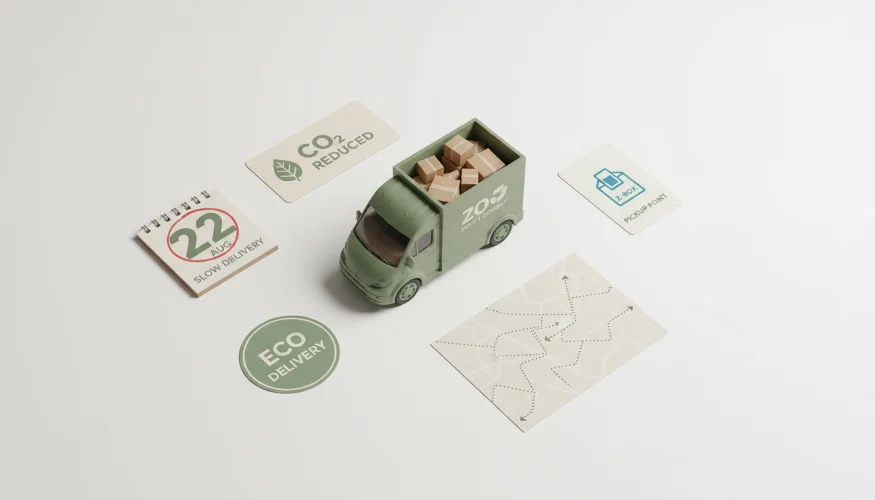
So if the situation allows, choosing slower delivery is the more ecologically responsible option. Some e-shops explicitly offer this option and label it as "eco delivery" or "green parcel". An alternative is collection from a pickup point – Zásilkovna, Z-BOX, or other pickup point networks significantly reduce the number of unnecessary journeys and are often more convenient for the customer than waiting at home for a courier.
Returned goods and complaints are a separate chapter. The Czech Republic is among the European countries with a high rate of returns from online purchases, with the fashion industry being the absolute record-holder in this regard. Customers order multiple sizes or variants, choose one, and return the rest. This model is convenient for consumers, but ecologically very costly – every return means additional transport, additional packaging, and in many cases goods that won't return to sale and will end up as waste.
The solution lies in more thorough selection before purchasing. Reading reviews, paying attention to size charts, looking at photos from different angles, or consulting an online advisor or customer service. The more carefully a purchase is thought through in advance, the less likely it is to end in a return.
An interesting real-world example is offered by the Swedish fashion community Houdini Sportswear, which alongside sales also offers clothing rental and servicing of older items. Their philosophy is built on the idea that the most sustainable garment is one that is repaired and worn further – not one that is returned and replaced with something new. A similar approach is slowly finding its way to Czech customers as well.
Another aspect worth mentioning is the digital waste associated with online shopping. Order confirmation emails, marketing newsletters, push notifications – all these messages are stored on servers that consume energy. Unsubscribing from newsletters you don't read and deleting old emails is a symbolic gesture, but across millions of users, even this behaviour has its impact.
How to choose e-shops with sustainability in mind
Not all online shops approach the issue of sustainability in the same way. When choosing where to shop, it's worth paying attention to a few things. Transparency is key – a reputable e-shop should be able to communicate what materials its packaging is made from, whether it works with ecologically certified carriers, and what policy it applies to returned products.
Certifications are a useful guide in this regard. Labels such as FSC (for paper packaging from sustainably managed forests), B Corp (for companies meeting strict social and environmental responsibility standards), or EU Ecolabel signal that the given shop or manufacturer takes its ecological footprint seriously. The B Corp certified companies database is publicly available and can be easily searched for specific brands.
Local e-shops have a natural advantage over large international platforms in the form of shorter transport distances. A product travelling from a Czech warehouse has a significantly lower carbon footprint than goods ordered from the other side of the world. This doesn't of course mean that international purchases are automatically bad, but when price and quality are comparable, the local choice is more ecologically favourable.
It also helps to observe how e-shops express themselves on sustainability topics on their websites and social media. Companies that are genuinely working to reduce their impact typically communicate about it openly and provide specific figures and targets – not just vague proclamations about how they "love the planet". Greenwashing, meaning misleading ecological marketing claims, is unfortunately still a widespread phenomenon to watch out for.
Reducing waste from online shopping is therefore not about giving up the comfort of the modern world. It's more about conscious decision-making – buying less, but better, choosing shops that share the same values, and handling packaging material responsibly. Every purchase is simultaneously a vote for a certain way the world operates. And the more people vote for sustainability, the faster the market adapts.