

Morning sun therapy will improve your sleep in 10 minutes
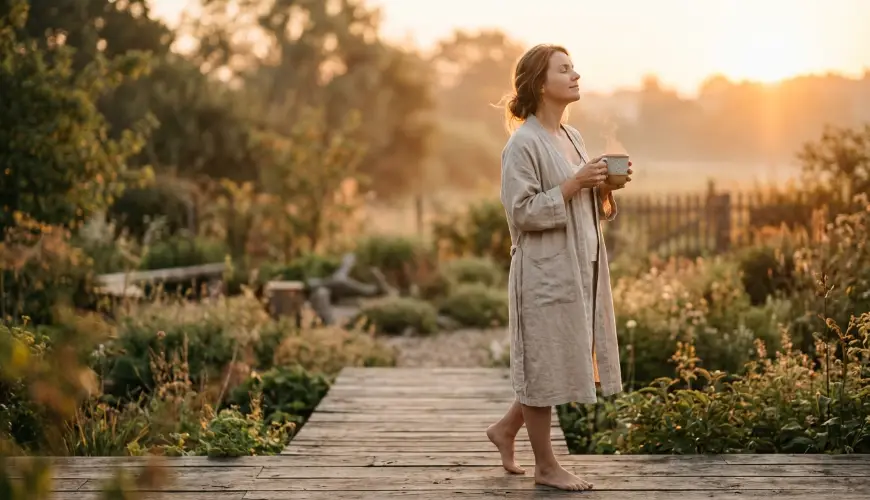
Every morning, something absolutely fundamental happens – and most of us completely overlook it. While reaching for our phones, brewing coffee, or rushing to the shower, the sun rises outside and sends a signal that has been the cornerstone of human health for millions of years. Morning sunlight is not merely a pleasant accompaniment to the morning – it is a biological trigger that literally sets the clocks of the entire body. And interestingly, just ten minutes a day is enough to start making a difference.
The modern way of life has literally cut us off from our natural light rhythm. We work in offices with artificial lighting, watch screens emitting blue light in the evenings, and wake up in the dark or immediately retreat indoors. The result? Disrupted sleep, chronic fatigue, poor mood, and a whole range of other issues that many attribute to stress or poor lifestyle habits – without suspecting that part of the answer lies literally just outside the window.
What happens in the body when you step into the light in the morning
The human body operates according to what is known as the circadian rhythm – an internal biological clock that governs sleep, wakefulness, body temperature, hormone production, and digestion. These clocks are synchronised primarily by light, specifically by natural daylight during the first hours after sunrise. A key role is played by a specialised area of the brain called the suprachiasmatic nucleus in the hypothalamus, which receives light signals directly from the eyes and coordinates the entire organism accordingly.
As soon as morning light hits the retina, the brain receives a clear signal: it is daytime, time to be active. A cascade of biological reactions is triggered – cortisol, the natural waking hormone, reaches its morning peak, body temperature begins to rise, and the entire system awakens. What is even more important for sleep, however, is that the brain simultaneously records when the day began, and on this basis calculates when it should begin producing melatonin in the evening – the hormone that induces sleep. In other words, the quality of night-time sleep is largely determined in the morning.
This mechanism is also described in the research of leading global sleep expert Matthew Walker from the University of California, Berkeley, author of Why We Sleep. Walker repeatedly emphasises that exposure to natural light early in the morning is one of the most effective yet most overlooked tools for improving sleep quality. "Light is the most powerful signal our biological clocks know," says Walker – and modern science supports him.
Research shows that people who are regularly exposed to natural light during the morning hours fall asleep more quickly in the evening, experience deeper sleep, and feel more rested in the morning. A study published in the academic journal Journal of Biological Rhythms demonstrated that just 10 to 30 minutes of morning sunlight exposure significantly improves circadian rhythm synchronisation – even in people suffering from chronic sleep disorders.
In practice, it looks like this: a person who wakes up at seven in the morning, steps outside or sits by a sunny window, and spends ten minutes there without sunglasses, gives their brain a precise time coordinate. In the evening, their body then begins producing melatonin at the right time – and sleep comes naturally, without the need for pills or rituals.
How to incorporate morning light therapy into everyday life
It may seem like something complicated or time-consuming. The opposite is true. Morning light therapy requires no special equipment, no app, and no subscription. All it takes is ten minutes and the willingness to step outside – or at least open a window and expose your face to direct light.
Timing is crucial here. Light exposure is most effective in the first 30 to 60 minutes after waking, ideally within an hour of sunrise. At this time, sunlight has a specific spectrum that the circadian system recognises as the strongest synchronising signal. Afternoon or evening walks are healthy for many other reasons, but they do not work nearly as effectively as a means of setting the biological clock.
It is also important to know that light must reach the eyes directly – not through glass. A window filters out a large portion of the UV radiation and specific light spectrum that is crucial for the circadian system. This does not mean one needs to stare directly into the sun – it is sufficient to be outdoors or sit by an open window and allow light to fall naturally on the retina. Even an overcast sky provides many times more light than the brightest indoor lighting.
Consider a real-life example: Jana, a thirty-four-year-old graphic designer working from home, had long complained of difficulty falling asleep and morning fatigue. Every evening she would lie in bed with thoughts she could not stop, and would wake up exhausted in the morning. She changed one thing – she began going outside every morning after waking for twenty minutes with a cup of tea. No phone, no headphones. Just light, fresh air, and quietly observing her surroundings. After three weeks, she noticed a significant change: she fell asleep more quickly, her sleep was deeper, and she woke up feeling genuinely rested. She had not purchased any supplements or changed her diet – she had simply added morning light.
Such experiences are not exceptional. They are the logical consequence of how our bodies function – and how the modern lifestyle systematically deprives them of the inputs they need.
Morning light also has another important effect that is not directly related to sleep but works closely alongside it: it stimulates the production of serotonin, the neurotransmitter associated with good mood, motivation, and a sense of wellbeing. Serotonin is also a direct precursor to melatonin – meaning the more serotonin the brain produces in the morning, the better it is able to produce melatonin in the evening. The morning and evening chemistry of the body are connected in ways that modern medicine is coming to understand ever more clearly.
For those living at northern latitudes or going through winter months with limited daylight hours, there is also an alternative in the form of light therapy lamps. These devices emit light at an intensity of 10,000 lux, equivalent to a bright sky, and can stimulate the circadian system even at times when there is not enough natural light outside. Experts such as Andrew Huberman from Stanford University emphasise, however, that natural sunlight is always the first choice – its spectrum is more complex and the biological response is stronger.
Why knowing is not enough – it must be put into practice
Knowledge alone will not improve sleep. Nevertheless, understanding the mechanism is important, because it changes motivation. When a person understands why ten minutes outside in the morning works, they are far more likely to actually maintain this habit – even on days when they do not feel like it, when it is raining, or when they are tempted to stay at the screen.
Sleep is one of the most underestimated components of health. The World Health Organisation identifies it as one of the three pillars of a healthy life alongside nutrition and physical activity – and yet it receives the least attention. Approximately one third of adults in developed countries suffer from some form of sleep disorder, with consequences ranging from reduced immunity and cardiovascular risks to greater susceptibility to depression and anxiety. And yet part of the solution requires no doctor's visit and no expenditure on supplements – it simply requires stepping outside in the morning.
It is understandable that in the hectic life of a modern person, this may sound like a luxury. But ten minutes is genuinely ten minutes. Less than one episode of a series, less than the average time spent on social media in the morning. And yet this brief period of time can have a disproportionately greater impact on the overall quality of both day and night.
Incorporating morning light into a daily routine can be combined with other habits that naturally support a healthy lifestyle. A morning walk is simultaneously exercise, an opportunity for meditation, or simply a quiet moment before the working day begins. There is no need to make it into a complex ritual – the simpler it is, the more sustainable it will be.
For those seeking inspiration in the area of healthy and sustainable living, Ferwer, for example, offers a range of products that can complement a morning routine – from natural teas suited to a morning ritual to eco-friendly everyday supplements. A healthy lifestyle is always a combination of small, consistent decisions – and morning light is one of the simplest of them.
Perhaps it is time to stop searching for complex solutions to problems that have simple causes. The body knows what it needs. It needs light, movement, natural rhythms, and sufficient night. And the first step towards all of this can be surprisingly easy: tomorrow morning, get up, open the door, and let the sun do its work.