
# Hip Stretches for People Who Sit All Day --- Spending long hours sitting leads to tight hip flex
The modern working world is largely a world of sitting. Offices, home offices, long meetings, car or train journeys – the average person of working age can easily spend eight to ten hours a day sitting down. What seems like an innocent habit, however, has far-reaching consequences for the body. And one of the most affected areas is the hips – a joint we don't perceive as intensely as our back or neck, but whose stiffness manifests over time as pain, poor posture, and limited mobility.
The hip joint is one of the largest and most complex joints in the human body. It connects the trunk to the lower limbs and enables movement across multiple axes – bending, extending, rotating. The problem arises when this joint remains in a single position for hours at a time. When sitting, the hips are permanently bent, the flexor muscles shorten, and the gluteal muscles weaken. The result is an imbalance that can manifest as lower back pain, groin tension, or even knee and ankle pain.
This is no fringe theory – research repeatedly confirms that a sedentary lifestyle is associated with a wide range of musculoskeletal problems. For example, a study published in the Journal of Orthopaedic & Sports Physical Therapy highlights a direct link between shortened hip flexors and lumbar spine pain. In other words: if your back hurts, the cause may be surprisingly far from the site of the pain.
Try our natural products
Why hip flexors need attention
The hip flexors are a group of muscles located at the front of the thigh and in the groin area. They include in particular the iliopsoas muscle, which is considered one of the most important and at the same time most neglected muscles in the entire body. This muscle connects the lumbar spine to the upper part of the femur, and its chronic shortening causes characteristic overloading of the lower back.
Imagine Martin, a thirty-year-old graphic designer who works from home. He sits at his computer for eight hours a day, then sits on the sofa in the evening to watch a series, and before he knows it, entire days pass during which he barely stretches. After several months, he begins to feel a dull ache in his lower back that worsens in the morning when he gets up. An orthopaedist explains that his lumbar spine is overloaded due to shortened hip flexors – and prescribes regular exercise and stretching. Martin is not an exception. His is the story of millions of people who don't realise how much their daily sitting is harming them.
The good news is that regular hip stretching can significantly improve this condition – even without visiting a physiotherapist, if the problems are only just developing. The key is consistency and proper technique.
The most effective hip stretching exercises
Before you start stretching, it's important to know that stretching should never hurt. A mild pull or feeling of tension is fine; sharp pain is a signal that something is wrong. Stretching is most effective when the muscles are warmed up – ideally after a light walk or brief warm-up.
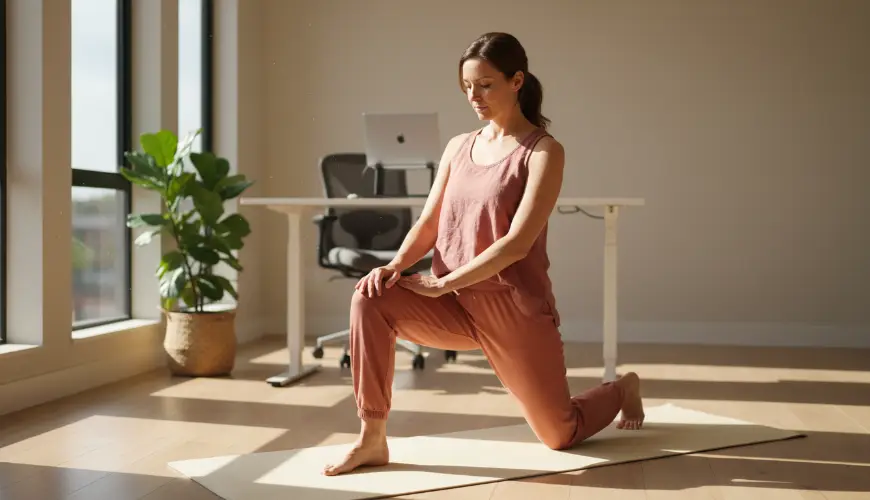
One of the best-known and most effective exercises for releasing the hip flexors is the so-called lunge stretch. You kneel on one knee, with the other leg bent in front of you at a right angle. You slowly move your hips forward and downward until you feel a pull at the front of the thigh and groin of the back leg. Hold this position for 30 to 60 seconds, then switch sides. This exercise directly targets the iliopsoas muscle and, when performed regularly, can significantly reduce tension in the lower back.
Another popular exercise is the so-called pigeon pose, which comes from yoga. You lie or kneel, bending one leg in front of you so that the shin is perpendicular to your body, and extend the other leg behind you. Lower your torso as close to the ground as possible. This position stretches the external rotators of the hip – muscles that are also significantly overloaded when sitting, because we tend to press our legs together or sit with our legs crossed. The pigeon pose is intense, but when performed regularly it brings relief that is hard to compare with any other exercise.
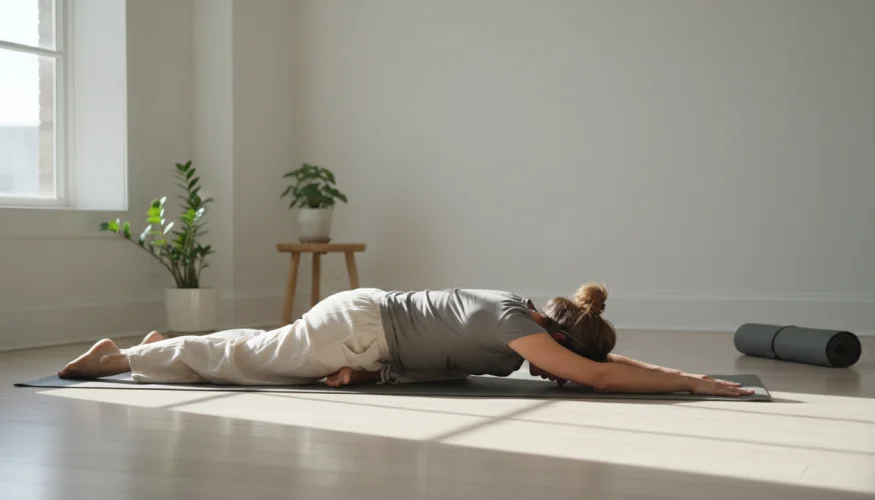
For those looking for a gentler alternative, an excellent option is the exercise known as the "figure four". You lie on your back, bend one leg, and place the ankle of the other leg on the knee of the bent leg. Then slowly pull the bent leg towards your chest. You will feel a pull in the buttock and outer hip. This exercise is gentle on the joints and suitable for beginners or people with more sensitive knees.
We must not forget to stretch the back of the hip and the glutes. The gluteal muscles are chronically both weakened and shortened after prolonged sitting – a paradoxical combination that arises when a muscle is not actively used but is simultaneously compressed by the body's own weight. A simple exercise is lying on your back and pulling one knee to your chest – hold for 30 seconds and switch sides.
If you want to enrich your stretching programme with elements that also strengthen the stabilising muscles, yoga or Pilates are excellent choices. Both systems work with the hip joint comprehensively and give it the attention it deserves. The World Health Organization (WHO) recommends that adults engage in moderate-intensity physical activity for at least 150 minutes per week – and hip stretching can be a great complement to this goal, especially for those whose work does not allow for much movement.
As physiotherapist and author Kelly Starrett said: "Mobility is not a luxury – it is a basic prerequisite for healthy, pain-free movement throughout life."
How to incorporate stretching into everyday life
Knowing the exercises is one thing, but performing them regularly is the real challenge. People who sit a lot paradoxically tend to feel they don't have time for movement – yet they are precisely the ones who need it most. The key is to integrate stretching into an existing routine so that it requires no special effort or trip to the gym.
One of the most practical strategies is the so-called movement break. Every hour of sitting, interrupt it with two to five minutes of movement – stand up, stretch, do a few lunges, or simply walk around the room. Research shows that even brief interruptions to sitting have a measurable positive effect on metabolism and the musculoskeletal system. Some smartwatches or phone apps can remind you of these breaks automatically.
In the morning after waking, the body is stiff, but morning stretching can set the whole day on a different course. Ten minutes on a mat is enough – a few lunges, pigeon pose, figure four – and the body wakes up in a completely different way than after a cup of coffee. In the evening before bed, stretching helps release the tension accumulated during the day and improves sleep quality.
The working environment also plays an important role. The height of the desk and chair, the position of the monitor, the type of seating surface – all of these affect how much the hips are strained while sitting. An ergonomic office chair with adjustable height and lumbar support can significantly reduce overloading. Some people swear by memory foam seat cushions or special wedge cushions that tilt the pelvis into a more natural position. Height-adjustable desks, which allow you to alternate between sitting and standing throughout the working day, are also becoming increasingly popular.
For those looking for a comprehensive approach to a healthy lifestyle, it also makes sense to think about what we wear. Tight jeans or uncomfortable clothing that restricts movement around the hips adds another layer to the problem. Loose, comfortable clothing made from natural materials allows for freer movement and a more natural body position – and this applies both at work and during exercise.
Hip stretching is not a matter for athletes or yoga enthusiasts. It is an everyday necessity for anyone who spends a large part of the day sitting – which means most of us. The body has an amazing capacity for recovery, but it needs the opportunity to do so. And that begins simply by getting up from the chair, rolling out a mat, and giving our hips a few minutes of the attention they deserve. The change is neither dramatic nor painful – quite the opposite. After several weeks of regular stretching, most people describe a feeling of lightness and freedom of movement that they hadn't even realised they were missing.