

Emotional overload of women in the roles of mother, partner, and worker
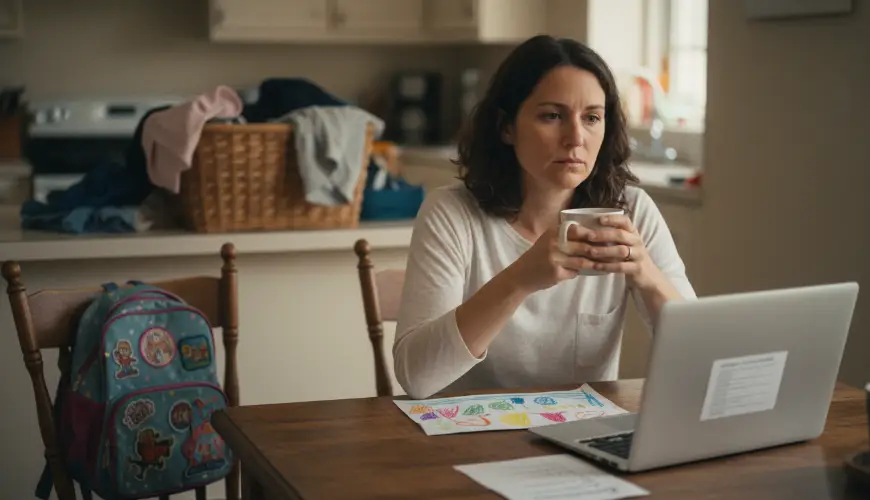
Modern women live in a world where they are expected to be simultaneously loving and patient mothers, attentive and present partners, and high-performing and reliable employees. These three roles are not merely social labels – they are everyday commitments with their own demands, rules, and emotional requirements. And it is precisely their coexistence that creates something that is still spoken about far too little: emotional overload that quietly exhausts millions of women.
This is not fatigue from one difficult day. It is a cumulative exhaustion that builds over weeks, months, sometimes years. It is a state in which a woman wakes up in the morning feeling that the day has not yet begun and she is already tired. Where she focuses on a project at work, but her mind is running through a list of things she needs to get done after returning home. Where she sits beside her partner in the evening, but her thoughts are elsewhere – on tomorrow's meeting, on the child who has a test in the morning, on the pile of laundry there simply was no time for.
Try our natural products




Why the coexistence of roles is so exhausting
Psychologists speak of a phenomenon called "mental load" – the invisible cognitive work of planning, organising, and monitoring the running of a household and family. Research repeatedly shows that this burden is borne primarily by women, even in households where both partners work full-time. According to a study published in the journal Community, Work & Family, women devote significantly more time to household management and childcare than men, with much of this work being invisible and unspoken.
But the problem is not just about time. It lies in what psychologists call emotional switching – the constant need to shift between different emotional states. At work, a woman is professional, assertive, analytical. At home, she immediately switches into the role of caregiver, listening, comforting, and resolving conflicts. In her romantic relationship, she is expected to be present, intimate, open. Each transition costs energy. And when these transitions occur multiple times a day, both the mind and body begin to send warning signals.
Consider the example of Lucie, a thirty-eight-year-old project manager and mother of two. In the morning she drops the children off at nursery, attends three online meetings, does the shopping in the afternoon, cooks dinner, helps her older son with his homework, listens to her partner who has had a difficult day, and late in the evening opens her laptop to finish a report for a client. Nowhere in this schedule is there space for herself. Nowhere is there a pause that is not simultaneously preparation for the next step. Lucie's story is not the exception – it is the rule.
Emotional overload differs from physical fatigue in that it is not easy to name or measure. Physical fatigue fades after sleep. Emotional exhaustion persists. It manifests as irritability, a sense of alienation, and an inability to find joy in things that once brought pleasure. In extreme cases, it develops into burnout or depression.
Social expectations that no one has spoken aloud
Behind women's emotional overload lie not only personal choices or poor time management. Behind it lie deeply rooted social norms that dictate what is expected of a woman in each of her roles – and these norms are often so taken for granted that no one even voices them aloud.
A mother is expected to be unconditionally available and emotionally warm. A partner is expected to be sensitive, communicative, and capable of keeping the relationship alive. An employee is expected to be high-performing, flexible, and professional. None of these roles is problematic in itself. The problem arises when all three are required simultaneously, without pause and without acknowledgement of how much energy they actually demand.
Sociologist Arlie Hochschild, in her groundbreaking book The Second Shift, described how women, upon returning from work, begin what she called the second shift – domestic work and family care. This second shift is not merely physical; it is also emotional. Hochschild named it "emotional labour" – work that consists of managing one's own emotions in order to meet the expectations of others. And this work, like paid work, is exhausting.
What further complicates the situation is the inner critic that never sleeps in many women. Even when a woman is objectively doing her utmost, she feels she is not patient enough as a mother, not present enough as a partner, not productive enough as an employee. This constant sense of inadequacy is itself a source of enormous emotional stress. Psychologist Kristin Neff, a pioneer in self-compassion research, repeatedly points out that women tend to be significantly harsher towards themselves than towards others – and it is precisely this inner stance that contributes to deepening exhaustion.
It is also worth noting that emotional overload is not tied to any specific life situation. It is experienced by women in stable relationships and by single mothers alike, by women with demanding careers and those who work part-time. It is experienced by women who, on paper, have everything – a functional family, a good job, a loving partner. Because the problem does not lie in what a woman has or does not have. It lies in how expectations are set and where the boundaries are drawn.
The situation is further compounded by the culture of constant availability that the digital age has brought. Work emails arrive in the evening and at weekends. Parent groups on social media generate an endless stream of messages and requests. The boundary between work time and personal time has become so blurred that many women cannot even say when they actually "switch off". And the answer is often straightforward: they never do.

Where to find the way back to oneself
To speak of women's emotional overload without offering any sense of direction would be incomplete. Yet it is important to state from the outset: the solution does not lie in a woman "managing better" or "being more efficient". Such an approach would simply be another way of transferring responsibility for a systemic problem onto her.
Real change begins on several levels simultaneously. At the relationship level, it involves an open conversation about the division of mental and emotional load – not just physical household tasks, but who plans, who remembers, who coordinates. Research shows that couples who consciously and regularly share the cognitive load report greater relationship satisfaction and lower stress levels for both partners. This is not about a perfect fifty-fifty split – it is about conscious sharing and mutual recognition.
At the level of the workplace, company culture plays a key role. Employers who offer genuine flexibility, support paternity leave, and do not create pressure for constant availability contribute to their female employees being able to function sustainably over the long term. European data shows that companies with greater equality in the workplace also achieve better results from a business perspective – as documented in the McKinsey & Company report on workplace diversity.
At the personal level, a key tool is the ability to say no – without guilt. What is often labelled as selfishness is, in reality, a basic condition for sustainable functioning. The aeroplane analogy of putting on your own oxygen mask before helping your child is well-worn, but factually accurate: a woman who is emotionally exhausted cannot fully care for others.
Professional support also plays an important role. Psychotherapy, and in particular approaches focused on working with emotions and boundaries, can help women recognise the patterns that lead to overload and gradually change them. Communities of women can equally help – spaces where it is possible to speak openly, without judgement and without the need to pretend that everything is fine.
Because that is perhaps the greatest trap of emotional overload: a woman learns to function even in a state of exhaustion so well that those around her – and often she herself – notice nothing. She learns to smile in meetings, to be present at dinner, to respond to messages. She learns to carry what she carries so quietly that it becomes invisible. And invisible things are difficult to change.
Perhaps the first step is precisely this: to name it. To say aloud – or at least to oneself – that three full roles at once are demanding. That being a mother, a partner, and an employee simultaneously is not a given, but an achievement. And that achievement deserves recognition – above all from the person delivering it.