

Morning walks in the spring are a simple ritual that starts the day more peacefully.
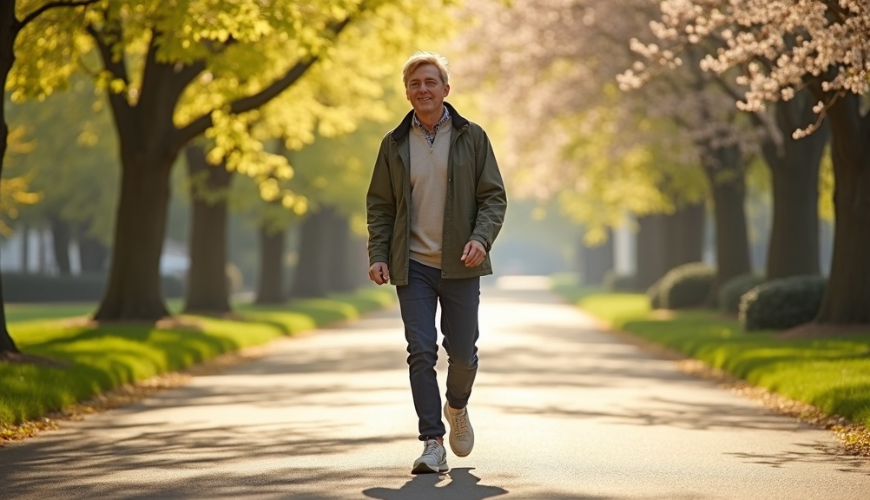
Spring has a special ability to brighten even those days that, just yesterday, seemed like an endless continuation of winter. In the morning, the light is suddenly softer, the air smells of earth and awakening trees, and one feels that it's possible to start anew – even without grand plans and resolutions. Here, a simple habit subtly presents itself, acting almost like a spring restart: morning walks in spring. It's not about performance or a sports discipline. Instead, it's a quiet ritual that clears the mind, gets the body moving, and sets the day at a more pleasant pace.
When discussing a healthy lifestyle, running, gym workouts, or complex training plans are often mentioned. Yet, walking and its health benefits are surprisingly broad – and accessible to almost everyone. And spring is the ideal backdrop for this. Anyone who has ever stepped outside in the morning "just for ten minutes" knows that it can easily turn into half an hour because there's a reluctance to return to a room filled with yesterday's air and a mental list of tasks.
Try our natural products




Morning Walks as a Spring Restart: Why They Work So Well
The morning is often the most sensitive part of the day. A person is just starting to piece themselves together: the body is waking up, the mind is coming to life, and the mood often depends on the first contact with the world. In this regard, a morning walk is a small but effective "switch" routine. It requires nothing complicated – just put on comfortable shoes and go out. And it is this simplicity that is its greatest strength.
Moreover, spring naturally encourages a desire to change habits. The days are getting longer, the mornings are no longer so inhospitable, and there's less struggle with the feeling of waking up "in the dark." Many people notice that when they take a morning walk, the day doesn't start so abruptly. There's more space in the mind, thoughts aren't as sticky, and the body isn't stiff from the night. It's not magic – rather a combination of small factors: movement, light, fresh air, and the rhythm of steps.
Attention should also be paid to the role of daylight. Being outside in the morning helps the body better orient itself on when it should be awake and when it should calm down. Even if the spring sky is sometimes overcast, outdoor light is significantly stronger than indoor light. You can read more about circadian rhythms and the influence of light on the organism on National Sleep Foundation, which has long been popularizing understandable insights about sleep and daily routines. Practically, this often means one thing: those who "light up" outside in the morning can more easily switch off in the evening.
And then there's another subtle dimension: the feeling that the day didn't start with a screen. For many people, a morning walk is the only time when the phone stays in the pocket or at home. The world manages without quick news for a while, and one realizes that even an ordinary street can be interesting – you just need to slow down. "The biggest changes often start with a small step that gets repeated." In the case of walking, this is literally true.
Walking and Health Benefits: What Happens in the Body (and Why It's Pleasant)
Walking is a natural movement that doesn't strain the body as aggressively as some intense sports, yet it can accomplish a lot. It's not just about calories or "fitness." Regular walking supports the heart and blood vessels, helps maintain a stable weight, strengthens the muscles of the lower body, and is gentle on the joints – especially when done at a comfortable pace and on a reasonable surface. The influence of exercise on heart health and the overall prevention of lifestyle diseases is regularly highlighted by organizations like the World Health Organization, which emphasizes that even moderate activity has significant benefits.
A large part of the magic of walking lies in how it affects the psyche. Rhythmic movement calms, reduces tension, and helps "untangle" stress that hasn't vanished overnight. People with sedentary jobs often know the feeling: the body feels shortened in the morning, shoulders pulled up, and breathing shallow. After twenty minutes of walking, posture straightens, breathing deepens, and the mind stops revolving around a single thought.
Spring also brings a natural accompaniment in the form of sounds and scents that are missing in winter. Birds are louder, the earth smells after the rain, and somewhere the grass is being mowed for the first time. These are small stimuli that the brain perceives as a signal that the environment is safe and lively. It's no coincidence that being outside is often linked with a better mood and greater mental resilience. For those who like data support, overviews can be found on Harvard Health Publishing, where it's repeatedly mentioned that even regular walking is among the most accessible forms of exercise with a significant impact on health.
The important thing is that walking "doesn't require perfection." There's no need to measure pace, monitor heart rate, or punish oneself for missing a day. That's why it can become a sustainable habit. And sustainability in health care is often more important than heroic performances that last two weeks.
To make it less abstract, imagine a typical spring morning in the city. A person leaves home fifteen minutes earlier than they have to. Instead of taking the tram, they walk one stop, passing an open café where the smell of pastries mingles with the cooler air, and at the crosswalk, they notice a tree that looked bare yesterday but now has a gentle green tinge at the tips of its branches. At work, they sit as always, the tasks are similar, emails will come anyway – but the body isn't "frozen" anymore, and the mind feels like the day started with movement and space. This difference is surprisingly significant for many people.
Spring and Walks: How to Make Them an Enjoyable Ritual That Lasts
The spring season is tricky in its variability. One day sun, the next day wind, the third day rain. That's why it makes sense to establish morning walks in a way that withstands "ordinary" weather. There's no need to wait for ideal conditions since ideal conditions often don't come on time. A much better approach is to shorten, slow down, or adjust the walk – but not to let it disappear entirely.
It also helps to change the perspective: it's not about "walking as much as possible," but to get outside. Sometimes ten minutes around the house is enough, other times one stretches it to three-quarters of an hour. Spring encourages exploration – even a familiar route can suddenly be different because the light, colors, and sounds change. Those who can, might occasionally head to a park, river, or a quieter street with trees. In nature, it's also easier to slow down without feeling like time is wasted.
In practice, a few simple principles have proven effective, which aren't restrictive but rather facilitate a start. And since this is an article that should be readable and usable, a single short list suffices:
- Start with a small goal: like 10–15 minutes, to avoid blocking the habit right at the start.
- Prepare things in the evening: shoes and a jacket by the door save surprisingly a lot of energy in the morning.
- Choose a "comfortable pace": one that allows for normal breathing and thinking.
- View the route as a reward: spring streets, park, view, favorite tree – small things that please.
- Don't stress over regularity: if one day doesn't work out, it's okay; the important thing is to return to it the next day.
Spring walks naturally incorporate the theme of sustainability. Walking is the most eco-friendly "means of transport," and in daily life, it can replace part of short car or public transport rides – at least occasionally. There's no need to make it an ideology. Rather a quiet bonus: fresh air for the person, less noise and emissions for the surroundings. And when discussing ecology, the practical side also makes sense: quality, repairable shoes and layered clothing that lasts more than one season. Spring mornings can be chilly and afternoons almost summery, so layers are the most comfortable solution – and often the most economical, as there's no need to have a completely new piece for every type of weather.
Walks can also be subtly connected with other healthy habits without creating a rigid regime. Someone might make a protein-rich breakfast after returning, another might have a glass of water, and another might stretch for a while. But even if none of this happens, what's important remains: the body moved and the mind got space.
And what if you don't feel like it? That too is part of reality. On such days, a small trick often helps: don't say "I'm going for a walk," but "I'm just going to walk to the corner and back." Often, once outside, a person will do one more street. And if not, even those few minutes count – just by strengthening the habit of stepping out.
Spring and walks go together because, after winter, the body is more sensitive to the return of movement. Walking is the ideal start: unobtrusive but regular. When combined with a bit of mindfulness, an ordinary route can become a small "reset" – noticing how the tree crowns change, how the light increases, how the air cools and clears after the rain. Who wouldn't want to start the day feeling that something improved even before the work rush begins?
In the end, all of this aligns with one simple truth: morning walks in spring are not a competition or a project. They are doors that can be opened anew every day. Sometimes they lead only to coming home with cold cheeks and warmer fingers, other times they bring ideas, calm, or energy. And it's precisely in this subtlety that their strength lies – spring doesn't happen in leaps, but in steps. Just like a good day.