
# How to Prevent Drawer Sagging and Door Squeaking
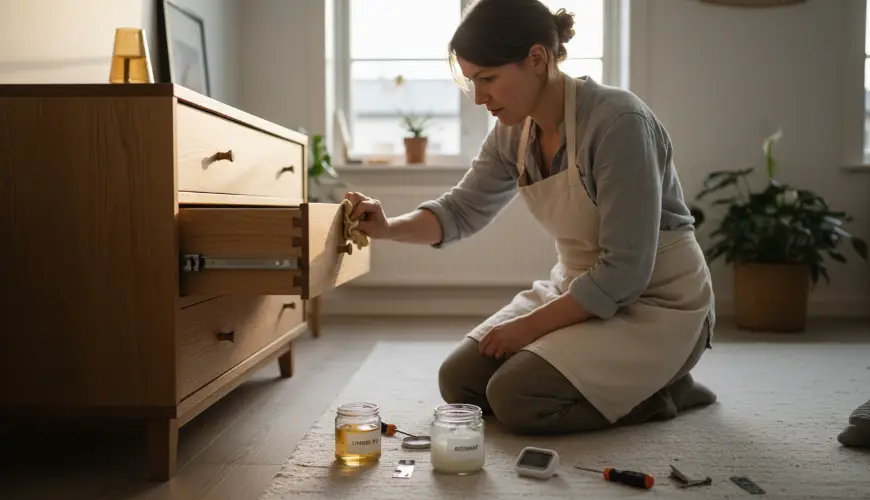
Everyone knows it – you open a drawer and instead of smooth movement you hear an unpleasant creak, or you notice that the entire side is starting to tilt alarmingly. Wardrobe doors stop closing properly, a drawer gets stuck halfway, and what was a functional piece of furniture just a year ago is slowly turning into a daily source of frustration. Warping drawers and creaking doors are among the most common problems with household furniture, and although they may seem like trivial matters, neglecting them leads to the rapid deterioration of the entire piece.
The good news is that most of these problems can be prevented – or at least significantly slowed down – with a little care, the right products, and basic knowledge of why they occur in the first place. Furniture is not a passive object that simply stands and waits. It responds to humidity, temperature, how it is used, and how it is assembled and what it is made of.
Try our natural products



Why do drawers warp and doors creak?
To prevent problems, it is important to understand their causes. Wood as a material remains alive even after processing – it expands and contracts depending on the surrounding humidity and temperature. This natural property of wood is behind a large part of the difficulties that furniture owners encounter. When the air in a room becomes too dry, for example in winter during intensive heating, wooden components shrink and joints loosen. Conversely, at high humidity, wood swells, drawers stop moving smoothly, and doors begin to stick.
Besides humidity, mechanical wear also plays a role. Hinges, joints, and drawer runners are subjected to daily stress and gradually wear out without regular maintenance. Screws loosen, joints lose their lubrication, and wooden parts wear down at contact surfaces. Add to this overloading – drawers full of heavy objects that their construction was not designed for – and we have a complete recipe for the premature demise of an otherwise quality piece of furniture.
The quality of the original craftsmanship and assembly also plays a role. Furniture assembled hastily or using unsuitable fasteners will begin to fall apart much sooner than a carefully assembled piece. As an old carpenter's saying goes: "Good furniture is recognised not at the time of purchase, but after ten years of use."
Prevention is always better than repair
The most effective strategy is to prevent problems before they even appear. Take a specific example: a family moves a solid wood chest of drawers into a new flat. During the first winter, they run underfloor heating at full blast, the air in the flat dries out to a minimum, and after three months they find that one drawer is almost impossible to pull out because its sides have warped. Yet so little was needed – simply maintaining stable air humidity in the room between 45 and 60 percent using a humidifier.
Regulating air humidity is the fundamental pillar of caring for wooden furniture. Experts in the field of cultural heritage protection, who care for historic furniture in museums, recommend maintaining relative air humidity precisely within this range and avoiding sharp fluctuations. The same principle applies to households. Investing in a simple hygrometer and possibly a humidifier or dehumidifier will pay off many times over in the long run.
The next step is correct furniture placement. Chest of drawers and wardrobes should not stand directly next to radiators, near heat sources, or in places where they are exposed to direct sunlight. Heat accelerates the drying of wood and causes uneven expansion of the material, which leads precisely to warping and distortion. Similarly, it is inadvisable to place furniture directly against a cold exterior wall, where moisture condensation may occur.
Regular inspection of joints and screws is another simple but effective preventive measure. Once a year – ideally in autumn before the heating season – it is worth going through the furniture, tightening any loose screws, and checking the condition of hinges and sliding rails. Loose joints are the first step towards more serious damage, as they transfer load unevenly and accelerate the wear of surrounding parts.

How to fix creaking doors and sticking drawers
If problems have already occurred, there is no reason to despair. Most common faults can be fixed yourself without needing to call a professional.
Creaking doors are most often caused by insufficient lubrication of the hinges. The solution is surprisingly simple: applying a suitable lubricant to the hinge joints can solve the problem immediately. Natural waxes, beeswax, or special lubricants based on natural oils have proven effective for wooden furniture. These eco-friendly alternatives are gentler on both the furniture and the home environment, and are available, for example, in online shops focused on ecological households. Avoid aggressive synthetic sprays, which can damage the wood around the hinges over time.
If doors do not close properly or stick, the cause is usually either deformation of the wood due to humidity, or the hinges becoming loose from their seating. In the first case, stabilising the humidity in the room will help – if the wood has swollen, it will return to its original shape once it dries. In the case of loose hinges, the screws need to be tightened, and if the screw hole no longer holds, a simple carpentry solution helps: the holes are filled with wooden dowels or hardwood and the screw is driven in again into solid material.
Sticking drawers are a somewhat more complex problem, as there can be multiple causes. If a drawer sticks when being pulled out or pushed in, the first step is to check whether it is seated evenly in the runners. Sometimes it is enough to remove the drawer, check the condition of the sliding surfaces, and apply a thin layer of wax or soap to them – yes, ordinary soap works as an excellent natural lubricant for wood on wood. This simple solution is known to every experienced carpenter and has worked reliably for centuries.
If a drawer is physically warping – that is, if its sides or base are beginning to separate from the rest of the structure – it is necessary to proceed with gluing. Quality PVA-based woodworking adhesive is the standard solution for repairing wooden joints. The joint must first be cleaned of old adhesive, new adhesive applied, clamped firmly, and left to dry sufficiently – generally at least 24 hours. Using furniture before the adhesive has fully dried is one of the most common causes of unsuccessful repairs.
For more serious cases of warping, where the entire drawer structure is going out of alignment, metal corner brackets or reinforcing strips screwed into the corners can help. These simple metal parts significantly increase the torsional rigidity of the structure and prevent further deformation. They are available at any hardware store and can be fitted by anyone with an ordinary screwdriver.
Furniture made from chipboard or MDF panels, which makes up a large part of modern flatpack furniture, is a separate chapter. This material is more sensitive to moisture than solid wood and is harder to repair once damaged. The key to the long life of chipboard furniture is absolute protection from moisture – especially at the bottom parts, which may come into contact with water when washing the floor. Any damage to the surface film or laminate layer must be treated immediately, as moisture penetrates into the core of the board and causes irreversible swelling.
Drawer runners also deserve special attention, particularly in more modern furniture equipped with telescopic metal guides. These systems are generally reliable but require occasional cleaning of dust and dirt that accumulates in the runners, and minimal lubrication. Furniture manufacturers such as IKEA in their furniture care guide recommend regular inspection and cleaning of these mechanisms as part of basic maintenance.
When thinking about furniture care, there is one aspect that is often overlooked: the way drawers are handled during everyday use. A drawer should never be pulled out by one corner, as this stresses the entire structure asymmetrically and gradually loosens the joints. The correct way is to grasp the drawer by the handle in the middle and pull evenly. Similarly, wardrobe doors should not be closed with a kick or slammed shut – every such impact transfers force into the hinges and their seating in the wood.
When it comes to an ecological approach to furniture maintenance, there are a number of natural products that are effective, environmentally friendly, and at the same time safe for households with children or pets. Linseed oil, beeswax, or coconut oil are excellent natural treatments for solid wood – they protect the surface, add flexibility to it, and also help regulate moisture absorption. These products are part of a broader philosophy of sustainable household management that focuses on longevity and gentleness rather than one-off solutions.
It is interesting that interest in traditional carpentry methods and natural products for furniture care has grown significantly in recent years. According to consumer behaviour survey data, demand for ecological household products is growing by tens of percent year on year, with one of the fastest-growing segments being products for furniture and wood care. People are increasingly realising that quality furniture that is well cared for can last for entire generations – and that is both economically and ecologically more advantageous than regularly buying new pieces.
Furniture that creaks and warps is not condemned to the scrapheap. With a little attention, regular care, and a willingness to address minor problems before they become major ones, a well-maintained piece can last for decades and become part of a family's history. And that is surely a much better story than a trip to the landfill.