
Hip thrust on the couch as a home workout for strong glutes
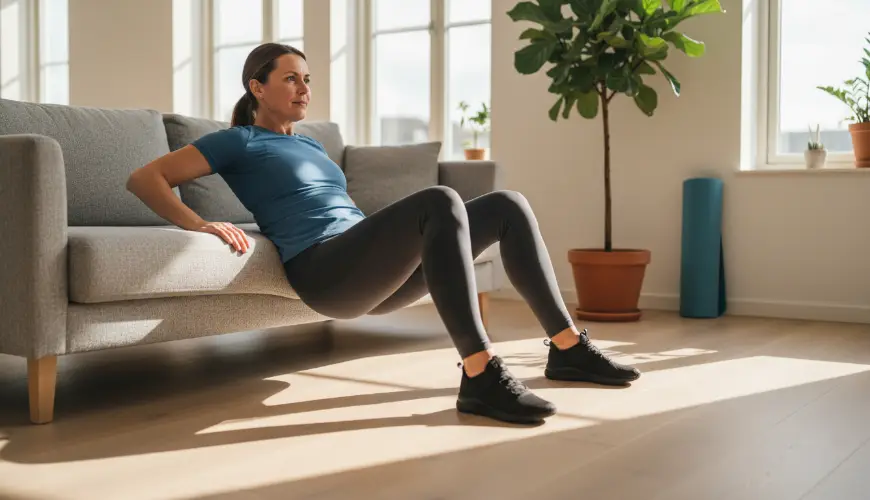
There is an exercise that has slowly but surely become a symbol of modern home training – and yet you need nothing more than your own couch to do it. The hip thrust, or hip raise, has gained enormous popularity in recent years among people who want to strengthen their glute muscles effectively, safely, and without having to pay for an expensive gym membership. And the best part is that almost anyone can do it, regardless of age or fitness level.
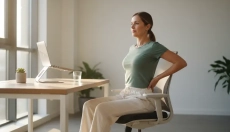
The gluteal muscles – technically the musculus gluteus maximus, medius, and minimus – are among the largest and most powerful muscle groups in the entire body. Yet in a large portion of the population, they are chronically weak, primarily due to a sedentary lifestyle. Long hours spent at a computer or in a car cause these muscles to literally "forget" how to function properly. The consequences are not merely aesthetic – weak glutes manifest as back, knee, and hip pain, and generally disrupt the stability of the musculoskeletal system. This is precisely why targeted strengthening of these muscles is so important.
Try our natural products

Why the hip thrust is so effective
The hip thrust is not just a social media fad. Research repeatedly confirms that it is one of the most effective exercises for activating the gluteal muscles overall. According to a study published in the peer-reviewed Journal of Strength and Conditioning Research, the hip thrust achieves significantly higher gluteal muscle activation compared to classic squats or lunges. While the squat is an excellent exercise for the entire lower body, the hip thrust targets the glutes directly and very specifically – particularly at the top of the movement, where the muscles are maximally shortened and under tension.
The principle of the exercise lies in a horizontal hip drive. The back rests against an elevated surface – and this is where the couch comes into play, making it an absolutely ideal tool for this purpose. The height of a standard couch (approximately 40–50 cm) corresponds to the optimal position at which a full range of motion in the hip joint is achieved. The muscles are thus forced to work through their entire functional range of motion, which is the key to their effective development.
Take a moment to imagine Markéta, a thirty-year-old mother of two who decided to return to exercise after maternity leave. She has neither the time nor the money for a gym, but she wants to tone her body and get rid of the back pain that has been bothering her since her second pregnancy. She started doing hip thrusts on the couch three times a week, just twenty minutes after putting the children to bed. After six weeks, she says herself that the back pain has almost disappeared and her glutes are firmer than they were before pregnancy. Her story is not an exception – it is exactly the type of result that this exercise delivers when performed regularly.
How to perform the hip thrust on a couch correctly
Technique is absolutely crucial when it comes to the hip thrust. A poorly executed exercise not only fails to produce results, but can also stress the lumbar spine or hip joints in ways that are not healthy. It is therefore worth paying careful attention to correct positioning right from the start.
The basic position looks like this: sit down in front of the couch with your back facing it, rest the upper part of your back (approximately the area of the shoulder blades) against the edge of the seat, bend your knees to a right angle, and plant your feet flat on the floor. The hips are low to the ground in the starting position. From this position, drive the hips upward until full hip extension is achieved – that is, until the torso, hips, and thighs form a straight line. At the top of the movement, it is important to consciously squeeze the glute muscles and hold for a fraction of a second before slowly lowering the hips back down.
Key points of correct technique:
- The chin is slightly tucked toward the chest, with the gaze directed slightly forward or toward the ceiling
- The feet are parallel or slightly turned outward, approximately hip-width apart
- The knees do not cave inward or flare outward during the movement – they maintain a stable position over the feet
- At the top position, do not push the hips into hyperextension – the torso, hips, and thighs should form a straight line, not an arched curve
- The movement is slow and controlled, not performed with momentum
One of the most common beginner mistakes is using the lower back muscles instead of the glutes. This is easy to identify – if you feel burning or tension in the lower back, that is a clear signal that your technique needs adjustment. Consciously bracing the core throughout the entire movement and slightly tucking the pelvis before initiating the lift will help.
Another common issue is having the back resting too low on the couch. If the back is supported too low, the movement pattern changes and the glutes do not work as they should. Ideally, the edge of the couch should be approximately at the height of the lower tips of the shoulder blades.
How to target results and progressively add load
Starting with your own bodyweight is perfectly fine – and for many people, it will be a sufficient challenge for the first few weeks. However, there will come a point when the body has adapted to that stimulus and it is time to progress the training further. And this is where the hip thrust proves itself to be an exercise with enormous potential for progressive overload.
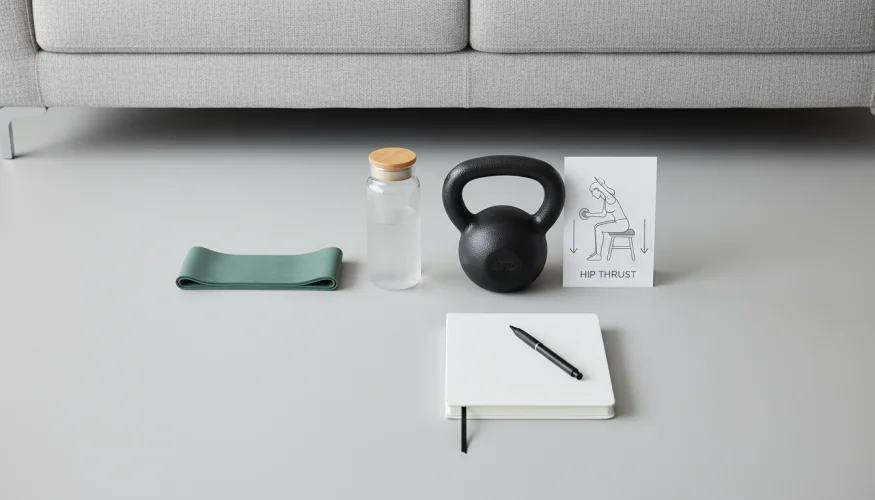
The simplest way to increase intensity is to add resistance. At home, a resistance band looped over the thighs works well, adding pulling resistance while also keeping the knees in the correct position. Another option is to place a weight on the hips – this could be a loaded backpack, a water bottle, or a kettlebell. Professional athletes in the gym use an Olympic barbell with weight plates, but home alternatives are entirely sufficient.
An interesting variation is the single-leg hip thrust, in which one foot is lifted off the ground and the entire movement is performed by one leg only. This variation significantly increases the demands on both strength and stability, and reveals any strength asymmetries between the left and right sides – information that can be very useful for injury prevention.
As physiotherapist and musculoskeletal specialist Kateřina Cajthamlová puts it: "The gluteal muscles are the foundation of the entire movement chain. Strengthening them is not just a matter of aesthetics, but above all of spinal health, joint health, and overall movement quality." This thought aptly captures why the hip thrust should not be viewed as an exercise solely for those who want a firmer backside – it is an investment in the long-term health of the musculoskeletal system.
For optimal results, it is recommended to incorporate the hip thrust into your training two to three times per week with adequate rest between individual training sessions. You can start with three sets of twelve to fifteen repetitions and gradually increase either the number of repetitions or the load. It is important to monitor how your body responds and not to skip the recovery phase – muscles grow and strengthen during rest, not during the workout itself.
A brief warm-up should also be part of every training session. Before the hip thrust, dynamic hip stretches, activation exercises for the glute muscles (such as the "clamshell," which involves opening the knees while lying on your side), and a few slow, controlled repetitions without load are all beneficial. This preparation increases blood flow to the muscles and reduces the risk of injury.
Equally important as the training itself is what happens outside of it. A diet rich in protein – whether from animal sources such as eggs, fish, or chicken, or from plant-based alternatives such as legumes, tofu, or tempeh – provides the building blocks for muscle growth and repair. Adequate protein intake combined with regular training is a combination without which results will come only very slowly.
People who suffer from knee or hip pain should consult a physiotherapist or doctor before beginning this exercise. The hip thrust is generally considered a safe exercise with a low risk of injury, but as with any movement, correct technique and appropriate load are prerequisites for safe training. More information on safe strength training is available from, for example, the Czech Association Sport for All, which is dedicated to promoting physical activity and a healthy lifestyle.
The couch sitting in the living room, usually serving only as a place to rest, can thus be transformed into genuine training equipment. You do not need expensive machines, a large space, or hours of free time. All it takes is twenty minutes, a bit of floor space, and the willingness to be consistent. The hip thrust on a couch is proof that effective training does not have to be complicated – and that strong, healthy glutes are an achievable goal for anyone who decides to start.