

Exercises for scapular stabilization at a desk for a healthy back
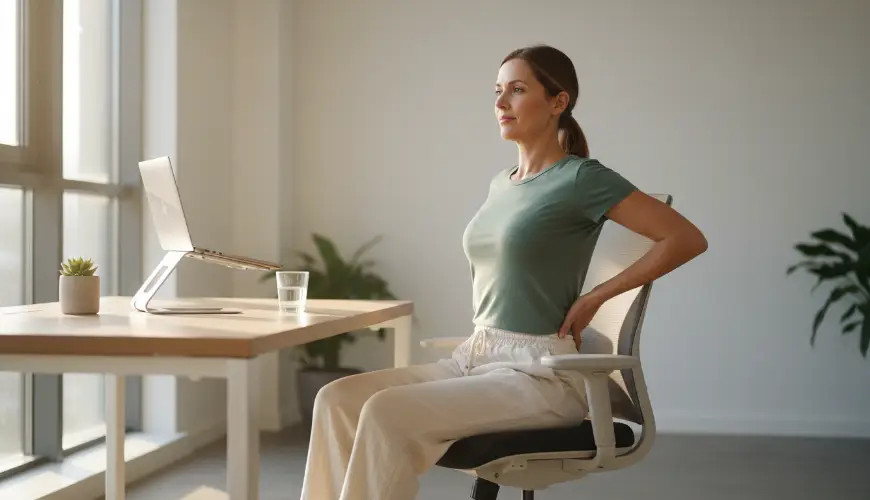
Sedentary work is today a reality for millions of people. Hours spent in front of a monitor, hunched backs, forward head posture, and shoulders pulled forward – this is the everyday image of the modern office. Few people realise that a large portion of back, neck, and shoulder pain stems from one specific problem: poor scapular stabilisation. The shoulder blades are not merely passive bones somewhere at the back of the chest – they are a fundamental pillar of the entire upper musculoskeletal system, and their function influences virtually every movement of the arms, shoulders, and spine.
The shoulder blades should be able to glide smoothly across the ribcage, draw towards the spine, and keep the shoulders in a neutral position. However, prolonged sitting at a desk disrupts this natural pattern. The muscles responsible for stabilising the shoulder blades – particularly the middle and lower portions of the trapezius, the rhomboid muscles, and the serratus anterior – gradually weaken or shorten. The result is imbalance, which manifests as pain, fatigue, and in extreme cases, restricted shoulder movement.
The good news is that this condition can be actively addressed. What's more – neither a gym nor special equipment is required. Many shoulder blade stabilisation exercises can be performed right at an office desk, during a work break, or even during a phone call.
Try our natural products





Why shoulder blades are so important and what happens when they don't function properly
The shoulder blade is an anatomically unique structure – it is a bone that is not firmly attached to the chest skeleton by a joint, but is maintained exclusively by muscular tension. This freedom allows it to move in multiple planes and adapt to arm movement. At the same time, however, it makes it highly vulnerable to muscular imbalance.
When the muscles around the shoulder blade cease to fulfil their function, the blade begins to deviate from its ideal position. This phenomenon is technically known as scapular dyskinesis, and according to various studies, it occurs in a significant proportion of people suffering from shoulder pain. Research published in journals such as the Journal of Shoulder and Elbow Surgery shows that impaired scapular function is one of the key factors in the development of impingement syndrome – a condition in which structures within the shoulder joint become pinched when lifting the arm.
Pain, however, is not always present immediately. Often the problem first manifests as a feeling of stiffness in the upper back, shoulder fatigue after brief mouse use, or an unpleasant clicking sensation during shoulder movement. A typical example is a graphic designer or programmer who spends eight or more hours a day at a computer. Initially they complain only of mild fatigue, but after several months neck pain develops, followed by headaches, and eventually shoulder pain. Yet the cause of this entire chain of problems lies in neglected scapular stabilisers.
This is precisely why it makes sense to begin working on scapular stabilisation preventively – ideally before problems even appear. And if pain has already arrived, properly chosen exercises can be the first step towards relief.
Specific exercises that can be performed at a desk
Before moving on to the exercises themselves, one important point deserves mention: quality of movement is always more important than quantity. As physiotherapist Pavel Kolář, one of the pioneers of dynamic neuromuscular stabilisation, says: "Movement itself is not enough – what matters is how the brain controls it and how the body performs it." In other words, twenty poorly executed exercises do not replace five performed correctly and with awareness of what is happening in the body.
The simplest exercise that can be performed literally in a chair is conscious drawing of the shoulder blades towards the spine. Sit upright, place hands loosely on the thighs or armrests, and slowly draw the shoulder blades together and slightly downward – as if trying to tuck them into the back pockets of trousers. Hold this position for three to five seconds and then slowly release. This sounds simple, but for many people accustomed to having their shoulders hunched forward, it represents a genuine challenge. The goal is not a forceful movement – it is about consciously engaging muscles that are otherwise "dormant."
Another excellent exercise at the desk is the so-called W movement, also known as the "soldier." Sit upright, raise the arms to shoulder height with elbows bent at right angles – as if surrendering. Then slowly pull the elbows down and back so that the shoulder blades approach the spine, with the hands ending approximately at hip height. The entire movement should be slow and controlled, without shrugging the shoulders upward. This exercise activates the middle and lower fibres of the trapezius and the rhomboid muscles – precisely those structures most weakened by sitting at a computer.
For those who have a little more space at their desk or can stand up briefly, an excellent option is chest stretching with fingers interlaced behind the back. Simply stand up, interlace the fingers of both hands behind the back, straighten the spine, gently tilt the head back, and slowly press the hands towards the floor while the chest opens forwards and upwards. This movement stretches the shortened pectoral muscles, which in people who sit at computers are typically chronically shortened and prevent correct shoulder blade positioning.
A highly effective, though less well-known, exercise is activation of the serratus anterior – the muscle that keeps the shoulder blade pressed against the ribcage and prevents it from winging (so-called "winged scapula"). While seated or standing, extend the arm straight in front of the body and then make a small movement forwards, as if trying to reach something distant. This is not a shoulder movement, but a conscious protraction of the shoulder blade forwards and outwards along the ribcage. The muscle is small and consciously engaging it takes a little time, but once a person "finds" it, the exercise becomes very effective.
Overview of exercises suitable for regular performance at a desk:
- Drawing shoulder blades towards the spine – sit upright, slowly draw shoulder blades together and downward, hold 3–5 seconds, 10–15 repetitions
- W movement – arms bent at shoulder height, draw elbows down and back, 10–12 repetitions
- Chest opening – fingers interlaced behind the back, straighten the spine, press hands downward and open the chest, hold 20–30 seconds
- Serratus anterior activation – arm extended in front of the body, conscious protraction of the shoulder blade forwards, 10 repetitions on each side
- Shoulder circles – slow, conscious backward shoulder circles, 10 repetitions
It is important to incorporate these exercises regularly – ideally every two hours of computer work. Five minutes is sufficient, but consistency is key.
How to support spinal health beyond exercise
Exercises alone are important, but insufficient if the rest of the day is spent in an unsuitable posture. Workplace ergonomics plays a crucial role in how much the muscles around the shoulder blades must compensate for poor body alignment. The monitor should be at eye level, the keyboard and mouse should be positioned so that the elbows form approximately a right angle and the shoulders are not raised. Detailed recommendations for setting up an ergonomic workstation are offered by, for example, the National Institute of Public Health or specialist sources focused on occupational medicine.
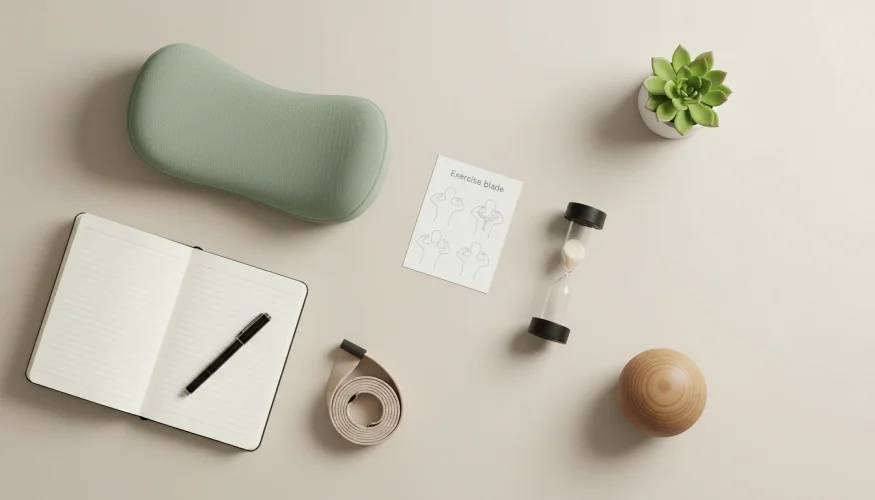
The choice of a suitable work chair also plays a major role. The back should be supported in the lumbar region, the feet should rest flat on the floor, and the seat should not press against the back of the knees. Various accessories are also available – from lumbar cushions and ergonomic mouse pads to standing desk mats – which can help significantly. A modern approach to equipping a home office or workstation is also offered by a number of e-shops focused on healthy living, such as Ferwer, where products supporting correct posture and wellbeing at work can be found.
Movement throughout the entire day is equally important. Research repeatedly shows that even regular exercise cannot fully compensate for the harmful effects of uninterrupted sitting. The World Health Organization (WHO) therefore recommends breaking up sitting with short movement breaks every 30 to 60 minutes. Nothing strenuous is required – simply standing up, walking around the room, stretching, or doing a few squats is sufficient.
Interestingly, scapular stabilisation is also closely linked to breathing patterns. People who breathe shallowly and only into the upper chest – which is very common under stress and when sitting at a computer – tend to have persistently elevated tension in the upper trapezius and weakened deep stabilisers. Conscious diaphragmatic breathing, in which the abdomen expands on inhalation and the chest remains relatively still, can significantly reduce this tension and contributes to better function of the entire trunk stabilisation system.
Care for the shoulder blades and upper back is therefore not merely a matter of exercises – it is a comprehensive approach encompassing movement, ergonomics, breathing, and overall body awareness. A start can be made right now, however, at the desk, with five minutes and the knowledge that every extra movement counts.