

The relationship doesn't have to suffer after the arrival of a baby
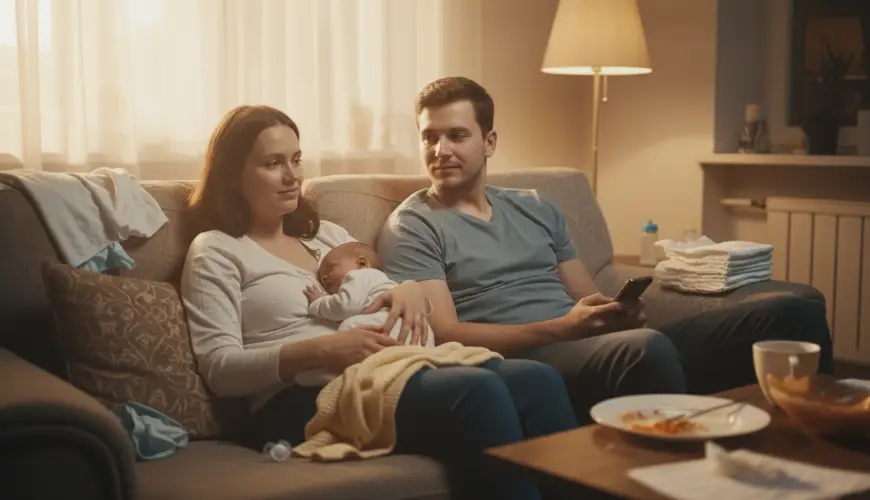
It is said that the arrival of a child is the most beautiful moment in a couple's life. And without a doubt it is – yet few people admit in advance just how much this moment can shake the foundations of a partnership. Newborn nights full of crying, endless diaper changes, the feeling that there aren't enough hours in the day, and on top of it all, two adults who can barely manage to greet each other, let alone exchange a few words about something other than infant colic. The partnership after the arrival of a child is a topic that is discussed surprisingly little, even though it affects practically every couple that decides to start a family. So how do you not lose each other during a period when the whole world revolves around a tiny little person?
Imagine Klára and Tomáš. They've been together for eight years, having traveled together, moved, renovated an apartment – in short, they've been through a lot and always managed to find their way back to each other. Then little Eliška was born. The first weeks were euphoric, full of visitors, flowers, and congratulations. But after a month, the euphoria began giving way to exhaustion. Tomáš went back to work and Klára stayed home feeling like she was on her own with everything. In the evening, when he came home, he wanted to rest, while Klára desperately needed someone to take over. Instead of conversation came reproaches, instead of embraces – silence. After three months, both felt they were living side by side like roommates sharing one small being but no longer a shared life. Klára and Tomáš's story is not exceptional – on the contrary, it is so common that thousands of Czech couples could tell it with only minor variations.
Research by American psychologist John Gottman, who spent decades studying partnerships at the Gottman Institute, showed that up to two-thirds of couples experience a significant decline in relationship satisfaction after the birth of their first child. It's not that partners stop loving each other – the problem is rather that the conditions under which they live together change radically, and most couples are simply not prepared for this change. Gottman found in his research that the key factor distinguishing couples who went through the crisis and remained strong from those who fell apart is the quality of friendship between partners and the ability to remain emotionally available even during periods of extreme stress. More about his work can be found on the pages of The Gottman Institute, where a wide range of resources is available for couples going through this life stage.
But what does it actually mean in practice – to remain emotionally available? It sounds wonderful in theory, but when you haven't slept for the third night in a row and your partner asks "what's for dinner?", it's difficult to respond with grace and empathy. Yet this is precisely where the rubber meets the road. It's not about being perfect or having constant understanding for everything. It's about realizing that both partners are going through an enormous life change simultaneously, yet each experiences it differently. A mother who is home with the child may experience an intense sense of isolation, loss of identity, and physical exhaustion. The father, who goes to work, may in turn feel pushed aside, unneeded in childcare, and overwhelmed by the new responsibility of being the breadwinner. Both perspectives are legitimate and both deserve space.
Try our natural products



Why partners grow apart after the birth of a child
One of the greatest paradoxes of parenthood is that an event that should bring a couple together often drives them apart. There are several reasons, and most of them have nothing to do with partners no longer loving each other. The first and most obvious factor is chronic lack of sleep. Sleep deprivation affects mood, cognitive function, patience, and the capacity for empathy – precisely the qualities a person needs most in a partnership. Studies published in the scientific journal Sleep have shown that even mild sleep deficit increases the likelihood of conflicts in a couple and reduces the ability to resolve them constructively.
Another factor is the uneven distribution of caregiving and household duties. Even in couples that functioned on an equal basis before the child was born, traditional gender patterns often reemerge after the baby arrives. The mother takes on most of the childcare and housework, the father focuses on work. Both feel they are doing their maximum, yet neither feels sufficient recognition from the other. This creates a vicious cycle of unspoken expectations and disappointments that gradually deepens.
Added to this is the transformation of intimate life. Physical closeness, which was previously a natural part of the relationship, is often dramatically reduced after childbirth – and it's not just about sexuality. Spontaneous touches, falling asleep together, and lazy mornings disappear. A woman's body goes through an enormous transformation and needs time to recover, while the man may perceive the lack of physical contact as rejection. Without open communication about these changes, a gap easily forms that becomes increasingly difficult to bridge.
And then there is one more factor that is discussed the least: the loss of time together as just the two of them. Before the child was born, the couple had natural opportunities for building the relationship – shared dinners, weekend trips, spontaneous conversations. After the baby arrives, all free time dissolves into childcare, and only a few minutes remain each day when both are awake and the child happens to be sleeping. If these minutes are filled with phone scrolling or housework, the relationship gradually loses its nourishing ground.
What helps keep a relationship alive even after the arrival of a child
The good news is that the decline in relationship satisfaction after the birth of a child does not have to be permanent and does not have to lead to a breakup. Gottman's research identified couples who passed through this phase without major scars and found that they share several common traits. Above all, these couples intentionally create space for their relationship, even when it is extraordinarily demanding during this period.
It doesn't have to be anything dramatic. Sometimes fifteen minutes in the evening is enough, when partners sit down and talk about something other than the child. It can be a conversation about what caught their attention that day, what made them happy, or what's troubling them. Psychotherapist Esther Perel, author of the book Mating in Captivity, emphasizes that the key to maintaining the partnership spark is to continue perceiving the other person as an independent being with their own inner world – not just as a co-parent. "The moment your partner becomes merely the father or mother of your child, you stop seeing them as a lover, a friend, as the person you fell in love with," Perel says in one of her TED talks.
In practice, this can look different for different couples. Some couples introduce regular "date nights," even if it's just a walk together with the stroller and coffee in hand. Others agree on a rotation system so that each partner regularly has time alone – because paradoxically, in order to be a good partner, you first need to fill your own cup. When a person is constantly exhausted and has no space for themselves, they have nothing left to give to their partner either.
Communication is another pillar that couples often underestimate. And this doesn't just mean the ability to talk about problems, but also the ability to express gratitude and appreciation. It sounds trivial, but the sentence "I see how hard you're trying, and I appreciate it" can work wonders during a parenting crisis. Gottman's research has repeatedly confirmed that couples who regularly express appreciation and gratitude have a significantly higher chance of long-term satisfaction. It's not about grand gestures – it's about small, everyday expressions showing that you notice and value the other person.
It is also important to not underestimate professional help. In the Czech Republic, there still persists a certain reluctance to seek out a couples therapist, as if it were an admission of failure. Yet it is the exact opposite – it is a sign that both partners care about the relationship enough to be willing to invest time and energy into it. Organizations such as the Association of Marriage and Family Counselors of the Czech Republic offer a directory of certified counselors across the country. Sometimes even a few sessions are enough for a couple to learn to communicate better and understand the dynamics that changed in the relationship after the arrival of a child.
Let's return once more to Klára and Tomáš. After several months of quiet frustration, Klára broke down crying one evening and told Tomáš that she felt like she was losing him. That evening they talked properly for the first time since Eliška was born – not about how much the baby ate or when her vaccination was due, but about themselves, their feelings, fears, and needs. They agreed on a few simple rules: every evening they would sit together for ten minutes just the two of them, on weekends they would take turns so each had two hours to themselves, and once a month they would arrange a babysitter and go out as a couple, not as parents. It wasn't a miraculous solution – they still had tough days and occasional arguments. But the feeling returned that they were in it together, that they were a team.
And this is perhaps the most important message: a partnership after the arrival of a child doesn't require perfection, but intentionality. It requires a conscious decision that the relationship is a priority deserving attention even during a period when it seems there is no time or energy for it. A child needs happy parents, and happy parents need a functioning relationship. It is not selfish to take care of the partnership – it is a responsibility.
Those looking for inspiration for a healthier and more balanced lifestyle during the parenting period can start with small steps in everyday life – from better food to exercise to products that support the well-being of the whole family. At the Ferwer e-shop, you'll find a wide selection of products for a healthy lifestyle and an eco-friendly household that can be one piece of the puzzle of a happier family life.
Parenthood is a marathon, not a sprint. And just as in a marathon, the best results are not achieved by the one who runs fastest at the start, but by the one who paces themselves and has a reliable partner by their side. Taking care of your relationship while you're taking care of a new human being is not a luxury – it is a necessity. And perhaps the most important investment you can make for your growing family.