
# How to Shop Smart at Secondhand Stores ## Proč nakupovat v secondhandech? ## Why shop at secondha
Secondhand shopping has been experiencing a true renaissance in recent years. Just a decade ago, many people associated it with necessity or hardship, but today it has become a symbol of conscious consumption, sustainability, and personal style. Young people share their "thrift hauls" on social media, influencers promote vintage pieces as fashion statements, and environmentally conscious customers recognise that every pre-owned jumper they buy instead of a new one is a small step towards a better planet. But how do you actually shop secondhand smartly, so you don't miss out either financially or in terms of quality?
The answer isn't as complicated as it might seem – you just need to know where to look, what to watch for, and which mistakes to avoid. And that is exactly what this article is about.
Try our natural products
Why secondhand makes sense – and not just ecologically
Before diving into practical advice, it's worth recalling why this whole phenomenon deserves attention in the first place. The fashion industry is globally one of the largest polluters – according to data from the Ellen MacArthur Foundation, it produces more greenhouse gas emissions than international aviation and shipping combined. The production of a single cotton T-shirt consumes approximately 2,700 litres of water – as much as the average person drinks in two and a half years.
Shopping secondhand breaks this cycle. Every pre-owned piece purchased extends the lifespan of a product, reduces demand for new production, and simultaneously limits the amount of waste sent to landfill. Beyond the ecological benefit, there is also a purely practical one: secondhand shopping can save significant amounts of money. A quality winter coat that costs several thousand crowns in a shop can be found at a market for a fraction of the original price – while retaining all its functionality and aesthetic appeal.
And then there is the aspect of uniqueness. At a time when fast fashion has flooded the streets with identical pieces, vintage or secondhand clothing is a way to stand out. Finding a coat from the eighties that nobody else has is just as thrilling for many shoppers as a treasure hunt.
Where to look: from online platforms to brick-and-mortar markets
The world of secondhand shopping has expanded dramatically over the past few years, largely thanks to digital platforms. Today, customers have a wide range of options to choose from, each with its own characteristics.
Online platforms such as Vinted, Depop, or Czech sites like Bazoš.cz and Facebook Marketplace offer an enormous selection and the convenience of shopping from home. Vinted is currently one of the most popular platforms in Europe – it allows users to buy and sell clothing, accessories, and shoes directly between individuals, with a built-in rating system and buyer protection. The latter is particularly important: the platform ensures that the seller only receives payment once the buyer confirms that the item has arrived in good condition.
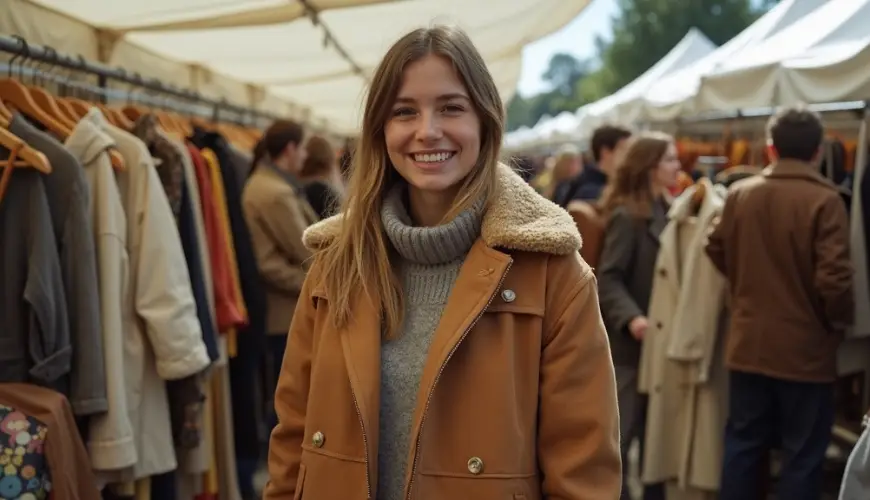
Brick-and-mortar markets and secondhand shops, on the other hand, have a different kind of charm. They allow you to physically inspect items, feel the material, and try on the fit. Large cities like Prague, Brno, and Ostrava have a rich network of vintage shops and markets where real gems can be found. All it takes is a little patience and a willingness to browse through rails without a predetermined plan. Experienced secondhand shoppers confirm that the best finds come precisely when you're not looking for anything specific.
There are also specialist platforms focused on luxury or designer pieces – such as Vestiaire Collective or The RealReal, where you can find authentic branded goods with authentication. These platforms are naturally more expensive, but still significantly cheaper than buying in a boutique.
An interesting alternative is charity shops, which are common in the United Kingdom, for example, and are gradually making their way into the Czech Republic. Here you can come across clothing donated from estates or during house moves – and the proceeds go to a good cause. Two birds with one stone.
We cannot forget flea markets and clothing swaps. These are held regularly in many Czech cities and are a great opportunity not only to buy, but also to sell items that are just taking up space at home. The atmosphere of these events is also unique – combining fun, social interaction, and sustainable shopping all in one.
How to shop smartly: what to watch out for
Finding items is only half the battle. Smart secondhand shopping requires a little know-how to avoid bringing home disappointment instead of treasure. There are several tried-and-tested principles that experienced shoppers follow almost automatically.
The first step is always a thorough inspection of the item. In brick-and-mortar shops, this means checking the seams, lining, zips, buttons, and overall condition of the material. Stains that won't wash out, torn seams, or damaged zips are warning signs – if the seller doesn't disclose these faults upfront, it makes for an unpleasant surprise. For online purchases, the key is to request detailed photographs and not be afraid to ask questions. A good seller will happily photograph a close-up of the zip, the size label, or any minor flaw.
Material composition is another factor that many people underestimate. Natural materials such as wool, cotton, linen, or silk are generally more durable and pleasant to wear than synthetics. They are also easier to clean and repair. When choosing a winter coat or jumper, it's worth checking the label – a high proportion of wool or cashmere is a sign of quality that will last for many more years.
Sizing is a chapter in itself when it comes to secondhand shopping. Older clothing, especially vintage pieces from the eighties or nineties, often follows different numbering than today's standards. A European size 38 from 1985 may be smaller than a modern size 36, and vice versa. It is therefore always better to rely on specific measurements in centimetres rather than the number on the label – and if there is an opportunity to try something on, never pass it up.
As fashion designer Vivienne Westwood once noted: "Buy less, choose well, make it last." This philosophy is actually a perfect summary of the approach to secondhand shopping – it's not about accumulating cheap things, but about consciously selecting the right pieces.
What to avoid: the most common mistakes and pitfalls
Just as there are proven practices, there are also typical mistakes made by both beginners and more experienced shoppers. Knowing them in advance is the best way to avoid them.
One of the biggest pitfalls is buying based on price rather than need. Secondhand clothing is inexpensive, and this tempts people into buying things simply because they're a good deal. The result is an overstuffed wardrobe full of pieces that never get worn. A better approach is to have a clear idea beforehand of what is actually missing from your wardrobe, and to look specifically for that – even if it takes longer.
Another issue can be overlooking hygiene considerations. Secondhand clothing should always be washed before wearing for the first time, ideally at the highest temperature the material can withstand. This is doubly true for items purchased at a flea market or from an unknown seller online. Most experienced shoppers consider this step a matter of course, but newcomers sometimes forget.
In the online environment, it is also important to watch out for counterfeits and misleading descriptions. Platforms like Vinted or Depop do have rating systems and buyer protection, but these are not always a guarantee of a trouble-free purchase. If someone is selling a luxury brand at a suspiciously low price without proof of provenance, caution is warranted. Authentic designer pieces usually have specific hallmarks – from the quality of stitching to the shape of the logo and serial numbers – and verifying these takes a moment, but it's worth it.
Beginners also sometimes underestimate the costs of shipping and any necessary repairs. If they buy a coat for 200 crowns, but shipping costs 150 crowns and the zip requires a repair worth another 200 crowns, the total price is suddenly not so attractive. When calculating costs, it's always a good idea to factor in these "hidden" expenses.
Finally, some shoppers get caught up in the atmosphere of a flea market or sale and make impulse purchases of items that don't actually suit them or fit their lifestyle. A simple rule is to ask yourself: "Would I buy this item if it cost three times as much?" If the answer is no, it's probably not the right choice at the current price either.
A few tips for smarter shopping
For clarity – here are the key principles worth keeping in mind:
- Before shopping, write down what is actually missing from your wardrobe
- Always check the condition of the material, seams, and fastenings
- Ask for details and request photographs
- Factor in shipping and any potential repair costs
- Always wash secondhand pieces before wearing them for the first time
- With vintage clothing, go by measurements, not the number on the label
Secondhand as a lifestyle, not just a passing trend
Imagine Klára, a thirty-year-old graphic designer from Brno, who three years ago began shopping exclusively secondhand. Initially it was an experiment motivated by a desire to save money, but it gradually became a conscious lifestyle. Today she has a wardrobe full of quality, original pieces – a wool coat from the seventies, vintage jeans that are more comfortable than anything she ever bought in a shop, and designer dresses she couldn't otherwise afford. She spends less, dresses better, and feels good about the way she shops.
Klára's story is not exceptional. More and more people are discovering that secondhand shopping is not a compromise, but a freedom – the freedom to choose consciously, to buy less, and yet to wear more. The key is the approach: patience, curiosity, and a willingness to search rather than simply buying whatever an algorithm or a shop window puts in front of you.
Smart secondhand shopping is ultimately not just about money or ecology – it is a way of approaching consumption as a conscious choice, rather than a reflex. And that is a value that goes beyond the price of any coat.