

Slow barefoot walking on grass as sensory training
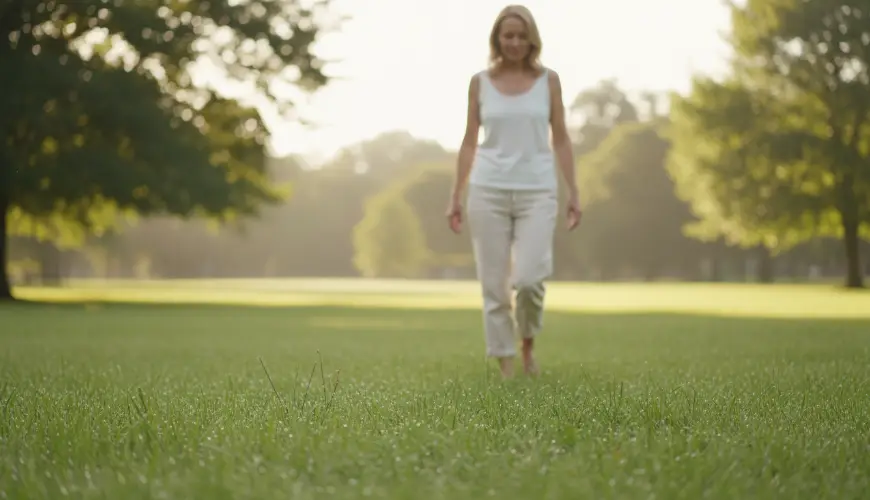
Try to remember the last time you went outside and consciously took off your shoes. Not because you were rushing to the pool or running across the sand at the seaside, but simply to walk. Slowly. Barefoot. On the grass. For most people, such a memory is surprisingly distant – and yet this is one of the simplest ways to give both body and mind what modern life systematically takes away.
Walking barefoot on natural surfaces is not some new invention of alternative medicine or a fashionable wellness trend that will disappear within a year. It is something people have done for hundreds of thousands of years as a natural part of everyday life. Only in the last few decades have we radically severed this contact with the ground – and more and more experts are asking whether we are paying for it in the form of stress, sensory numbness and impaired balance.
Try our natural products




What happens in the body when you walk slowly and barefoot
The foot is one of the most richly innervated areas of the entire human body. It contains thousands of nerve endings, mechanoreceptors sensitive to pressure, vibrations and surface texture, and even thermoreceptors that respond to temperature. When we put on standard shoes with a rigid sole and cushioning, we essentially disconnect this entire sensory system from input. The foot receives a simplified, homogeneous signal – or none at all. The brain stops receiving the rich feedback it was evolutionarily calibrated for, and compensates with increased muscle tension and reduced confidence in movement.
Slow barefoot walking on grass reverses this situation. Every step brings new information: the unevenness of a blade of grass, the moisture of morning dew, small stones hidden beneath the surface, the warmth of sun-heated soil or the coolness in the shade of a tree. The brain must process this data in real time, activating the muscles of the foot, ankle and calf in ways that shod movement never requires. The result is what experts in movement neuroscience call proprioceptive training – strengthening the body's ability to perceive itself in space.
Research published in the journal Frontiers in Human Neuroscience showed that regular contact of the feet with natural surfaces positively influences balance, coordination and muscle activation across age groups. Interestingly, the effect was more pronounced at slower walking speeds – the brain simply had more time to process sensory information before the next step arrived.
Slowness here is therefore not a weakness or laziness. It is a deliberate condition that turns a walk into exercise. It is precisely the slowing down that transforms a mundane outdoor movement into something that can rightly be called sensory training.
Grounding – more than a metaphor
The word "grounding" is used so frequently today and in so many different contexts that it has almost lost its concrete meaning. But in the case of walking barefoot on grass, it has an entirely literal physical dimension that the scientific community has begun to discuss seriously in recent years.
The human body is electrically conductive. The Earth carries a natural negative electrical charge. When we stand or walk barefoot on a natural surface – grass, soil, sand – free electrons are transferred from the ground into the body. This phenomenon is referred to in English as earthing or grounding and has been the subject of several studies examining its influence on inflammatory processes, sleep and the autonomic nervous system. A review study in the Journal of Environmental and Public Health from 2012 summarised the available evidence and concluded that direct contact with the Earth's surface has measurable physiological effects, including reduced cortisol levels and improved sleep quality.
The science in this area is far from settled, and it would be premature to overstate the findings. Nevertheless, it is interesting that what generations of people have intuitively felt – that contact with the ground brings relief and calm – is gradually finding its scientifically verifiable basis.
Take Maria, a forty-four-year-old accountant from Brno, who suffered from chronic headaches and insomnia. Her doctor recommended reducing screen time and spending more time outdoors. Maria began spending twenty minutes in her garden each morning before work – walking slowly barefoot on the wet grass, without her phone, without headphones. After three weeks, she noticed she was falling asleep more easily and the morning headaches had eased. She cannot say whether it was the physical activity, the nature, or the contact with the ground itself – it was most likely a combination of everything. But she stopped analysing the causes and simply kept walking.
There are thousands of such stories, and they are remarkably similar. It is not about miraculous healing, but about the gradual, quiet restoration of something we lost without noticing.
As the writer and natural philosopher John Muir once wrote: "In every walk with nature, one receives far more than he seeks." And perhaps precisely because it is wonderful in the most straightforward, most tangible sense, we so easily overlook that it is literally right beneath our feet.
How to turn a barefoot walk into a conscious sensory ritual
There is no need to go to a forest or own a large garden. A patch of lawn in a park, a field path outside a village, or even a strip of grass alongside a pavement will do. What matters more than the location is the approach – and that approach is deliberate slowing down and attention.
Before the walk itself, it is worth standing still for a moment. Just like that. Allow the feet to adjust to the temperature of the surface, notice how the body's weight shifts from the heel to the front of the foot, how the grass responds to pressure. This initial moment of stillness prepares the nervous system for what is to come – and is itself a small meditation.
During the walk, a few simple principles can turn movement into genuine sensory training:
- Slow down to half your usual pace – or even less. The goal is not distance, but depth of sensation.
- Pay attention to each step individually – how the heel makes contact with the ground, how the weight shifts, how the toes respond to the surface.
- Notice the temperature, moisture and texture – is the grass warm or cool? Thick or sparse? Even or uneven?
- Let your eyes rest – instead of scanning the surroundings, try softening your gaze, focusing on the middle distance, or closing your eyes for a few steps (in a safe location).
- Breathe consciously – slow barefoot walking naturally synchronises breath with movement, if you allow it to.
The entire practice need not last longer than twenty or thirty minutes to have a noticeable effect. Studies in the field of mindfulness and movement repeatedly show that the quality of attention matters more than the duration of the activity – and slow barefoot walking creates conditions in which focused attention is natural rather than forced.
For those who wish to deepen the practice, there is also the Japanese tradition of shinrin-yoku – forest bathing – which involves slow movement in nature with maximum engagement of all the senses. Although shinrin-yoku primarily takes place in a forest, its principles can be applied to simple barefoot walking in a park. Japanese research on shinrin-yoku has repeatedly demonstrated reduced levels of stress hormones, improved mood and a strengthened immune system in regular practitioners.
It is also important to think about safety – before your first barefoot walk, it is worth inspecting the terrain and making sure there are no sharp objects hidden in the grass. People with diabetes or reduced sensation in their feet are advised to consult their doctor before taking up this activity, as their feet are more vulnerable to minor injuries.
Why grass specifically, and why slowly
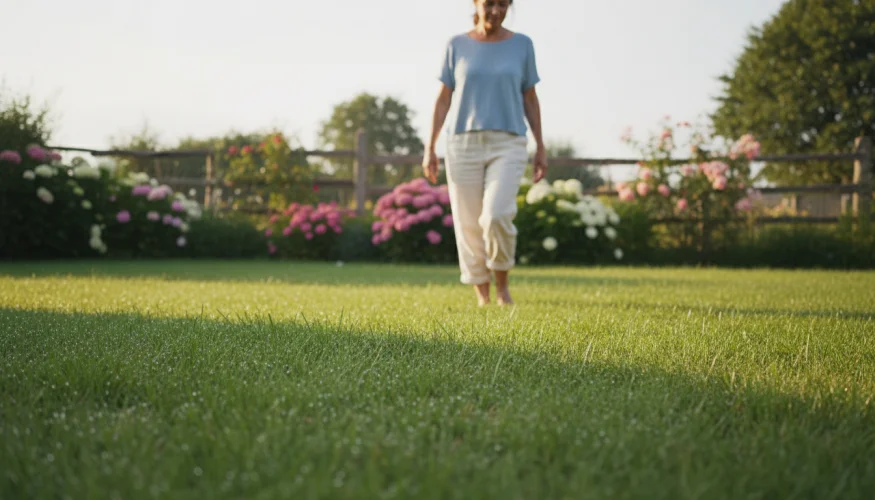
Grass as a surface for barefoot walking has several specific properties that distinguish it from concrete, paving or even sand. It is soft, but not homogeneous – every centimetre differs slightly from the one before. It is naturally moist, especially in the morning or after rain, which stimulates thermoreceptors differently than a dry surface. And it is alive – beneath it lies a layer of soil full of microorganisms, roots and tiny life forms that naturally create an uneven, variable surface.
This variability is the key. The brain and nervous system develop through stimulation, not uniformity. When we continually walk on the same, predictable surfaces in cushioned shoes, the sensory part of the nervous system responsible for movement gradually loses its sharpness – much like a muscle that stops being used. Slow barefoot walking on grass reverses this process. It is in a sense a rehabilitation of the senses that requires no equipment, no subscription and no specialist.
Slowness then multiplies the entire process. During fast walking or running, the brain switches into a different mode – tracking the route, anticipating obstacles, optimising the energy efficiency of movement. These are valuable abilities, but they are not the ones we are seeking during sensory training. Slowness creates space for perception. It gives the brain time to register subtle stimuli that would otherwise be overlooked. And paradoxically – precisely because it is slow and seemingly undemanding movement – many people underestimate it and never try it.
And yet so little is needed. A morning twenty-minute barefoot walk on the grass before breakfast, or an evening stroll around the garden at sunset, can be the simplest sensory ritual one can incorporate into daily life. No app. No special equipment. No instructor. Just you, the grass and conscious movement.
At a time when the wellness industry offers increasingly sophisticated technologies for monitoring the body, optimising performance and measuring stress, it is refreshing to be reminded that some of the most effective tools for self-care are thousands of years old and entirely free. Slow barefoot walking on grass is one of them – and perhaps precisely because it is so simple, it takes us so long to rediscover it.