

# How to Properly Load Dishes into the Dishwasher
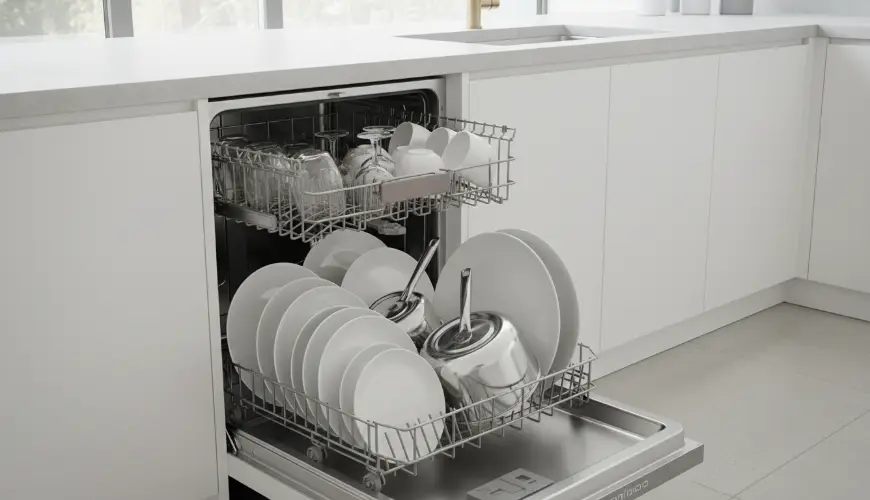
Anyone who has ever opened a dishwasher only to find half the plates still covered in dried-on food residue knows how frustrating that experience can be. Yet the solution usually doesn't lie in buying a more expensive detergent or switching to a different program. The key to effective washing is actually hidden in something much simpler – the way we load the dishes into the dishwasher. It sounds trivial, but properly arranging plates, pots, and glasses is literally a small science that can save time, water, energy, and nerves.
According to data from the European Commission, dishwashers are among the appliances where proper use affects water and energy consumption almost as much as the appliance's energy rating itself. In other words – even the most efficient dishwasher will waste resources if it isn't used sensibly. And conversely, even an older model can surprise you with its effectiveness when the dishes are loaded the way the manufacturer intended.
Let's take a simple real-life example. The Novák family bought a new dishwasher with an A energy rating and modern sensors. After the first few weeks of excitement, however, disappointment set in – glasses had a cloudy film, greasy stains remained on pots, and cutlery stuck together. The problem wasn't the technology. Mrs. Nováková was simply loading the dishes however it suited her at the moment – large pots on top, plates chaotically next to each other, and the cutlery basket stuffed to bursting. A few small changes in the arrangement were all it took, and the results improved dramatically. This experience is far from unique, and that's exactly why it's worth looking at how to properly load a dishwasher so that every wash cycle truly fulfills its purpose.
Try our natural products


Why arrangement matters so much
A dishwasher works on a fairly simple principle. Spray arms spin jets of hot water mixed with dissolved detergent, and these jets hit the surface of the dishes. For grime to actually dissolve and wash away, the water jet must reach every piece of dishware without obstruction – and the dirty water must have somewhere to drain. Whenever one item blocks another, a "dead zone" is created where the water can't reach. And that's exactly where you'll find dried-on tomato sauce or grease that wasn't washed away.
Most modern dishwashers have two spray arms – one beneath the lower rack and another between the lower and upper racks (some models even have a third arm at the top). Water therefore flows predominantly from bottom to top. This leads to a fundamental rule: the dirty side of the dishes should always face downward, toward the source of the water jet. For plates, this means a slight tilt toward the center; for bowls and mugs, it means turning them upside down.
Free space is also important. When plates are crammed tightly against each other, water simply can't penetrate between them. Optimal spacing between individual pieces of dishware is approximately one to two centimeters – just enough to freely slide a hand between them. It sounds like a waste of space, but in reality, it's more efficient to run the dishwasher with more loosely loaded dishes that actually get clean than to cram in the maximum number of items and then hand-wash half of them afterward.
There's yet another aspect that's often forgotten – even weight distribution. If all the heavy pots and pans are on one side, this can affect the stability of the spray arm in some models or cause the rack to jam when sliding in. But evenness also has a practical dimension: when items are stably positioned, they won't shift during the wash cycle and block the arm.
Incidentally, a blocked spray arm is one of the most common causes of unsuccessful washing. All it takes is a long spoon holder or a large cutting board protruding over the edge of the lower rack, and the arm stops. The result is a dishwasher full of dirty dishes and needlessly consumed water and energy. That's why it pays to manually spin both arms before each cycle and check that they rotate freely.
As a kitchen appliance designer once remarked to Wirecutter magazine: "A dishwasher is designed to work for you – but only if you give it a chance to work properly." And that's exactly the point. It's not rocket science, just a matter of respecting how the appliance works.
A practical guide for each rack
Let's look at specific principles that work for the vast majority of dishwashers on the market – whether they're slim 45 cm models or standard sixty-centimeter ones.
The lower rack is meant for the largest and dirtiest items. This is where plates, pots, pans, roasting dishes, and large bowls belong. Plates should stand upright in the pre-made slots, all facing the same direction – ideally with the dirty side toward the center of the dishwasher, where the water pressure is strongest. Large flat items, such as cutting boards or baking sheets, belong against the back or side wall, where they won't block water flow to the rest of the dishes. Pots and pans should be placed upside down and slightly tilted so water can drain freely from them. It's important not to nest them – a pot stacked inside another pot simply won't get clean.
The upper rack is home to smaller and more delicate dishware. This is where glasses, cups, mugs, smaller bowls, plastic containers, and lids belong. Everything with a cavity must be turned upside down and slightly tilted so water doesn't pool inside – otherwise, after washing, you'll find a puddle of dirty water mixed with detergent at the bottom of every mug. Glasses shouldn't touch each other, because vibrations during the wash cycle risk causing damage. Most upper racks have foldable holders that can be adjusted to the size of the dishware – it's worth experimenting with them.
Plastic containers deserve special attention. They're lightweight, and if they're not properly secured, the strong water jet can flip them over. A flipped plastic container not only stays dirty but also fills with water and can block the jet directed at surrounding dishes. That's why plastic containers belong exclusively in the upper rack, as far from the spray arm as possible, and ideally secured between other items.
And then there's the cutlery basket, which tends to be the source of the biggest problems. The basic rule is simple: cutlery should alternate between handle up and handle down so pieces don't stick together. When all the spoons face the same direction, their curved surfaces fit perfectly into one another and water can't get between them. Knives should always point blade-down – for safety when unloading. Some dishwashers offer a cutlery tray in the upper section instead of a basket, which spreads cutlery out individually and usually provides better washing results.
There are several things that fundamentally shouldn't go in the dishwasher, even though many people regularly put them there. These include wooden cutting boards and spoons (wood cracks and warps in the dishwasher), knives with quality steel blades (high temperatures and aggressive detergent dull the edge), cast iron pans (they lose their protective seasoning), fine porcelain with gold or silver decoration, and copper cookware. Before putting anything in the dishwasher, it's worth checking the symbol on the bottom – a crossed-out dishwasher means a definitive no.
While we're on the topic of what belongs in the dishwasher and what doesn't, we can't overlook detergents and their dosing either. More tablets or gel doesn't mean cleaner dishes – on the contrary, overdosing creates excessive foam that dampens the effectiveness of the spray arms, and a white film then remains on the dishes. Most manufacturers recommend one standard tablet per wash cycle, even with a full load. Rinse aid, which many consider an unnecessary luxury, actually plays an important role – it reduces the surface tension of water so it runs off dishes more easily and doesn't leave droplets that create spots when they dry. And regeneration salt is essential wherever the water is hard – without it, limescale deposits build up on the dishes and inside the dishwasher, gradually reducing the efficiency of the entire appliance.
One of the most common myths is that dishes need to be thoroughly pre-rinsed under running water before being placed in the dishwasher. According to tests by Consumer Reports, this is not only unnecessary but actually counterproductive. Modern detergents contain enzymes that need organic residue to activate – on a perfectly clean surface, they have nothing to work on and their effectiveness drops. It's enough to simply scrape off coarse food remnants into the bin (bones, peels, large chunks) and place the dishes straight into the dishwasher. Dried-on residue can optionally be briefly soaked, but the jets of hot water handle normal soiling on their own.
Choosing the right wash program is another factor that determines the outcome. The eco program, which virtually every dishwasher offers today, operates at a lower temperature for a longer time – it's ideal for normally soiled dishes and saves energy. The intensive program with temperatures around 70 °C is designed for heavily soiled pots and pans with burnt-on food. The quick program saves time but uses more water and energy over a shorter period, so it's only suitable for lightly soiled dishes you need quickly. Most people get by with two programs – eco for everyday washing and intensive for weekend cooking.
Also worth mentioning is maintenance of the dishwasher itself, because even the best loading won't help if the appliance is clogged. The filter at the bottom of the dishwasher should be cleaned at least once a week – simply remove it, rinse it under running water, and if needed, clean it with an old toothbrush. Once a month, it's worth running an empty dishwasher on the highest temperature with a dishwasher cleaning product or a cup of white vinegar placed on the upper rack. This dissolves grease and limescale deposits in the hoses and on the spray arms. A clean dishwasher means clean dishes – and lower energy consumption, because the appliance doesn't have to overcome the resistance of buildup.
When all these principles come together, the result is often surprisingly significant. The Novák family mentioned at the beginning found that after a few weeks of the new approach, they stopped re-washing dishes by hand, their tablet consumption dropped (because they stopped adding a second one "just in case"), and they ran the dishwasher one fewer cycle per week because the dishes fit in more efficiently. Such small changes, when added up over a year, translate not only into lower water and electricity bills but also into a longer lifespan for the appliance itself.
A properly loaded dishwasher ultimately isn't a matter of perfectionism but of common sense. All it takes is understanding where the water flows from, where it needs to drain, and giving each piece of dishware the space for the water jet to actually reach it. A few minutes spent on careful loading pay off in the form of sparkling clean plates, crystal-clear glasses, and the pleasant feeling that the household is running the way it should.