
Hallway exercise works better than you think, even in a small apartment
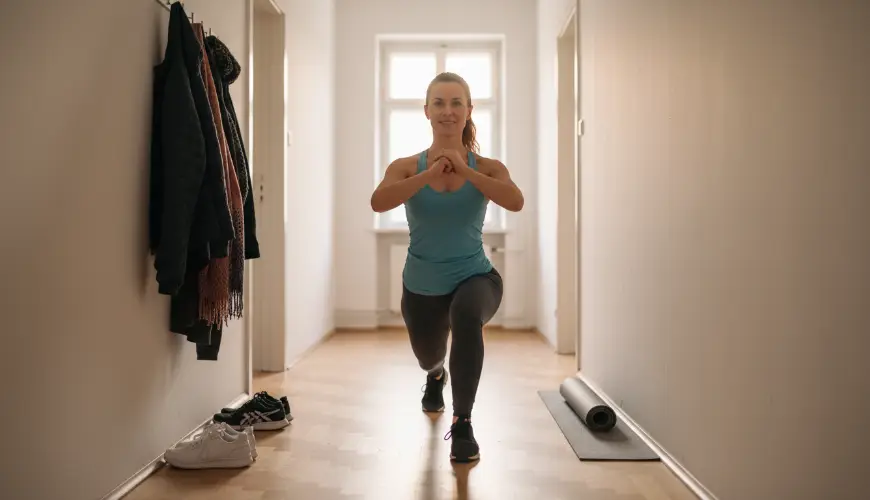
A small apartment doesn't have to be an obstacle to an active lifestyle. Millions of people live in panel buildings, studio flats, or older apartments where the living room barely fits a couch and a television, let alone a yoga mat or a set of dumbbells. And yet there is a space that most of us overlook - a narrow, elongated area between the doors that mainly serves as a place to leave shoes and jackets. The hallway. Seemingly unusable, yet surprisingly practical.
The idea of exercising in the hallway may sound absurd. But just look at what it offers: a length of usually two to four metres, a solid floor, walls on both sides that can be used for support, and above all - privacy. No neighbour through the wall, no children running around, no television tempting you to rest. The hallway is, in its own way, a natural gym for anyone who wants to stay active without having to pay for a fitness centre or remodel their entire apartment.
Try our natural products


Why a small space doesn't mean small results
Modern fitness science repeatedly confirms that a large area is not needed for effective training. Research published in, for example, the British Journal of Sports Medicine shows that high-intensity interval training (HIIT) performed in an area of less than two square metres can deliver comparable cardiovascular results to running on a treadmill. The key is not space, but intensity, regularity, and proper technique.
The hallway in an average Czech apartment measures roughly eighty centimetres in width and two to three metres in length. That is more than enough for a whole range of exercises that do not require outstretched arms or lateral jumps. On the contrary - a limited space naturally forces movements that are controlled, targeted, and less random than a sprawling circuit workout in the living room.
Imagine Martina, a thirty-three-year-old teacher from Brno, who lives with her partner and two children in a three-bedroom apartment. The living room belongs to the children, the bedroom is too small, and so Martina began dedicating fifteen minutes every morning to the hallway. She started out sceptically, but after three weeks she found that her legs had become more toned, her balance had improved, and - perhaps most importantly - she had created a regular morning ritual that she had always put off before. The space stopped limiting her and started motivating her.
It is precisely the ritual that distinguishes people who exercise regularly from those who are always meaning to get around to it. And the hallway has one enormous advantage: you walk past it every day. In the morning on the way to the bathroom, in the evening when locking up the apartment. All it takes is simply stopping.
Specific exercises that actually work in the hallway
Before you start putting together your own programme, it is worth knowing which movements are most suitable for a narrow, elongated space. These are not compromises - they are exercises that the hallway actively favours.
Forward lunges are perhaps the most natural exercise for this type of space. A step forward, bending the knees, returning - and the hallway serves as a natural track. Ten lunges on each leg back and forth, and the glutes and quadriceps will get a proper workout. The walls on either side also provide psychological reassurance for balance, which is particularly appreciated by beginners or people recovering from injury.
Walking backwards and lateral lunges work similarly, activating stabilising muscles that remain unused during ordinary movement. Physiotherapists recommend these exercises for people with knee or hip problems as part of a rehabilitation programme - and the hallway is an ideal environment for them.
The wall at the end of the hallway or along the sides is a chapter in itself. Wall push-ups are a less demanding variation of classic push-ups and are excellent for strengthening the chest, shoulders, and triceps. Resting your back against the wall in a seated position - the so-called static squat position - is an outstanding exercise for the thighs and endurance, in which you do not move at all, yet the muscles work at full capacity. Just twenty to thirty seconds and you will feel the difference.
For those who want to engage the upper body as well, the door frame can be used. Gripping the frame and gently hanging with arms extended activates the back and improves posture - a problem that affects the vast majority of people who work at a computer. It is not a substitute for pull-ups on a bar, but as a daily preventive measure against back pain it works surprisingly well.
Breathing and stretching exercises form a separate category. The hallway is quiet, enclosed, and separated from the hustle of the household - which makes it an ideal place for a short morning mobility routine. A forward bend, trunk rotation, calf stretches against the wall. Five minutes every morning can significantly affect how the body feels throughout the day.
For completeness, it is worth mentioning jumping on the spot and high knees - that is, running on the spot with knees raised. These exercises require no lateral movement, only vertical activity, and yet they rank among the most effective cardiovascular exercises of all. The only condition is that the floor beneath you can withstand it and that the neighbour below you does not hear it too loudly - for this purpose there are cushioning mats that significantly reduce both noise and impact on the joints.
How to turn your hallway into a real home gym
Equipment for hallway workouts does not need to be expensive or bulky. On the contrary - one of the greatest advantages of this approach is a minimalist philosophy: fewer things, more movement.
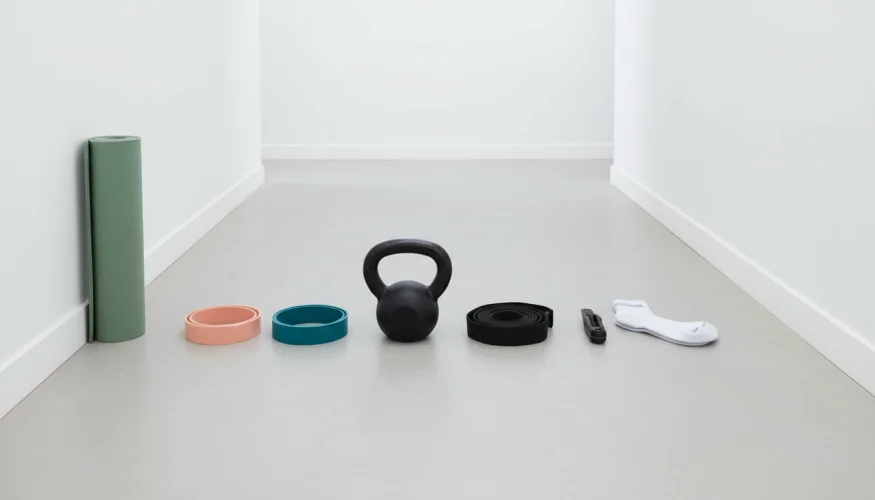
A basic set for hallway training looks roughly like this:
- A non-slip mat (even a thin one, folded along the wall, takes up no space)
- Resistance bands of various strengths - light, compact, and yet enabling dozens of exercises for the whole body
- A kettlebell or dumbbell - a single weight stored in the corner of the hallway is enough for basic strength training
- A door frame loop for bodyweight or band exercises
Resistance bands in particular have become a phenomenon in home fitness in recent years. They are inexpensive, quiet, take up no space, and allow for progressive training - that is, gradually increasing the load just as in a gym. The American Council on Exercise (ACE) recommends them as one of the most versatile tools for home fitness.
It is also important to think about the floor. Parquet or tiles are slippery and hard - unsuitable for exercising in bare feet or socks. A thin mat or even an old carpet folded to the width of the hallway will solve the problem. Those who exercise more regularly will appreciate investing in a quality mat with good shock absorption, which protects both the joints and the floor.
"The best workout is the one you actually do," says American trainer and author Mark Lauren, and this simple truth applies doubly to home exercise. Having a perfectly equipped gym in the basement of your building that you never visit is less useful than five minutes of lunges in the hallway every morning before breakfast.
The psychology of small spaces: why the hallway can help us
Also worth mentioning is the less-discussed aspect of exercising in a small space - the psychological one. Large open areas can paradoxically create a feeling that a workout must be long, complicated, and exhausting. The hallway eliminates this pressure. The space itself says: you cannot spend an hour here, so do what you can and move on.
Research in behavioural psychology shows that short, repeated activities have a greater impact on long-term health than occasional intense efforts. Ten minutes a day over the course of a year is, from a health perspective, significantly better than an hour once every three weeks. The hallway naturally supports precisely this model - it is accessible, requires no preparation or changing shoes, and is therefore easier to return to.
There is also something known as the anchor effect - if you repeatedly associate a place with an activity, the brain begins to automatically connect passing through the hallway with movement. Just as you make coffee at the coffee machine or brush your teeth at the mirror, you will naturally begin to stretch or do a few squats in the hallway. Without thinking, without a motivational speech, simply out of habit.
This is perhaps the greatest gift that a narrow hallway can give you - not a big workout, but small, everyday movement that gradually becomes such a natural part of your day that you can barely remember how you used to feel without it.
A healthy lifestyle does not, after all, take place in luxury fitness centres or in Instagram photos with a perfect mountain view. It takes place in real apartments, in real time, with real limitations. And sometimes all it takes is opening the door and taking the first lunge - literally.