
Angels at the Wall or Wall Angels as a Remedy for Rounded Backs
You stand at a computer all day, collapse on the couch in the evening, and wake up in the morning with stiff shoulders and the feeling that your back simply isn't right. Does that sound familiar? Rounded back is today one of the most widespread movement problems of the modern age, and yet it is a condition that can be prevented or significantly alleviated even without visiting a physiotherapist. One of the most effective tools in this fight is an exercise called wall angels – which is unassuming, requires no equipment, and yet can do a great deal for your body.
Rounded back, professionally referred to as thoracic hyperkyphosis, most commonly develops as a result of prolonged sitting in a forward-leaning position, working at a screen, or one-sided loading. The muscles on the front of the body shorten, the chest closes up, and the muscles between the shoulder blades gradually weaken, because we simply don't need them – or more precisely, we forget to use them. The result is the characteristic forward head posture, sunken chest, and shoulders pulled forward. According to the World Health Organization, back pain is among the most common reasons for work incapacity worldwide, with a sedentary lifestyle being one of the main contributing factors.
Try our natural products



What exactly are wall angels and why do they work?
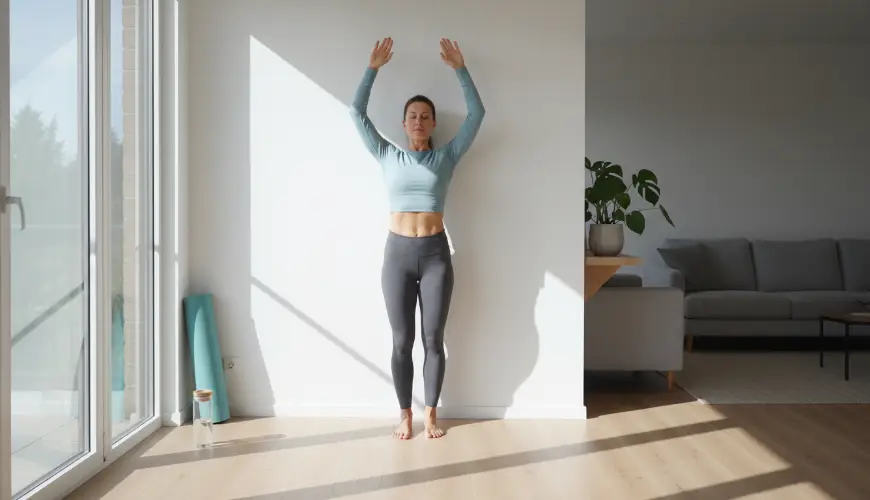
The name of this exercise is no coincidence – the movement resembles drawing angel wings in snow, except that instead of snow, a wall serves as the surface, and instead of lying down, you stand. The basic principle is simple: your entire back, buttocks, the back of your head, and your arms rest against a flat wall surface, and in this position you perform a slow, controlled movement with your arms from your sides upward above your head and back. It sounds simple, but that is precisely where the trickiness lies – keeping your entire back in contact with the wall during this movement is, for most people with rounded backs, nearly impossible at first.
Why is that? Because rounded back is not merely an aesthetic problem, but a manifestation of deep muscular imbalance. Muscles such as the trapezius, rhomboids, and rotator cuff muscles are weakened or inhibited, while the pectoral muscles and the front of the shoulder joint are shortened and overstretched. The wall angels exercise works precisely on this problem – it forces the body to activate muscles we have neglected for years, while at the same time gently stretching the shortened structures on the front of the chest. It is essentially a movement lesson for the neuromuscular system, which must relearn how to properly coordinate the shoulders, shoulder blades, and spine.
Physiotherapists and movement specialists classify wall angels among so-called corrective exercises – that is, exercises whose primary goal is not building muscle mass or burning calories, but correcting movement patterns and restoring the natural function of the body. As physiotherapist and movement therapy author Kelly Starrett says: "Movement is medicine, but only when performed correctly." And this principle applies doubly to wall angels – a poorly performed exercise may bring only minimal effect, while careful execution with an emphasis on movement quality produces visible results after just a few weeks of regular practice.
Consider Martina, a thirty-three-year-old graphic designer from Brno who spends eight to ten hours a day in front of a monitor. She began to notice that her neck hurt, her shoulders were constantly stiff, and a colleague once remarked that she "looked somehow hunched." A classic situation familiar to many people. Martina started doing wall angels every morning – just five minutes, ten repetitions – and after six weeks she says herself that her shoulders move more freely, her neck pain has eased, and she even breathes better. That last point surprised her the most, yet it is entirely logical: an open chest means more space for the lungs.
How to perform the exercise correctly and what to watch out for
Correct execution is everything with wall angels. Stand with your back to a wall so that your heels, buttocks, your entire back including the lumbar region, and the back of your head are touching it. Bend your arms at the elbows to a right angle and place them against the wall – the backs of your hands and your entire forearms should be in contact with the wall. This starting position is in itself a challenge for many people, because lumbar lordosis or a rounded thoracic spine prevents them from meeting all the conditions at once. In such a case, it is better to slightly bend the knees and bring the lumbar spine closer to the wall, even if the heels are not completely against it.
From this starting position, begin slowly sliding your arms upward along the wall, as if you wanted to bring your hands above your head. The key is to maintain contact of the elbows, forearms, and backs of the hands with the wall throughout the entire movement. As soon as you feel an elbow or wrist beginning to lift away, stop – that is your current range of motion. Do not force the body to do more than comes naturally. The movement should be slow, conscious, and controlled. Going up takes approximately three to four seconds, and the same going down.
Among the most common mistakes is arching the lower back, where a person tries to compensate for insufficient thoracic mobility with excessive lordosis. Another mistake is raising the shoulders toward the ears – the shoulders should remain down and the shoulder blades should move downward and together as the arms rise. It sounds paradoxical, but this coordination of the shoulder blades is precisely what makes the exercise truly effective. If you are unsure about your technique, a recording from a side angle or feedback from a trainer can help.
As for frequency, experts in the field of movement medicine recommend incorporating wall angels every day or every other day, with two to three sets of ten to fifteen repetitions being optimal. The exercise can be performed in the morning as part of a morning warm-up, at work as a break from sitting, or in the evening as a calming movement routine. It works excellently in combination with other corrective exercises, such as stretching the pectoral muscles in a door frame, the chin tuck exercise for correcting forward head posture, or activation of the deep spinal stabilization system.
It is also important to mention what wall angels are not – they are not an exercise that will on its own resolve chronic pain or advanced structural spinal deformity. If you suffer from significant pain, tingling in the limbs, or other neurological symptoms, consulting a doctor or physiotherapist first is always appropriate. Corrective exercise is a powerful tool for prevention and rehabilitation, but it has its limits and its rules. The Czech Society for Orthopaedics and Traumatology and various physiotherapy associations repeatedly emphasize that movement therapy should be individually tailored to each patient.
It is interesting to observe how the approach to preventing movement problems has changed in recent years. While the standard response to back pain was once bed rest, science today clearly shows that movement itself – correct, targeted movement – is the best medicine. Research published in the Journal of Orthopaedic & Sports Physical Therapy repeatedly confirms that corrective exercise focused on the thoracic spine and shoulder girdle leads to demonstrable improvement in posture and subjective pain relief.
Wall angels are, moreover, a prime example of how maximum effect can be achieved with minimal means. You don't need expensive equipment, a gym membership, or hours of time. You need a wall, a little patience, and a willingness to listen to your own body. It is precisely that patience which tends to be the greatest obstacle – results are not immediate, and the body requires time to rebuild ingrained movement patterns. But that is exactly the investment that pays off.
The modern lifestyle places us in a situation where we sit more than at any point in human history. The average Czech person spends more than nine hours a day sitting, as data from various epidemiological surveys focused on population physical activity show. That is an enormous burden on the spine, shoulders, and the entire musculoskeletal system. And while we cannot always change our working conditions overnight, we can change what we do in those few minutes we have for ourselves. Five minutes a day of angel movements at the wall can be the beginning of a journey back to natural, upright, and pain-free posture – and that is precisely the change that is worth making.