

# How to Effectively Use Resistance Bands in Your Training Resistance bands are one of the most ver
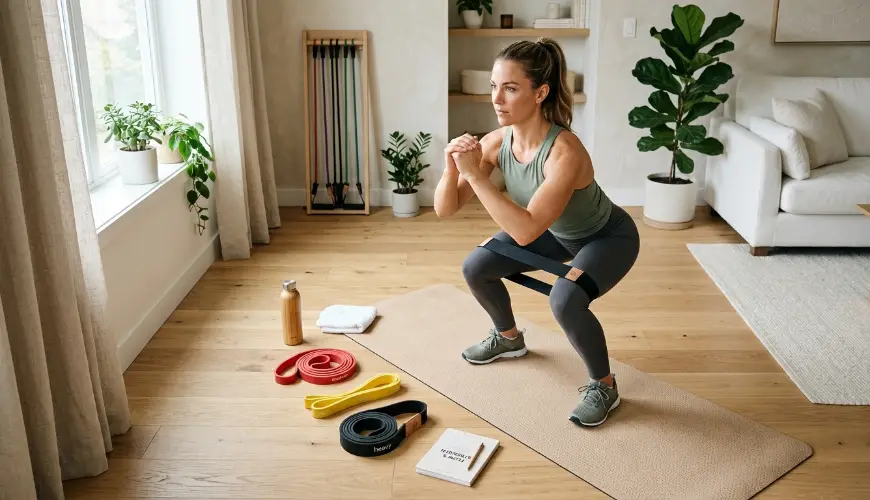
Resistance bands are among the most underestimated tools in the entire fitness world. Few people would expect that a simple strip of rubber could replace heavy dumbbells, rehabilitation equipment, and expensive weight machines – while still fitting in a backpack pocket. Yet many people use them incorrectly or only pull them out of a drawer when a physiotherapist recommends it. So how can resistance bands be used effectively to actually deliver results?
The answer is not as complicated as it might seem. The key is to understand how these bands work from a biomechanical perspective, why they differ from conventional weights, and how to incorporate them into training in a way that is truly comprehensive and safe. And that is exactly what this article is about.
Try our natural products



Why resistance bands are not just "for beginners"
One of the biggest myths surrounding resistance bands is the idea that they are intended exclusively for people who are just starting to exercise, or for seniors in rehabilitation. This reputation does them a disservice. In reality, they are regularly used by professional athletes, physiotherapists, and experienced strength coaches – and for good reason.
Unlike dumbbells or kettlebells, an elastic band provides what is known as variable resistance. This means that the more you stretch it, the greater the force you must exert. This principle is very interesting from a muscle stimulation standpoint, because muscles are forced to work throughout the entire range of motion, not just at its most difficult phase. Research published in the Journal of Human Kinetics shows that combining free weights with elastic resistance can lead to greater activation of muscle fibres than free weights alone. In other words, a resistance band adds a layer of intensity that purely mechanical load cannot offer.
Consider the example of Martina, a thirty-year-old office worker who bought a set of resistance bands intending to exercise at home. At first she used them only for basic exercises like squats and lunges, but over time she discovered that adding a band to squats or glute exercises produced noticeably greater muscle tension. After three months of regular training she noticed not only firming, but also improved knee stability in everyday movement. That is precisely the potential of these simple tools when used systematically.
It is also worth mentioning that resistance bands are gentler on the joints than free weights. While exercising with dumbbells places direct compressive force on the joints, elastic resistance distributes this load differently – the muscle is loaded while the joint remains relatively protected. This is why bands are so popular in rehabilitation following knee, shoulder, or hip injuries.
How to choose and incorporate bands into your training
Before you begin exercising, it is important to choose the right type and resistance level. The market offers several basic variants: loop bands (short, closed, ideal for lower body exercises), long bands with handles (suitable for upper body exercises and pulling movements), and tube bands (with grips that allow you to simulate movements similar to machine exercises). Each type has its application, and ideally a person training should have at least two to three different resistance levels available so that training can be progressively intensified.
Choosing the correct band stiffness is crucial. A band that is too light will not provide sufficient stimulus for the muscle, while one that is too heavy forces poor technique. The general rule is that the band should be stiff enough that the last two to three repetitions of a set are genuinely challenging, but still technically manageable. Beginners typically reach for a light resistance band (often labelled yellow or light red), while advanced exercisers work with dark, very stiff bands.
As for incorporating bands into training, there are essentially three approaches. The first is standalone band training, where bands are the only piece of equipment – suitable for home workouts or travel. The second approach is combining bands with free weights, where a band adds extra resistance to dumbbell exercises, such as placing a loop over the shoulders during a squat. The third, and very effective approach, is using bands as an activation and mobilisation tool at the start of a workout – a short series of exercises with a light band before strength training demonstrably improves glute activation and reduces the risk of knee injury.
As renowned physiotherapist Gray Cook, author of the functional movement concept, once said: "Strength built on a faulty movement pattern is just reinforced dysfunction." Resistance bands are an excellent tool for correcting movement precisely because they force the body to work with accuracy and control.
The most effective exercises and common mistakes
When it comes to specific exercises, resistance bands offer a surprisingly wide range of possibilities. For the lower body, the most popular are squats with a loop above the knees (which activate the glutes and prevent the knees from caving inward), lunges with a band around the ankles, or lateral walks in a squat position – the gold standard for strengthening hip abductors. These exercises are invaluable not only for athletes but also for people suffering from knee or back pain.
For the upper body, bands work excellently in exercises such as banded rows in a bent-over position (similar to rowing), rear deltoid flyes, or various pressing movements. A loop band can also be used during push-ups – placing it across the back significantly increases the difficulty and forces the chest muscles to work through the full range of motion.
We must not forget the core. A band anchored to a fixed point allows rotational exercises for the oblique abdominal muscles, or the pallof press – an exercise that is among the most valuable in the gym for spinal stabilisation.
Despite all the advantages, certain mistakes are repeatedly made when exercising with resistance bands that sabotage results or even lead to injury. The most common include:
- Performing movements too quickly – elastic resistance tempts users to rely on momentum, but proper exercise requires slow, controlled tempo, especially during the return phase to the starting position
- Poor band anchoring – the band must be securely fixed or stepped on to prevent uncontrolled release
- Ignoring trunk lean or rotation – during upper body exercises, the body naturally tries to involve the back in the movement, which must be actively resisted
- Using one band for all exercises – different muscle groups require different resistance levels, so varying the resistance is essential
Another important aspect is regularly checking the condition of the bands. The elastic material wears over time, micro-tears can form, and the band may snap unexpectedly. Experts recommend visually inspecting bands before every workout and replacing them at the first signs of damage. Quality bands made from natural latex or eco-friendly materials are not only more durable but also safer for the skin of sensitive individuals.
Resistance bands are also an excellent tool for progressive overload – the fundamental principle of any effective strength training. Once a certain resistance becomes too easy, simply reach for a stiffer band or combine two bands at once. This ability to gradually increase intensity without needing to purchase ever-heavier weights is one of the greatest practical advantages that bands offer.
The scientific basis for their effectiveness is not merely theoretical. The American Council on Exercise (ACE) has repeatedly confirmed that training with resistance bands produces comparable results in muscular strength and endurance to exercising with free weights, particularly for beginners and intermediate exercisers. For advanced athletes, bands serve as an ideal complement to conventional strength training, rather than a replacement for it.
It is also interesting how well resistance bands fit into the philosophy of a sustainable and mindful approach to exercise. They require no electricity, are made from a minimal amount of material, are easy to transport, and with proper care have a very long lifespan. At a time when more and more people are looking for ways to live and exercise with a smaller ecological footprint, bands represent a logical choice.
Whether the goal is weight loss, rehabilitation after an injury, preparation for a sporting season, or simply maintaining fitness while travelling for work, resistance bands offer a solution for every situation. All it takes is to take them seriously, invest time in correct technique, and not be afraid to gradually increase the difficulty. Results will then come naturally – just as in any other discipline where patience and consistency pay off more than immediate but unsystematic effort.