

Canning without sugar is worth trying
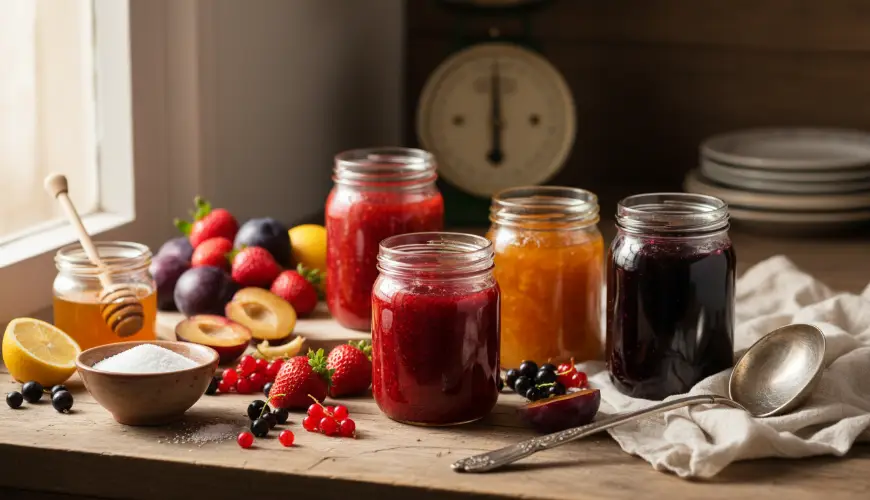
Every summer, kitchens across the country fill with the scent of cooked fruit, the hissing of jars, and that particular sense of satisfaction when a lid "clicks" into place correctly. Preserving is one of the traditional Czech domestic rituals that has survived generations and is still experiencing a renaissance today – albeit in a slightly different guise. More and more people are asking whether it's even possible to preserve without sugar, or whether sweetener is an indispensable part of the whole process. The answer isn't simple, but it is encouraging: yes, it can be done without sugar – you just need to know how.
Sugar has always played a dual role in traditional preserving. On one hand, it was a flavour element that gave jams and preserves their characteristic sweetness. On the other hand, it served an important technological function – acting as a preservative that helped extend the product's shelf life while also aiding gelation. Without understanding these two roles, it would be difficult to replace sugar meaningfully. But once you understand exactly what sugar does in a preserve, unexpectedly broad possibilities open up.
Try our natural products

Why people are looking for alternatives
The growing interest in sugar-free preserving isn't driven solely by a fashionable wave of healthy eating. The motivations are varied and very personal. Diabetics and people with insulin resistance need to limit their intake of simple sugars, but don't want to forgo the pleasure of homemade preserves. Parents of young children are looking for ways to reduce the amount of added sugars in their children's diets. And then there are those who simply want their jam to taste primarily of fruit – not of sugar.
According to data from the World Health Organization, the intake of free sugars should not exceed 10% of total daily energy intake, with a reduction to 5% bringing additional health benefits. In practice, this means that the average Czech person should consider how much sugar they're consuming even in so-called "healthy" homemade products. A classic jam can contain up to 60 grams of sugar per 100 grams of product – meaning more than two-thirds of the entire jar.
It's also worth mentioning that interest in more natural methods of food preservation isn't just a matter of recent years. Before the era of industrial sugar, people preserved fruit through drying, fermentation, honey, or simply through heat sterilisation. Returning to these methods is therefore more of a look back than a radical innovation.
What can replace sugar and how it works
This is where we get to the heart of the matter. Sugar in preserves can be replaced, but no substitute is universal. Each option has its own properties, advantages, and limitations, and the choice depends on what you expect from the finished preserve.
Natural sweeteners such as honey or maple syrup are the most natural option. Honey contains its own preservative substances – enzymes and organic acids – while also imparting a characteristic flavour. The downside is that it loses some of its beneficial compounds during cooking, and its intense aroma can overpower the taste of the fruit. Maple syrup works similarly, but with a more delicate flavour. Both are still sources of sugars, just in a more natural form, so they're not the ideal solution for diabetics.
Stevia is a plant-based sweetener that contains no calories and has no effect on blood sugar levels. It can withstand heat treatment, making it suitable for cooked preserves. The challenge lies in its intensity – it is many times sweeter than sugar – and its specific, slightly bitter aftertaste, which doesn't suit everyone. However, with the right dosage and combined with more acidic fruits (such as redcurrants or plums), it can work very well.
Erythritol and xylitol are sugar alcohols with a low glycaemic index that behave similarly to regular sugar during cooking. Erythritol is better tolerated by people with sensitive digestion than xylitol, which in larger quantities can cause digestive issues. Both are suitable for preserving, but they don't gel like sugar, so a different thickener needs to be factored in.
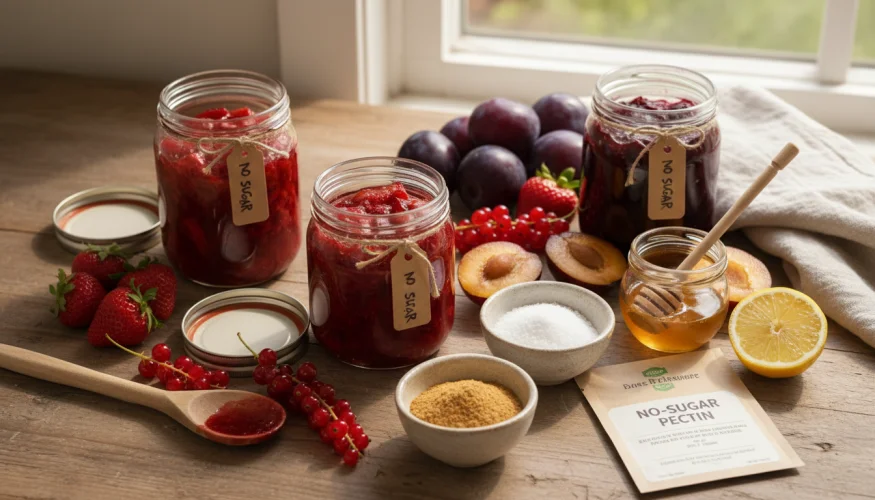
And this brings us to another key topic – pectin. Classic jams set because sugar, together with the pectin found in fruit (or added separately), forms a gel. Without sugar, you need to reach for a special pectin that gels even without sugar or with a minimal amount. Products labelled "low-sugar pectin" or "no-sugar pectin" are available on the market, designed precisely for this purpose. Alternatively, agar-agar can be used – a natural thickener derived from seaweed that works independently of the presence of sugar.
An interesting option is also preserving through heat sterilisation alone – that is, without any sweetener. In this case, fruit or vegetables are simply packed into jars and sterilised at a sufficiently high temperature. The result isn't a jam, but a compote or fruit preserved in its natural juice, which retains its natural flavour and can be sweetened to taste at the time of consumption. This method is particularly popular among people who want maximum control over what they eat.
What to watch out for when preserving without sugar
Leaving out sugar carries certain risks that are important to be aware of. Sugar in traditional recipes isn't just about flavour – it's a genuine preservative that increases the osmotic pressure in the product, thereby inhibiting the growth of microorganisms. Sugar-free preserves generally have a shorter shelf life and are more susceptible to mould and spoilage, especially if proper sterilisation technique is not followed.
For sugar-free preserving to be safe, several principles must be observed. Jars must be perfectly clean and sterilised – ideally rinsed with boiling water or dried in the oven. Lids should be new, with no visible damage. The sterilisation itself should take place at the correct temperature and for a sufficient length of time. Finished products should be stored in a cool place, ideally in the refrigerator, and consumed within a shorter timeframe than classic jams – typically within two to four weeks of opening.
The famous French chef and advocate of natural food Michel Guérard once said: "The best preservative is freshness and care." And although he said it in a different context, it applies perfectly to homemade sugar-free preserving. Careful preparation and proper storage can compensate for what sugar traditionally provided.
A practical example can be found in the experience of an ordinary Czech family who decided to switch to sugar-free preserving after their grandmother was diagnosed with diabetes. Instead of classic strawberry jam, they began making strawberry jam sweetened with erythritol and a special pectin. The result was a little runnier than they were used to on the first attempt, but after adjusting the ratio of thickener and extending the cooking time, they achieved a consistency that surprised the whole family. Their grandmother could once again enjoy homemade jam without worrying about her blood sugar levels – and that's a result worth a little experimentation.
It's also important to mention that the acidity of the fruit plays a key role in sugar-free preserving. More acidic fruits such as redcurrants, gooseberries, plums, or cherries are naturally better suited to sugar-free preserving than, for example, pears or apricots, which are less acidic and need more help with preservation. Adding lemon juice or citric acid not only improves shelf life but also helps the pectin to set properly.
For those who want to get started, a summary of the basic steps that distinguish sugar-free preserving from the classic method may be useful:
- Choose fruit with a higher natural pectin and acidity content (redcurrants, apples, plums)
- Use a special pectin designed for preserving without sugar or with a low sugar content
- Choose a suitable sweetener according to your needs (stevia, erythritol, honey)
- Sterilise jars more thoroughly than with classic preserving
- Store in a cool place and consume more quickly than classic preserves
- Add lemon juice for better preservation and gelation
Information on safe home preserving and various conservation methods can be found, for example, on the website of the National Center for Home Food Preservation, an American institution at the University of Georgia that specialises exclusively in this area, whose recommendations are respected by experts around the world.
Sugar-free preserving is not a compromise or a second-rate option – it is a conscious choice that requires a little more knowledge and care, but rewards you with a result that is closer to the natural taste of fruit. Jam made from wild strawberries sweetened with just a touch of stevia tastes different from the classic version – but for many people it tastes better, because you can finally hear the strawberries themselves, not just the sugar. And that is perhaps the best reason to give it a try.